

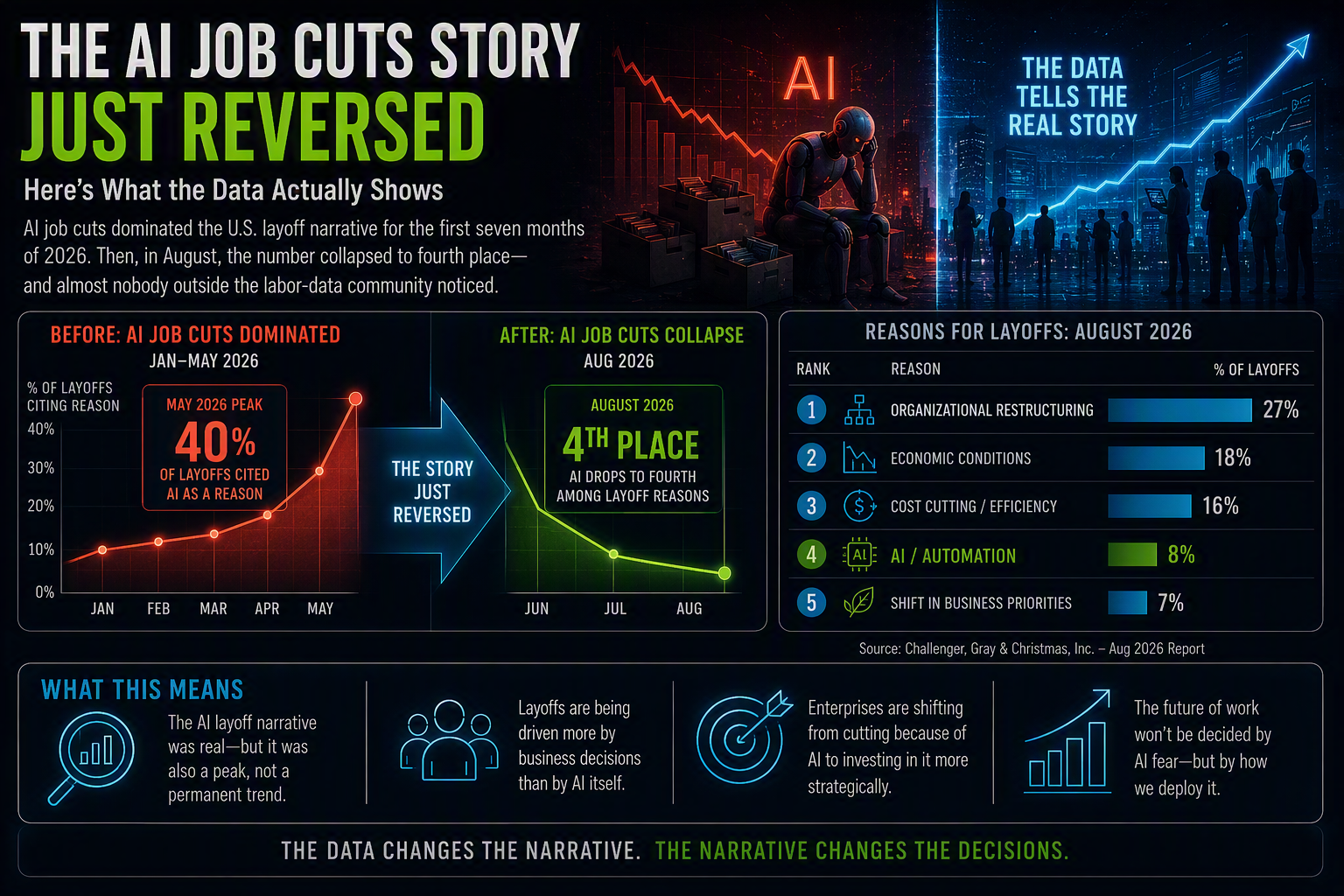
AI job cuts dominated the U.S. layoff narrative for the first seven months of 2026, topping employers’ stated reasons for cutting staff for five consecutive months and hitting a single-month peak of 40 percent in May. Then, in August, the number collapsed to fourth place — and almost nobody outside the labor-data community noticed.
The loudest AI story of 2026 wasn’t a breakthrough. It was a data point that reversed itself, while the headlines kept repeating the peak instead of the trend.
In this post
- The AI job cuts peak nobody followed up on
- What August’s AI job cuts reversal actually shows
- The restructuring relabeling problem
- What the Gulf’s own data shows instead
- What this means for enterprise and telecom leaders
The AI Job Cuts Peak Nobody Followed Up On
For five consecutive months, March through July 2026, U.S. employers named artificial intelligence as the single most common reason for announced job cuts, according to Challenger, Gray & Christmas, the outplacement firm that has tracked stated layoff reasons since 2023. The streak peaked in May, when 38,579 of that month’s announced cuts were attributed directly to AI — 40 percent of everything cut that month. By July, AI still led the list, with 10,970 cuts (33 percent of the month’s total) and a year-to-date figure of 112,713 AI-attributed cuts, about 24 percent of everything announced in 2026 to that point.
| Month | AI-attributed cuts | Share of that month’s total | Rank among stated reasons |
| May 2026 | 38,579 | 40% | 1st (of a 5-month streak) |
| July 2026 | 10,970 | 33% | 1st |
| August 2026 | 3,462 | 7% | 4th |
Table 1. AI-attributed U.S. job cuts, selected months, 2026. Source: Challenger, Gray & Christmas, Inc., monthly Job Cut Announcement Reports (published Aug. 6 and Sept. 3, 2026).
What August’s AI Job Cuts Reversal Actually Shows
Then came the August report, published September 3. Total job cuts for the month were 52,881 — up 58 percent from July but down 38 percent year-over-year, and, in Challenger’s own words, “the quietest August since 2022.” Restructuring took the top spot with 16,173 cuts (31 percent), followed by market and economic conditions (15,260) and closings (6,743). AI fell to fourth place, cited in just 3,462 cuts — 7 percent of the month’s total, its smallest monthly share since the streak began. The year-to-date AI-attributed total now stands at 116,175 cuts, roughly 22 percent of everything announced in 2026 — a figure that barely moved between July and August, because the pace of new AI-cited cuts had nearly stopped.
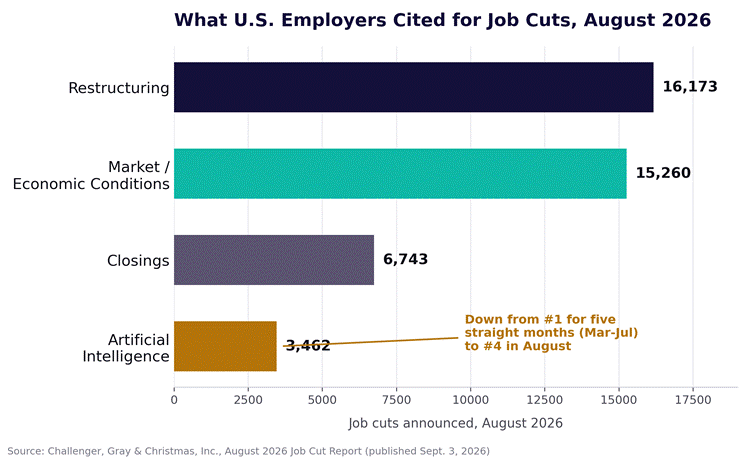
Figure 1. What U.S. employers actually cited for job cuts in August 2026. Source: Challenger, Gray & Christmas, Inc., August 2026 Job Cut Report (published Sept. 3, 2026).
| 40% AI’s share of May’s job cuts — the single-month peak | 7% AI’s share of August’s job cuts — 4th place, behind 3 other reasons | 116,175 AI-attributed U.S. job cuts, year-to-date through August 2026 |
Hiring told the opposite story. Employers announced 12,325 new hiring plans in August, up 725 percent from the same month a year earlier, and 119,825 for the year to date — 37 percent ahead of 2025. Whatever AI is doing to the shape of the U.S. workforce, in August it correlated with more announced hiring, not less.
The Restructuring Relabeling Problem
None of this proves AI’s labor impact is shrinking. It points to a more useful conclusion: “AI” and “restructuring” describe overlapping realities, and companies choose between the two labels for reasons that have little to do with what actually happened inside the building. Andy Challenger, the firm’s chief revenue officer, has made a version of this point about the firm’s own AI figures — noting that companies weigh how each label lands with investors against how it lands with the employees who remain. A cut labeled “restructuring” and a cut labeled “AI” can eliminate the identical task. The category a company picks is closer to messaging strategy than to root cause.
That cuts both ways. Challenger’s own reporting is careful to note that an AI-attributed cut does not establish that a person was directly replaced by an AI system — only that AI was one factor a company chose to name, often alongside others. Tech sat at the center of both the AI figures and the broader 2026 total: the sector logged 155,126 job cuts through August, up 52 percent year-over-year and 29 percent of all cuts industry-wide — but tech is also where restructuring, closures and funding-driven cuts concentrate for reasons that predate generative AI by decades.
What the Gulf’s Own Data Shows Instead
If the U.S. debate is over whether AI is really behind the cuts or just this quarter’s preferred label, the Gulf isn’t having that argument at all — its numbers describe a market adding AI-related roles, not shedding them. UAE AI-related hiring grew 48 percent year-on-year through 2025, the fastest pace of any market tracked globally, while Saudi Arabia posted 26 percent growth in the same category, with data-scientist postings up 43 percent and AI-engineer hiring up 31 percent. State-run upskilling is running at a scale with no real American equivalent: Saudi Arabia’s SAMAI program trained more than a million citizens in its first year, and the UAE’s AI+ initiative targets 50,000 Dubai government employees for AI literacy training.
None of that means the region is further along in using AI productively — on the data, it’s the opposite. BCG’s January 2026 assessment of GCC organizations found only 39 percent qualify as “AI Leaders,” with 61 percent still classified as “Laggards” with limited deployment capability, and it attributed 70 percent of the obstacles to people, organization and process gaps rather than technology. Telecom, media and technology was the one sector clearly pulling ahead of the regional pack, gaining six percentage points of AI maturity a year — ahead of energy and consumer goods, both stuck near 25 percent AI-Leader status.
Put the two data sets together and the regional story is neither replacement nor transformation. It’s capacity-building running well ahead of the operating discipline needed to turn that capacity into measured value — a different problem from the one August’s U.S. headlines implied, and arguably a harder one to solve with a press release.
What This Means for Enterprise and Telecom Leaders
The practical lesson for anyone setting workforce or automation strategy isn’t “is AI cutting jobs, yes or no” — the national data can’t actually answer that question, because it counts labels, not causes. The more reliable signal sits one level down, at the task level, where telecom operators are already running their own version of the same story: automated alarm correlation, AI-assisted fault triage and network-operations copilots are measurably reducing the manual-effort hours behind specific tasks, without most operators reporting the kind of headcount collapse the “AI job cuts” headlines implied for the wider economy. The task shrinks or disappears; the role usually gets redefined toward oversight and exception-handling rather than eliminated outright — which lines up with what Challenger’s own data shows for the broader labor market far better than the peak-month headline ever did.
| Function | The noisy signal to ignore | The task-level signal to track instead |
| Network operations | “AI causing telecom job cuts” headlines | Share of L1 fault-triage tickets closed without human escalation |
| Customer care | National contact-center layoff counts | Share of contact volume resolved by agentic systems vs. routed to a human |
| Finance & shared services | “AI” vs. “restructuring” labeling in competitors’ earnings calls | Cycle-time change on the specific processes AI tools were deployed against |
| Sales & commercial | Broad AI-adoption survey percentages | Which parts of the deal cycle are actually running through AI tools today |
Table 2. What to track instead of the national headline number, by enterprise function.
For a GCC enterprise or telecom leader specifically, the actionable BCG finding isn’t the leader/laggard split — it’s that most of the gap is organizational, not technical. Buying capability isn’t the regional constraint; building the operating model to convert it into measured value is, and that is a slower, less newsworthy project than either “AI cut jobs” or “AI created jobs” headlines suggest.