

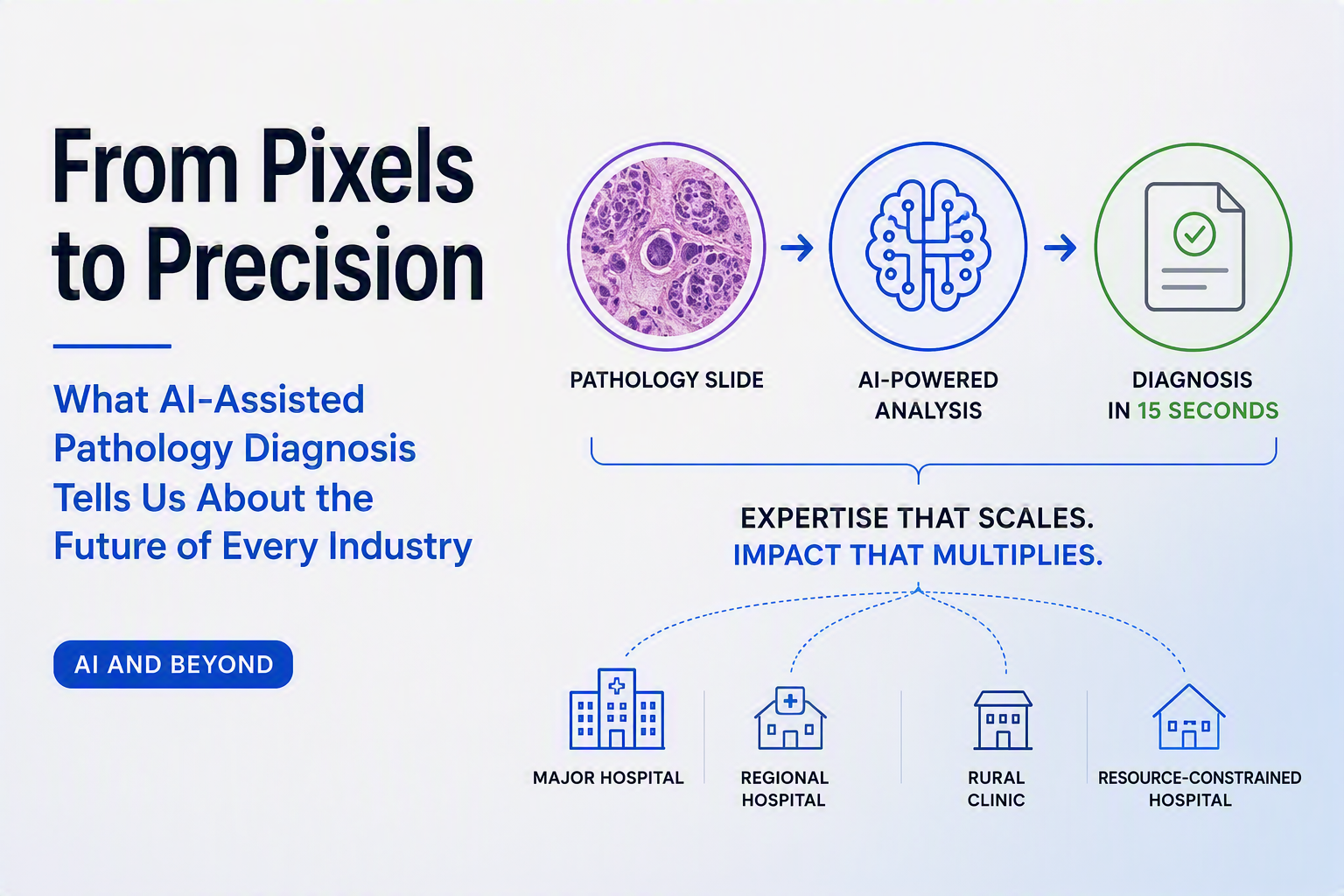
A single case study from a recent industry event says more about AI-assisted diagnosis than most 40-page strategy decks. A major hospital combined a small fleet of specialized AI agents, a handful of underlying models, dedicated compute, hundreds of medical textbooks, and over a million pathology slides into a single diagnostic pipeline. The result: a pathology report that once took clinicians minutes of manual tissue analysis now generates in roughly 15 seconds — covering the most common cancer types, and extending that expertise to thousands of smaller, resource-constrained hospitals that would otherwise never see it.
AI-assisted diagnosis, beyond healthcare
Strip away the medical framing and what remains is a reusable pattern: take a scarce, highly-trained human capability, encode it into a multi-agent system trained on the institution’s own accumulated knowledge, and redistribute that capability to every location the organization touches — regardless of local expertise. That is not a healthcare story. That is an enterprise distribution story.
The strategic lesson
- Expertise becomes infrastructure. The institution didn’t just automate a task — it converted years of accumulated knowledge into a deployable asset.
- Speed compounds trust. A 15-second report isn’t just efficient; it changes the economics of when diagnosis happens, enabling earlier intervention.
- Inclusion is a byproduct of scale. Once the model exists, marginal cost to extend it to a smaller hospital is near zero — turning an efficiency play into an equity play.
What AI-assisted diagnosis actually requires under the hood
None of this works without three things operating together: a knowledge base built from the institution’s own historical cases, enough compute to run inference in near real-time, and a feedback loop that lets the system improve as it sees more data. Miss any one of the three and you get a slower, less reliable version of the same idea — which is why so many AI pilots in this space stall before they ever reach production. The pattern also explains why buying “an AI model” is never the real project; the real project is building the pipeline of data, compute, and feedback around it.
The so-what for telecom and enterprise leaders
Every large enterprise sits on its own version of “a million pathology slides” — years of tickets, contracts, network logs, or customer interactions that encode expertise nobody has time to document. The organizations that win the next three years won’t be the ones with the most data. They’ll be the ones who turn that data into an agent that acts on it in seconds, not months.