


Telecom contract negotiation on a connectivity deal usually comes down to three numbers: monthly price, term length, and SLA uptime. Platform deals add terms that most connectivity negotiators have never had to defend, and the customer’s procurement team is often negotiating them for the first time as well. That unfamiliarity on both sides is where margin is lost or protected.
This module closes Part 3 of the course. It assumes the pricing model from Module 2 has already been chosen and the deal has been qualified (Module 7); the question here is how the four platform-specific terms get negotiated without giving away the economics that made the deal worth pursuing.
In a platform deal, the price is rarely where the margin is lost. It is lost in the terms nobody thought were negotiable.
The four terms that matter in telecom contract negotiation
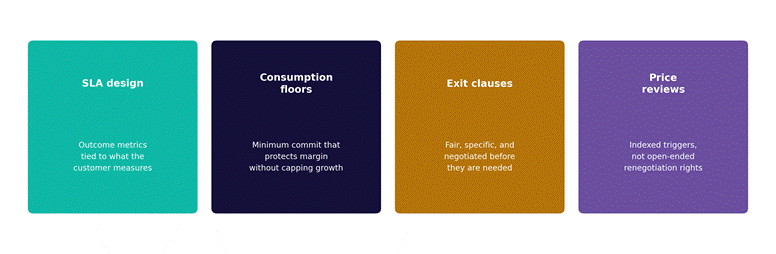
Figure 1. The four platform-specific terms. Each one has a defensible opening position and a point beyond which the deal stops making sense.
SLA design
Connectivity SLAs measure the network: availability and packet loss on a circuit. Platform SLAs should measure what the customer actually experiences, such as application response time or job completion rate. The trap is accepting an outcome SLA whose result depends on systems you do not control. Every outcome SLA needs a clear boundary stating which components are inside your responsibility and which are excluded.
Consumption floors
A consumption-based deal needs a committed minimum. Without it, the provider carries all of the demand risk, and the deal’s economics depend on usage the customer has no obligation to generate. The negotiation is about where the floor sits: high enough to cover the fixed cost of serving the account, low enough that it does not recreate the over-provisioning problem the consumption model was meant to solve.
Exit clauses
Customers adopting a new platform service reasonably want a way out if it underperforms. Refusing an exit clause tends to stall procurement. The better position is a specific, conditional exit: termination allowed if a defined SLA is missed for a defined number of consecutive periods, with a clear data and service transition obligation. Vague termination-for-convenience language is the version to resist.
Price reviews
Multi-year platform deals often include price review rights. An open-ended review clause effectively converts every anniversary into a renegotiation. Indexed or trigger-based reviews (tied to a published inflation index, or to usage crossing a defined tier) give the customer protection without reopening the entire commercial structure each year.
Negotiation reference table
| Term | Opening position | Acceptable range | Walk-away point |
| SLA | Outcome metric with clearly bounded responsibility | Hybrid: network SLA plus one bounded outcome metric | Outcome SLA covering systems outside your control |
| Consumption floor | Floor covering full fixed cost to serve | Floor covering most fixed cost, with a ramp to full | No floor at all on a dedicated or reserved build |
| Exit clause | Exit only after sustained, defined SLA failure | Exit on SLA failure, plus a reduced-fee early exit after year one | Unconditional termination for convenience at any time |
| Price review | Indexed to a published inflation measure | Index plus a tier-based review on large usage changes | Annual open renegotiation of all pricing |
Trading, not conceding
Every concession on one of these terms should be traded for movement on another. A lower consumption floor can be exchanged for a longer initial term. A more generous exit clause can be exchanged for an indexed price review instead of an open one. Conceding a term without a trade signals to procurement that the remaining terms are also soft. The same principle drives the objection scripts in Module 9: concede the true part, then redirect.
Worked example
Procurement on an edge-compute deal asks for three changes in a single redline: remove the consumption floor, add termination for convenience on 90 days’ notice, and add an annual price review.
- Do not respond to the redline line by line. Treat the three requests as one package and respond with a package.
- Hold the floor, but lower it. Offer a floor at 70% of the original level, ramping to 100% after six months (the exit-criteria discipline of Module 10, applied commercially), explaining that the edge nodes are dedicated hardware deployed for this customer.
- Replace convenience termination with conditional exit. Offer termination if the agreed availability metric is missed in three consecutive months, plus a reduced-fee early exit after month 12.
- Index the review. Accept a price review, indexed to a named published inflation measure and capped.
- Ask for the trade. In exchange, request a 36-month initial term instead of 24. Procurement accepts, because each of its three concerns received a specific, reasonable answer rather than a refusal.
What comes next
This closes Part 3, Win the Deal. Module 13 opens Part 4, Run the Team, starting with how a KAM team should be structured when it has to sell both connectivity and platform services against a single segment target.
In your last platform deal, which of these four terms did you concede without getting something in return?