


B2B telecom pricing has run on one logic for decades: meter the pipe, charge for capacity, guarantee an SLA. It’s a pricing model built for a product where the value is genuinely linear — twice the bandwidth costs roughly twice as much, because twice the bandwidth is quite literally twice the physical resource being provisioned.
Platform services break that logic completely, and a surprising number of enterprise telecom deals still get priced as if they hadn’t. Module 1 established that the growth sits almost entirely in beyond-core services, not legacy connectivity — this module covers the pricing mechanics specific to that shift, because pricing a platform service like a leased line is one of the fastest ways to lose the deal the TechCo pitch was supposed to win.
If the pricing model can’t explain why a customer would use more of the service, it was built for a different product.
Why B2B telecom pricing has to change shape, not just numbers
The connectivity pricing model answers one question well: how much capacity does this customer need, reserved and guaranteed, all the time? That question makes much less sense for a service whose entire value proposition is elasticity — scaling up during a demand spike, scaling down when it isn’t needed, paying for outcomes rather than reserved capacity that sits idle most of the time.
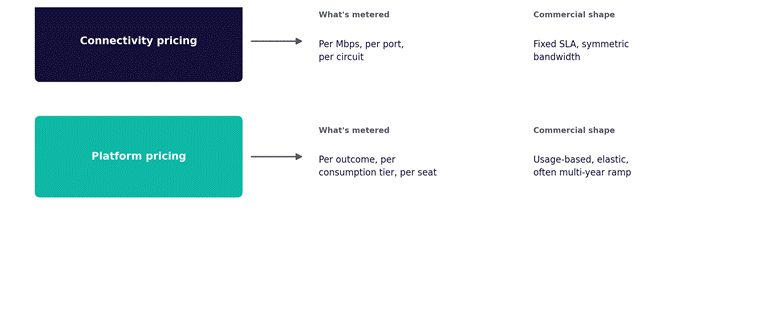
Figure 1. The two pricing logics aren’t variations on a theme — they meter fundamentally different things.
Four pricing models replacing per-Mbps connectivity
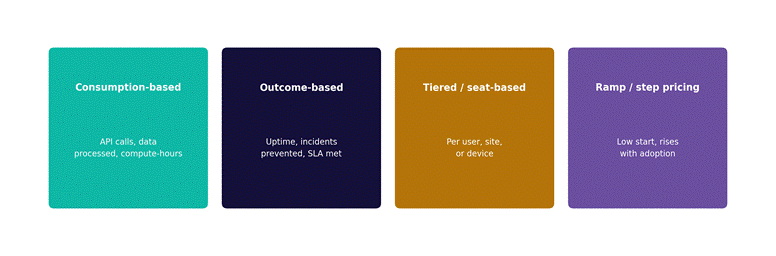
Figure 2. Four platform pricing models, often blended rather than used in isolation.
| Model | How it works | Where it fits |
| Consumption-based | Priced per unit of actual usage — API calls, data processed, compute-hours | Cloud connectivity, edge compute, AI/analytics with genuinely variable demand |
| Outcome-based | Priced against a measurable result — uptime, incidents prevented, latency SLA met | Managed services where the customer cares about the result, not the mechanism |
| Tiered/seat-based | Fixed tiers bundling capabilities, priced per user, site, or device | Enterprise software riding on top of connectivity — fleet management, IoT platforms, security |
| Ramp/step pricing | Lower initial pricing that steps up as adoption grows, often tied to a multi-year term | Any platform sell where the customer needs to prove internal ROI before full-scale pricing |
These aren’t mutually exclusive — most real platform deals blend two or three. A network slicing commercial offering, for example, often combines a tiered base (QoS class selection) with consumption-based overage pricing above a committed baseline.
What actually changes in the deal, mechanically
- The unit of measurement moves from the provider’s cost structure to the customer’s value structure. Connectivity pricing is built around what it costs to provision capacity. Platform pricing has to be built around what the customer is trying to achieve.
- Forecasting risk shifts. A fixed-capacity contract is predictable for both sides. Consumption-based pricing makes revenue variable for the provider and cost variable for the customer — exactly the trade a customer wants when their own demand is variable.
- The contract term structure changes. Ramp and outcome-based models generally need longer initial terms to make sense financially, since early-period pricing often sits below the eventual steady-state rate.
- Renewal conversations stop being purely about price. A connectivity renewal negotiates the same fixed product at a new price. A platform renewal asks whether usage and outcomes justify expanding the relationship — a fundamentally different, usually easier, conversation to win.
Worked example: converting a fixed quote to consumption pricing
An account team is about to quote a managed edge-compute service at a flat $18,000/month, modeled directly on how the same team has always priced a dedicated circuit — fixed capacity, fixed fee, regardless of actual use.
- Check the demand pattern first. The customer’s workload is bursty — heavy during a seasonal sales period, light the rest of the year. A flat fee priced for peak capacity means the customer is overpaying for 9 months and the account team is leaving no room to grow the deal when the next burst comes.
- Rebuild as consumption-based. Price a lower baseline committed tier ($6,000/month) covering off-peak usage, plus metered overage during burst periods. Modeled against the customer’s actual historical pattern, this totals roughly $14,000/month on average — lower than the flat quote, but it’s the more competitive, better-fit number that wins the deal and keeps the relationship elastic.
- Price the overage tier to reward growth, not punish it. A common mistake is overage pricing so steep it penalizes exactly the growth the deal should be capturing. Overage priced close to marginal cost keeps the customer expanding usage rather than capping it artificially to avoid a penalty.
- Result. The deal closes at a number the customer’s own usage data justifies, the account team has a natural expansion conversation built into the pricing model itself, and the pitch is now consistent with the TechCo positioning from Module 1 rather than contradicting it with connectivity-style pricing underneath.
The mistake that kills margin: pricing platform value like connectivity
The most common commercial error in this transition isn’t picking the wrong model — it’s defaulting to the familiar one out of habit. The GCC hyperscaler footprint makes this mistake more costly than it used to be: a prospect comparing a fixed-capacity platform quote against a cloud-native consumption-based alternative already live in-market will notice the mismatch immediately.
A practical framework for pricing a platform deal
- Identify what the customer is actually trying to achieve — not the capacity requested, but the outcome the capacity is meant to produce.
- Determine whether demand is genuinely variable or effectively constant — platform pricing isn’t automatically superior, it’s a better fit for variability.
- Choose the model (or blend) that ties cost to what the customer actually varies, not to a proxy the provider finds easier to measure.
- Structure the term and ramp to match how long the customer genuinely takes to realize value.
- Build the renewal conversation around demonstrated usage and outcomes from day one.
What comes next
Module 3 moves from pricing structure to account intelligence: reading an enterprise account’s technical signals to find expansion opportunity before the customer raises it — exactly the signal that would have flagged the bursty-demand pattern in this module’s worked example before the quote was even drafted.
Which pricing model does your own sales motion lean on most by habit, and is that still the right fit for what you’re actually selling?