

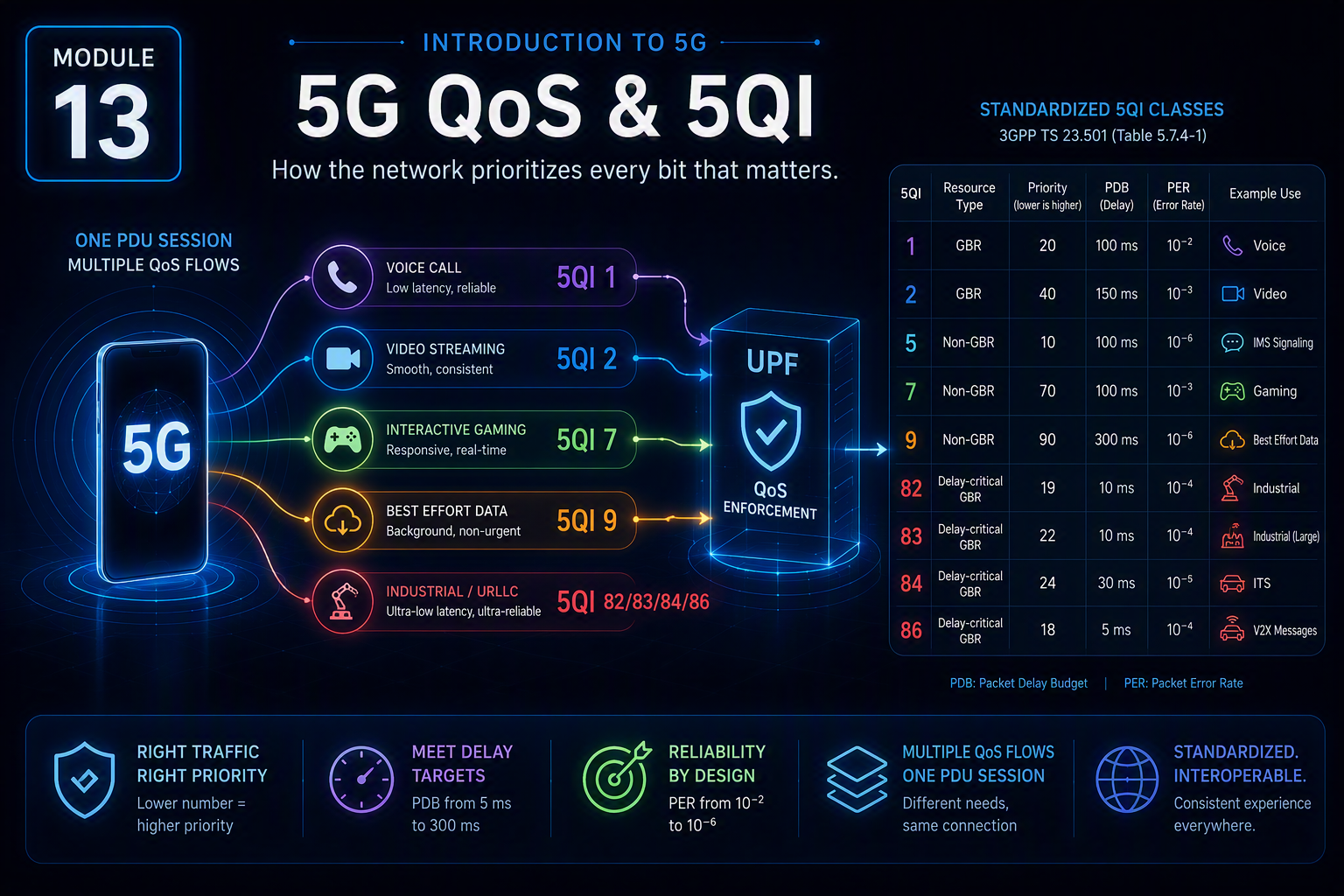
5G QoS 5QI values are standardized to the exact millisecond and percentage point in 3GPP TS 23.501, Table 5.7.4-1 — not loose guidance, but a precise table any compliant network and device must interpret identically, which is what makes QoS behavior predictable across operators and vendors.
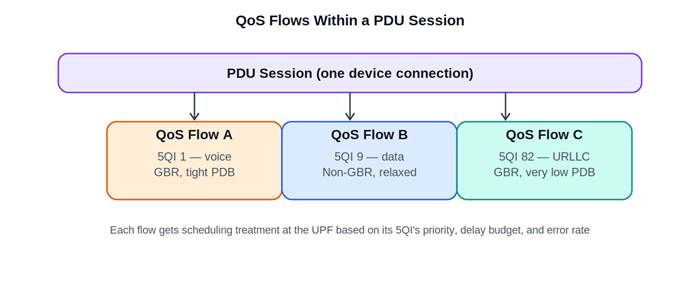
Diagram for Module 13
Diagram: 5G QoS 5QI — multiple QoS flows within a single PDU session.
Why QoS still matters even with slicing in place
Even within a single slice (Module 12), different traffic flows from the same device need different treatment. A video call and a background file sync on the same device, same slice, have very different latency and reliability needs — QoS is the mechanism operating at this finer grain.
From QCI to 5QI: standardized, and genuinely extended
LTE used QCI (QoS Class Identifier). 5G’s equivalent, 5QI, is defined in TS 23.501 Table 5.7.4-1 with real, specific values:
| 5QI | Resource type | Priority | Packet Delay Budget | Packet Error Rate | Example use |
| 1 | GBR | 20 | 100 ms | 10⁻² | Conversational voice |
| 2 | GBR | 40 | 150 ms | 10⁻³ | Conversational video |
| 5 | Non-GBR | 10 | 100 ms | 10⁻⁶ | IMS signaling |
| 7 | Non-GBR | 70 | 100 ms | 10⁻³ | Voice, video, interactive gaming |
| 9 | Non-GBR | 90 | 300 ms | 10⁻⁶ | Default / best-effort data |
| 82 | Delay-critical GBR | 19 | 10 ms | 10⁻⁴ | Discrete automation (URLLC) |
| 83 | Delay-critical GBR | 22 | 10 ms | 10⁻⁴ | Discrete automation, larger payload |
| 84 | Delay-critical GBR | 24 | 30 ms | 10⁻⁵ | Intelligent transport systems |
| 86 | Delay-critical GBR | 18 | 5 ms | 10⁻⁴ | V2X messages |
Source: 3GPP TS 23.501, Table 5.7.4-1 (Standardized 5QI to QoS characteristics mapping).
Note the pattern directly connecting back to Module 1: 5QI values 82, 83, 84, and 86 — the delay-critical GBR class, introduced specifically for URLLC — carry Packet Delay Budgets of 5–30ms and error rates as tight as 10⁻⁵, a class that simply doesn’t exist in LTE’s original QCI table, which was designed around eMBB-era assumptions about acceptable latency.
What each field actually specifies
- Resource type — GBR (guaranteed minimum bitrate), Non-GBR (best-effort within priority), or Delay-critical GBR (guaranteed rate with a strict delay budget, discarding packets that miss it rather than delivering them late).
- Priority level — lower numbers mean higher priority when the network must decide which traffic to favor under contention (5QI 1’s priority 20 outranks 5QI 9’s priority 90).
- Packet Delay Budget (PDB) — target maximum delay, ranging from 5ms (5QI 86, V2X) to 300ms (5QI 9, best-effort data).
- Packet Error Rate (PER) — target acceptable loss rate, from 10⁻² (5QI 1, voice, tolerant of occasional loss) to 10⁻⁶ (5QI 9, data needing near-perfect delivery at the RLC layer).
QoS Flows: 5G’s finer-grained alternative to LTE’s bearer model
LTE organized QoS around the bearer. 5G introduces the QoS Flow, associated with a specific 5QI, existing within a PDU session (Module 10). Multiple QoS Flows can exist within one PDU session — a voice call’s flow (5QI 1) and a background sync’s flow (5QI 9) can both exist within one session, each tagged differently and treated accordingly by the UPF.
How this connects to what’s already been covered
QoS enforcement ties directly to the UPF (Module 10): the UPF applies treatment to user-plane traffic based on its 5QI, making real-time scheduling decisions consistent with each flow’s PDB and priority. QoS interacts with slicing (Module 12) too — a URLLC slice (SST=2) might default every flow to the delay-critical GBR class, while an eMBB slice (SST=1) predominantly uses 5QI 9-class flows.
Why this standardization actually matters in practice
Without a standardized table like TS 23.501’s, every operator would need bespoke agreements about traffic prioritization — an interoperability failure at global roaming scale. 5QI’s standardization means a device roaming onto an unfamiliar network still gets consistent, predictable QoS treatment for a given traffic class, because the values are standardized industry-wide, not defined independently per operator.
Next in this series: Module 14 — Mobility and Handover in 5G: Xn and N2 Handovers, and Session Continuity.
One thought on “Introduction to 5G — Module 13: Quality of Service in 5G — 5QI and How the Network Prioritizes Traffic”