


Taking an enterprise account from an incumbent telecom provider is the hardest motion in this course, and the most commonly mishandled. The instinct is to undercut on price across the whole relationship. That almost never works: switching connectivity is operationally painful for the customer, the incumbent can usually match a discount, and a price-led displacement attempt teaches the customer to use you as leverage in their renewal with someone else.
Module 4 separated four competitor types and noted that competing against another telco is the one case where traditional selling still largely applies. This module refines that: against an entrenched incumbent, the winning approach is a narrow wedge, proven in production, then expanded.
You rarely win an incumbent’s account in one deal. You win one service, prove it, and let the proof do the selling.
Why price-led attacks on an incumbent telecom provider fail
| Reason | What actually happens |
| Switching cost is real | Re-cabling, migration windows, and change-management risk sit with the customer’s IT team. A 10% saving rarely outweighs a weekend outage risk in their eyes. |
| The incumbent can match | An incumbent defending a large account will usually meet a discount on the specific line being contested, leaving you with nothing but a lower market price. |
| You become leverage | A customer who receives an aggressive competing quote often uses it to renegotiate with the incumbent, which is a common outcome of a price-only bid. |
| It signals commodity | Leading with price confirms the customer’s view that connectivity is interchangeable, undermining the TechCo positioning from Module 1. |
The four-step wedge sequence
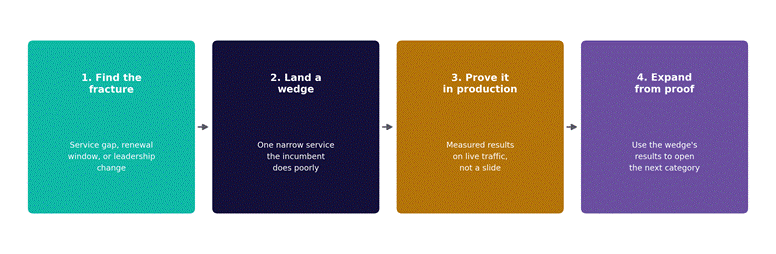
Figure 1. The wedge sequence. Each step depends on the one before it; skipping step 3 is the most common failure.
Step 1: Find the fracture
Incumbents lose accounts at specific moments, not continuously. The useful fractures are: a service the incumbent delivers poorly (repeated tickets on one product line), a renewal window on one contract that is decoupled from the others, a leadership change on the customer side (a new CIO or CTO often reviews vendor relationships in their first year), and a new initiative the incumbent is not positioned for, such as an edge or IoT program surfaced through Module 3‘s signals.
Step 2: Land a wedge
Pick one narrow service where you are demonstrably stronger and the incumbent is demonstrably weaker. A good wedge is small enough that the customer can approve it without a major procurement process, independent enough that it does not require migrating the incumbent’s core services, and visible enough that its results will be noticed by the stakeholders mapped in Module 8.
Step 3: Prove it in production
Measured results on live traffic are the entire point of the wedge. Agree the measurement up front, using the same discipline as Module 10‘s POC exit criteria, and report against it on a fixed cadence. A wedge that runs quietly without reported results gives you no expansion leverage.
Step 4: Expand from proof
Use the wedge’s measured results to open the next whitespace category from the Module 5 account plan. The expansion conversation is no longer “switch to us”; it is “the service we already run for you hit these numbers, so here is what the same approach would do for this adjacent area.”
Displacement readiness scorecard
Score each factor 0 to 2 before committing a team to a displacement effort. Seven or more out of ten justifies active pursuit; below five usually means waiting for a better fracture.
| Factor | Score 0 | Score 2 |
| Fracture | No known dissatisfaction or trigger event | Documented service issue, leadership change, or decoupled renewal |
| Wedge candidate | Only core services available to contest | A narrow, separable service where you are clearly stronger |
| Sponsor | No contact inside the account willing to champion a trial | A named technical sponsor who wants the alternative tested |
| Measurability | Success would be subjective | Clear numeric metric agreed with the sponsor |
| Expansion path | No adjacent whitespace mapped | Two or more Whitespace and Hot categories from Module 5 |
Worked example
A financial services account has run all connectivity through one incumbent for eight years. The account team’s first plan is a full-estate competitive quote at a 15% discount.
- Score readiness first. Fracture scores 2: the customer logged repeated latency complaints on its branch-to-cloud traffic. Wedge candidate scores 2: branch cloud access is separable from the core MPLS estate. Sponsor scores 1: an infrastructure lead is sympathetic but not yet committed. Total with measurability and expansion path: 8 of 10.
- Drop the full-estate quote. Instead, propose a managed cloud-access service for 12 branches only, priced on the consumption model from Module 2.
- Agree the metric. Median branch-to-cloud latency under a defined threshold during business hours, reported monthly.
- Result. The wedge runs for two quarters and meets the metric every month. At the next infrastructure review, the sponsor brings the reports to the CIO, and the account team is invited to propose the remaining branches. The incumbent still holds the core estate, but the account now has a second, proven supplier inside it.
What comes next
Module 12 covers the negotiation mechanics specific to platform deals: SLAs, consumption floors, exit clauses, and price reviews, which is where many wedges either become durable contracts or quietly stall.
Look at the largest account on your target list held by an incumbent: what is its fracture, and what is the narrowest service that could act as your wedge?