
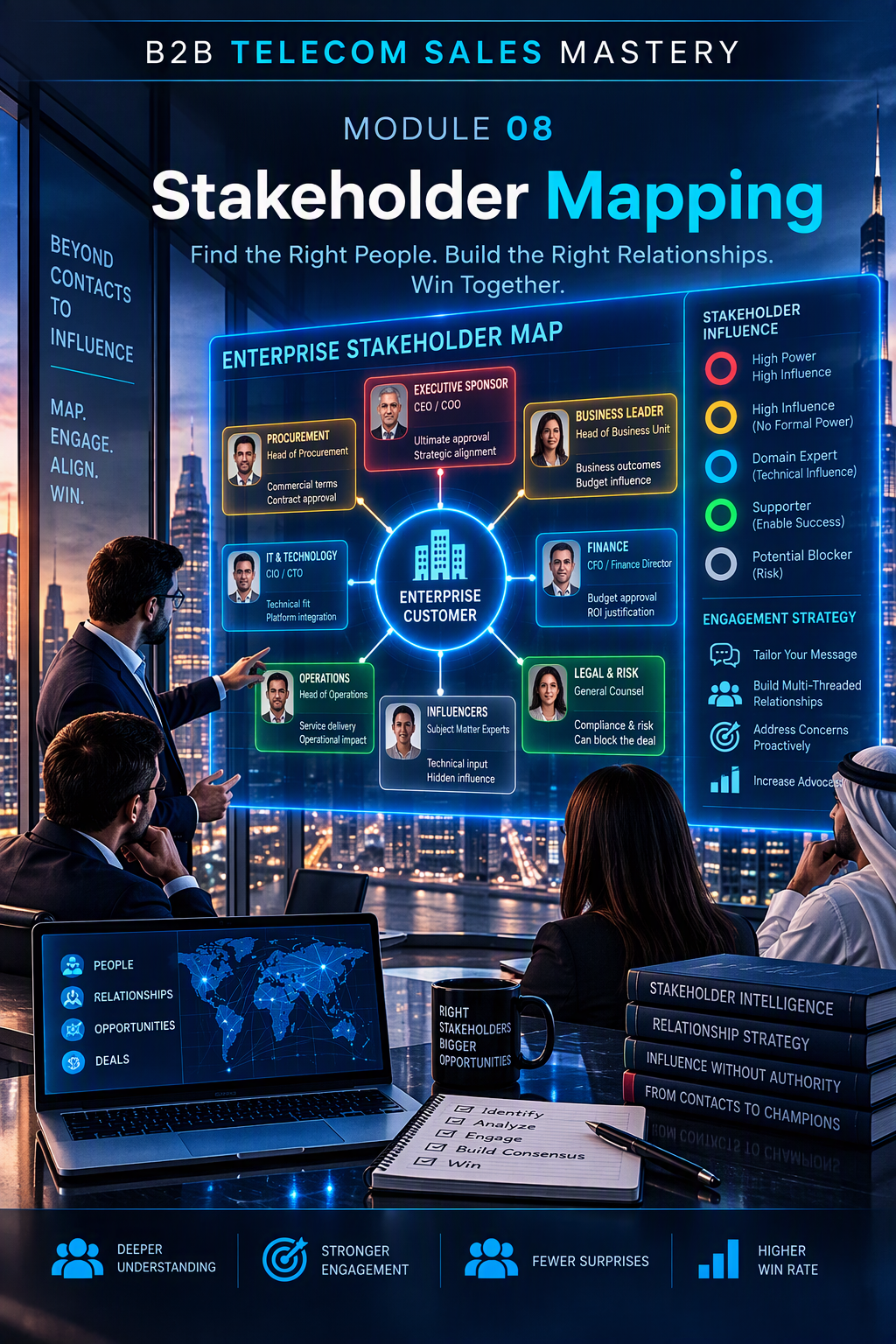
In this module, we will be discussing the B2B Telecom Sales Stakeholder mapping, Module 7‘s Authority score is usually the weakest part of a telecom platform deal, and the reason is structural: a platform sale often needs sign-off from someone who was never part of the original connectivity relationship. Stakeholder mapping is how that gap gets closed — systematically identifying who actually has power, who has influence without formal power, and who can quietly block a deal nobody thought to engage.
The person who signs is rarely the only person who can stop the deal.
Five roles in a typical platform deal
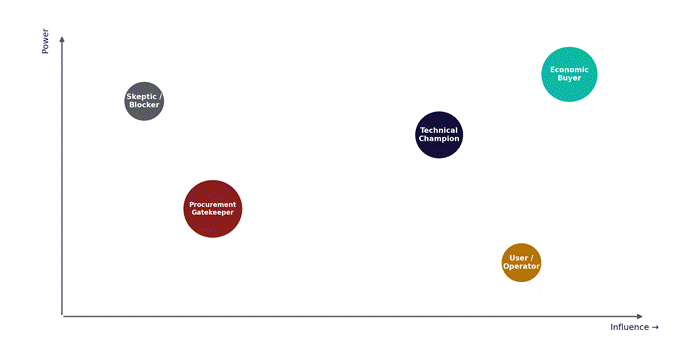
Figure 1. Plot every stakeholder by power (formal authority) and influence (ability to shape the outcome) — position, not title, determines the engagement strategy.
| Role | What they care about | Engagement strategy |
| Economic Buyer | Business outcome, budget justification, risk | Lead with outcome framing (Module 1’s TechCo language), not technical detail |
| Technical Champion | Whether the solution actually works, how it fits their architecture | Lead with the deepest technical credibility available — this is the audience Module 3’s and Module 4’s technical fluency is built for |
| User/Operator | Day-to-day usability, disruption to existing workflow | Show, don’t just tell — this role responds to a demo or proof point, covered in Module 10 |
| Procurement Gatekeeper | Compliance, pricing structure, vendor risk | Engage early with Module 2’s pricing-model clarity so the deal doesn’t get flattened into a connectivity-style commodity evaluation |
| Skeptic/Blocker | Often unstated — previous bad experience, competing priority, territorial concern | Identify specifically what’s driving the skepticism before trying to counter it generically |
The stakeholder most deals miss
The Skeptic/Blocker quadrant — high power, low visible influence in normal deal conversations — is where qualified deals quietly die. This person rarely objects loudly; they simply don’t actively support, and a deal that needs consensus stalls without anyone naming why. Explicitly mapping who this might be, and addressing their specific concern directly, is usually a higher-leverage activity than more time spent with an already-supportive Technical Champion.
Worked example
A deal scoring 6/8 on Module 7’s BANT framework stalls for six weeks with no clear reason — the Technical Champion remains enthusiastic throughout.
- Map the full stakeholder set, not just the engaged contacts. The account team has only ever spoken with the Technical Champion and, briefly, the Economic Buyer.
- Identify the gap. Procurement has never been engaged directly — and procurement’s standard evaluation template is built around connectivity-style pricing, which this platform deal’s consumption-based pricing doesn’t map onto cleanly.
- Engage procurement directly with a plain explanation of the pricing model (Module 2), rather than leaving the Technical Champion to translate it secondhand.
- Result. The deal unstalls once procurement’s actual confusion — not a hidden objection, just a structural mismatch with their evaluation template — is addressed directly.
What comes next
This closes Part 2 of the course. Module 9 opens Part 3, Win the Deal, starting with objection handling — including a scripted response library for the most common pushback a mapped-but-unaddressed stakeholder is likely to raise.
For your highest-value open deal: who’s your Skeptic/Blocker, and have they actually been engaged directly, or only inferred?