


Telecom deal qualification, not every technical signal from Module 3 or whitespace cell from Module 5 is a real opportunity yet. Qualification is the filter that separates “worth pursuing now” from “worth monitoring.” BANT — Budget, Authority, Need, Timeline — is a standard B2B qualification framework; this module adapts each letter specifically for telecom platform deals, where the standard version’s assumptions don’t always fit.
A hot technical signal with no budget and no timeline isn’t a deal. It’s a watch-list item.
BANT, adapted for telecom platform deals
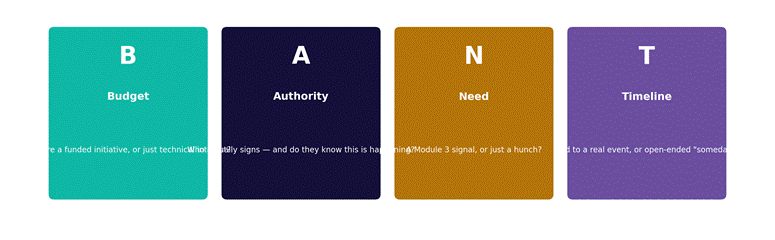
Figure 1. BANT adapted for platform deals — each letter reframed around what’s actually different in telecom enterprise sales.
| Letter | Standard BANT question | Telecom platform adaptation |
| B | Is there budget? | Is there a funded initiative, or only technical interest? A hot Module 3 signal with no budget line is real, but not yet qualified — the next step is finding where budget would come from, not assuming it exists. |
| A | Who approves the purchase? | Who signs for a platform deal is often different from who signed the last connectivity renewal — platform spend frequently needs a technical or digital-transformation budget holder who may not even be in the existing relationship yet. |
| N | Is there a need? | Is this a verified Module 3 signal (capacity headroom, traffic shift, redundancy gap, shadow infrastructure), or an assumption based on the vertical fitting the Module 1 growth data? A scored signal is real need; a hunch is not. |
| T | When do they need it? | Tied to a specific, real business event (a new site opening, a contract expiring, a compliance deadline), or an open-ended “someday” with no forcing function? The former is worth active pursuit now; the latter belongs in Module 5’s Whitespace & Cold quadrant. |
Scoring a deal for real qualification
Score each letter 0-2 (0 = unknown/absent, 1 = partially confirmed, 2 = confirmed). A total of 6+ out of 8 is a genuinely qualified deal worth active resourcing; 3-5 needs specific work to close the gaps before committing full account-team effort; below 3 belongs on the watch list, not the active pipeline.
| Letter | Score 0 | Score 2 |
| Budget | No funded initiative identified | A named budget line or clearly fundable initiative confirmed |
| Authority | Decision-maker unknown or unconfirmed | Economic buyer identified and engaged directly |
| Need | Assumption only, no Module 3 signal | A scored Module 3 signal at 2+ confirming the need |
| Timeline | No forcing event, open-ended | A specific date or event driving urgency |
Worked example
A Module 3 checklist flags a strong capacity-headroom signal at a manufacturing account — scoring 2. The account team wants to immediately commit full resourcing to pursue it as a deal.
- Run the full BANT score before committing resources. Need scores 2 (the signal is real and verified). But Authority is unconfirmed — nobody has spoken to whoever would actually fund a capacity expansion. Budget is unknown. Timeline has no specific forcing event.
- Total score: 2 of 8. This is a real signal, not yet a qualified deal — resourcing it as if it were already qualified risks the account team’s time on something that may not close for quarters, if ever.
- Next action, correctly scoped. Rather than a full proposal, the right next step is a single conversation aimed specifically at Authority and Timeline — identifying who would own this budget and whether there’s a real event driving urgency — before investing further effort.
What comes next
Module 8 covers stakeholder mapping — the specific method for finding and engaging the Authority this module just flagged as commonly missing in platform deals.
Pick one opportunity currently in your pipeline and score it against this table — does the total match how much effort it’s currently getting?