


Telecom account planning usually produces a document that gets built once a year, reviewed at renewal, and otherwise ignored. That’s a filing exercise, not a planning tool. A working account plan does one job: it tells the account team where the next deal is, before the customer asks for it — combining what Module 3 taught about reading technical signals with what Module 4 taught about knowing which competitor is already in the whitespace.
An account plan that doesn’t change what you do Monday morning is a report, not a plan.
The whitespace-mapping framework
Map every service category relevant to the account — connectivity, cloud, security, IoT, analytics, whatever applies — onto two axes: whether it’s currently owned (contracted) or whitespace (not contracted), and whether the signal strength (from Module 3’s checklist) is hot or cold.
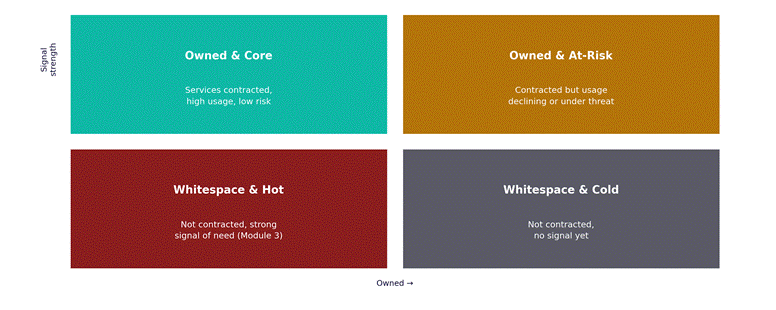
Figure 1. The whitespace-mapping quadrant — plot every relevant service category for the account, then work the quadrants in order.
Working the quadrants, in order
| Quadrant | What it means | What to do |
| Owned & Core | The stable base of the relationship | Protect — monitor for the risk signals from Module 3, don’t neglect it while chasing new logos |
| Owned & At-Risk | A contracted service losing ground — declining usage, competitive pressure | Defend immediately — this is often the highest-urgency quadrant, and the easiest to miss because it’s already “won” on paper |
| Whitespace & Hot | Not contracted, but signal data shows real need — the primary expansion target | Pursue first — this is the highest-probability new revenue in the account |
| Whitespace & Cold | Not contracted, no signal yet | Monitor — don’t actively pursue until a signal appears, but don’t ignore the category either |
Account planning worksheet (fill per account)
| Service category | Owned? | Signal strength | Quadrant | Next action |
| (e.g. core connectivity) | ||||
| (e.g. cloud/edge compute) | ||||
| (e.g. security services) | ||||
| (e.g. IoT/analytics) |
Signal strength comes directly from Module 3’s scored checklist — a category scoring 2 or higher on any signal is “hot.” Competitive risk (which rival type, from Module 4, is most likely already active in each whitespace category) belongs as a note alongside each row once identified.
Worked example
An account plan for a regional retail chain maps four categories. Core connectivity: owned, stable — Owned & Core. Cloud/edge compute: not contracted, but Module 3’s capacity-headroom signal shows strong growth at three new store locations — Whitespace & Hot. Security services: not contracted, no particular signal — Whitespace & Cold. A dormant IoT pilot from two years ago: technically still contracted but usage has dropped to near zero — Owned & At-Risk.
- Work Owned & At-Risk first. The dormant IoT line is a near-term churn risk hiding inside a renewal that otherwise looks healthy — worth a direct conversation before the renewal date, not after.
- Pursue Whitespace & Hot next. The cloud/edge opportunity at the new stores is the clearest expansion play — and per Module 4, likely has a hyperscaler already circling it given the technical signal strength.
- Leave security as monitor-only until a signal appears — pursuing it now would be guessing, not planning.
What comes next
Module 6 moves from account planning into deal execution: why RFPs structured purely around price lose to competitors with less technical credibility, and how to change that dynamic before the RFP is even issued.
Pick one account from your own book and fill in the worksheet above — how many categories land in Whitespace & Hot that aren’t currently being actively pursued?