


The telecom industry’s enterprise opportunity has a number attached to it now, and the number is large enough to change how operators plan: GSMA Intelligence puts the addressable market for telcos moving beyond core connectivity at more than $400 billion — roughly 35% of the entire mobile operator revenue base worldwide.
That is not a forecast of new spending appearing from nowhere. It is a reallocation already underway, and the report is explicit about where it goes: not to operators who keep selling what they have always sold, but to whichever provider — telco or otherwise — shows up as a technology partner instead of a connectivity vendor. GSMA’s shorthand for that shift is telco to techco, and the data underneath it is worth sitting with before treating the phrase as another slide-deck slogan.
The $400 billion isn’t waiting for telcos to claim it. It’s already being spent — the only open question is which vendor category captures it.
This course: what it covers and how it’s built
This is Module 1 of a 21-module course built specifically for B2B telecom sales — account managers, KAMs, and sales leaders selling enterprise connectivity and platform services. It assumes no prior sales-methodology background, and it doesn’t repeat generic B2B sales advice available everywhere else; everything here is built around what’s structurally different about selling telecom enterprise services in a market shifting from connectivity to platform.
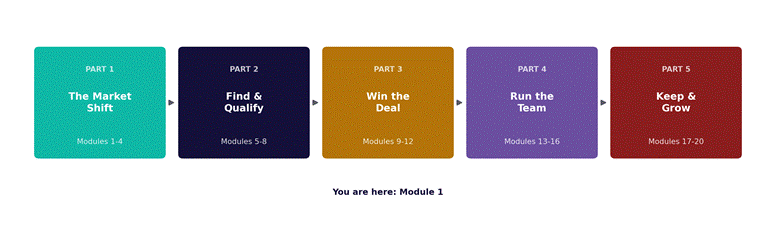
Figure 1. The course roadmap — five parts, 21 modules, moving from market context through to account growth and retention.
The five parts
| Part | Covers | Modules |
| 1. The Market Shift | Why the old connectivity-first playbook is losing ground, and what’s replacing it | 1–4 |
| 2. Find and Qualify | Account planning, RFP positioning, qualification, and stakeholder mapping for platform deals | 5–8 |
| 3. Win the Deal | Objection handling, proof-of-concept design, competitive displacement, negotiation mechanics | 9–12 |
| 4. Run the Team | Team structure, forecasting, coaching, and territory design for a mixed connectivity/platform book | 13–16 |
| 5. Keep and Grow | Onboarding, expansion selling, and renewal defense — the part most sales content skips entirely | 17–20 |
A capstone module (21) closes the course with composite deal walkthroughs applying the full course to realistic, anonymized scenarios.
Why the growth sits entirely outside core connectivity
The GSMA report splits B2B revenue into two very different growth stories. Core telecom services — SD-WAN, unified communications, mobile voice and data — still make up about 70% of operator B2B revenue, worth roughly $250 billion in 2023. But GSMA projects just 3% compound annual growth for that segment through 2030. It is a mature, commoditized market, and operators competing only on it are competing on shrinking margin.
Everything else — cloud and data center services, cybersecurity, IoT, analytics, AI, blockchain — is where the addressable growth actually sits, averaging roughly 12% CAGR across these beyond-core categories. This is the literal meaning of telco to techco: not a rebrand, but a revenue-mix shift away from services a telco has always been structurally good at, toward services that require a different operating model entirely — platform thinking, software delivery, vertical domain expertise.
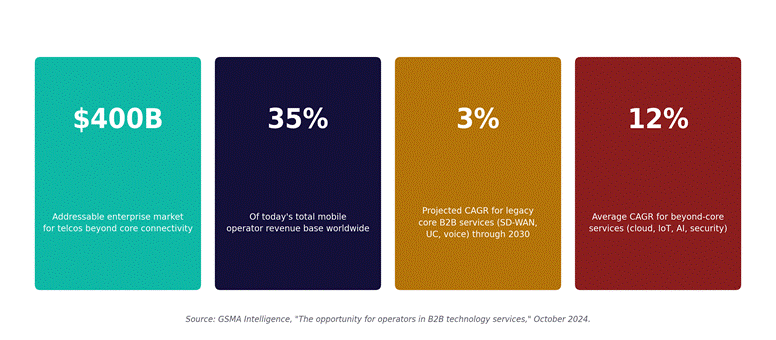
Figure 2. The core numbers behind the telco-to-techco shift. Source: GSMA Intelligence, October 2024.
Where the opportunity concentrates: four verticals
GSMA’s report sizes four verticals specifically, based on 2023 addressable-market data:
| Vertical | 2023 value | Share of 4-vertical total | CAGR to 2030 | What telcos sell |
| Manufacturing | $61B | 38% | 12.1% | Private 5G, edge compute, IoT connectivity |
| Financial services | $59B | 37% | 10.9% | Secure connectivity, cloud migration, fraud/AI analytics |
| Automotive | $22B | 14% | 12.0% | Connected-vehicle platforms, V2X, telematics |
| Aviation | $16B | 10% | 8.4% | In-flight connectivity, airport IoT, operational data |
Together these four verticals account for $159 billion — about 37% of the total opportunity. The remaining 63% spreads across healthcare, public sector, retail, media, smart cities, energy, agriculture, oil and gas, transportation and logistics, professional services, and mining.
Self-assessment: is your own sales motion telco or techco?
Before the course goes further, it’s worth placing your own current motion on this spectrum honestly — later modules build directly on wherever you land here.
| Question | Telco signal | TechCo signal |
| What does your typical first sales conversation open with? | Capacity, coverage, price per Mbps | The customer’s business outcome or problem |
| How is a renewal conversation usually framed? | Same product, new price | Usage and outcomes achieved, then what’s next |
| Who do you lose competitive deals to most often? | Another telecom operator | A hyperscaler, SI, or vertical SaaS vendor |
| How is your team’s technical credibility used in a sales cycle? | Mostly post-sale, in delivery | Pre-sale, as a differentiator in the pitch itself |
Most real sales motions are a mix — that’s expected this early. The honest answer to this table is the starting point Module 5’s account-planning framework will ask you to build from.
What this means for a telco’s own sales motion
The practical read for anyone selling enterprise telecom services is that the growth math no longer rewards a connectivity-first pitch. A prospect’s SD-WAN or MPLS renewal is a 3%-CAGR conversation — necessary, but not where the addressable value sits. The $400 billion is attached to conversations about network slicing as a commercial product, QoS-differentiated services, cloud and data center partnerships in-region, and AI/analytics layered on top of the network rather than sold separately from it. Module 2 covers exactly how pricing has to change shape to capture this; Module 3 covers how to spot the opportunity inside an account before the customer raises it.
This also reframes what counts as competition. An operator’s real competitor for this budget increasingly is not the operator across the street — it is the hyperscaler, the systems integrator, or the vertical-specific SaaS vendor already selling the enterprise the “beyond-core” layer directly. GCC operators face this compressed: global cloud providers are already live or announced in every major GCC market, which narrows the window for local telcos to own that platform layer themselves rather than reselling someone else’s. Module 4 covers this competitive reset in full.
Worked example: reframing a renewal conversation
A mid-market manufacturing customer is six weeks from renewing a standard MPLS/SD-WAN contract. The account team’s default move is a like-for-like renewal at a modest price increase.
- Check the account against this module’s self-assessment. The renewal conversation, as planned, opens with price — a pure telco-signal motion.
- Apply Module 1’s vertical lens. Manufacturing is the single largest beyond-core vertical by 2023 value ($61B) and the fastest-growing (12.1% CAGR) — this account sits in the highest-opportunity vertical in the entire dataset, which the renewal-as-usual plan completely ignores.
- Reframe the opening question. Instead of presenting a renewal price, the account team asks what’s driving any new connected-equipment or edge-compute initiatives on the shop floor — a question a connectivity vendor doesn’t normally ask, but a technology partner does.
- Result. The renewal conversation surfaces an unrelated private-5G pilot the customer’s operations team is already scoping with a different vendor — an opportunity the account team would never have found by only discussing the existing contract.
Nothing about this requires new technology or a bigger budget — it requires asking a different first question, grounded in knowing where the actual growth sits.
What comes next
Module 2 covers exactly how B2B telecom pricing has to change shape — not just numbers — to actually capture platform-style revenue instead of pricing new services like old connectivity products out of habit.
Using the self-assessment table above: which column does your own team’s current sales motion land in more often, and what would it take to shift one conversation type toward the TechCo column this quarter?