

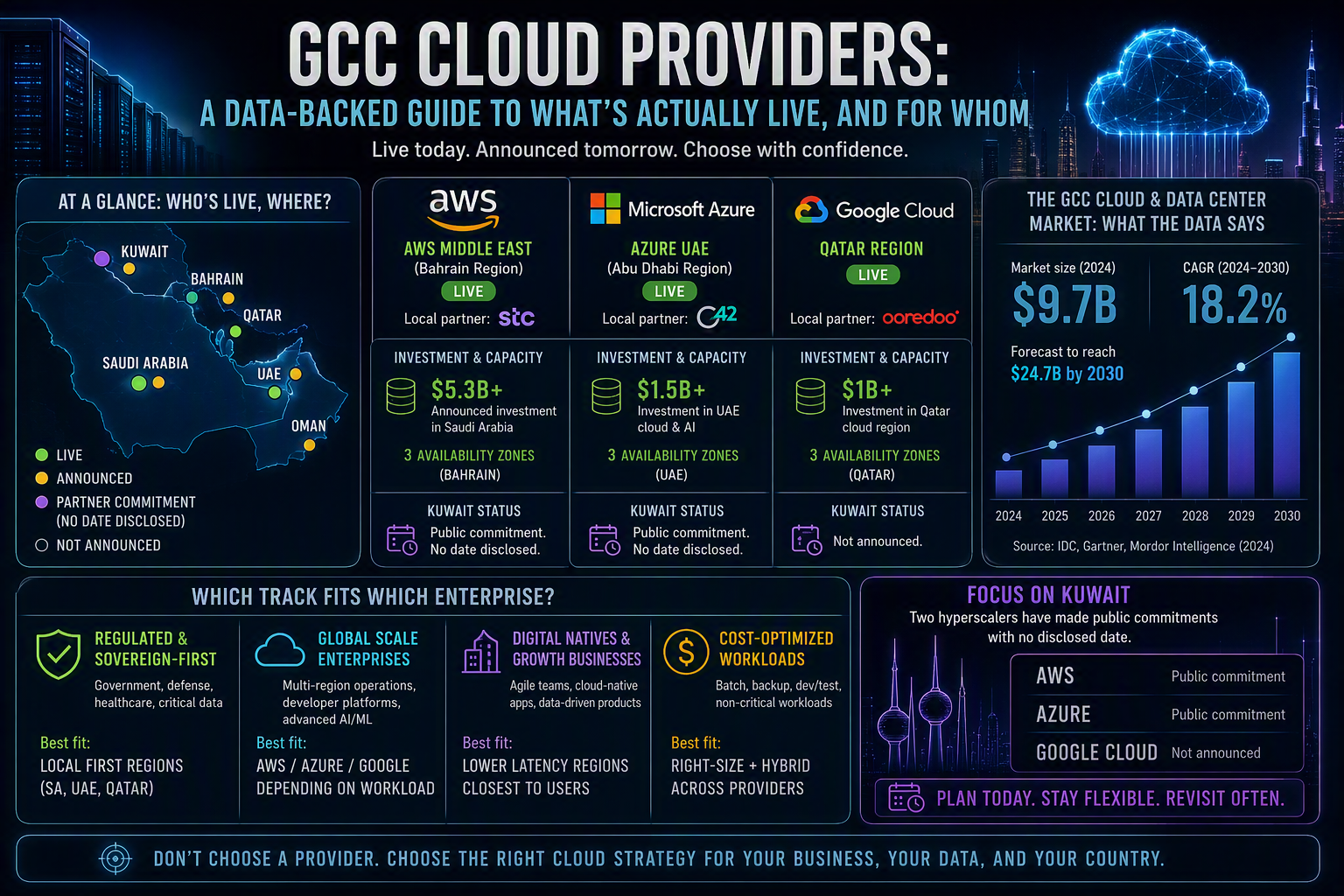
GCC cloud providers are easy to compare on a vendor’s own slide — three logos, three checkmarks, one roadmap. They are much harder to compare once you separate what is actually live today, in a specific country, from what has only been announced. That gap is where most enterprise cloud-placement decisions in the region quietly go wrong.
This piece replaces the general version of that comparison with sourced numbers: which regions are live versus merely promised, what each provider and its government partner have disclosed about investment and capacity, what independent research firms say the GCC cloud and data-center markets are actually worth, and — because a comparison without a recommendation is just trivia — which track fits which kind of enterprise, including the specific case of Kuwait, where two of the three major hyperscalers have made public commitments with no disclosed date attached.
A region marked “announced” on a vendor’s roadmap is not a procurement option. It’s a forecast — and in this market, forecasts have been running eighteen to thirty-six months behind.
The GCC Cloud Providers Market, By the Numbers
Start with why this matters at all. McKinsey’s state-of-AI research for the GCC found organizational AI adoption at 84%, up from 62% two years earlier — four points behind the 88% global average, but rising fast. The gap is in what happens next: only 31% of adopters have moved past pilots into scaled deployment, and just 11% qualify as “value realizers” — organizations attributing at least 5% of earnings to AI. Fifty-three percent name output inaccuracy driven by weak data infrastructure as their top barrier to scaling, and 89% still plan to increase AI budgets regardless (McKinsey & Company, QuantumBlack, “The State of AI in the GCC Countries”).
Gartner puts a regional number on the infrastructure being built to close that gap: MENA IT spending is forecast at USD 169 billion in 2026, up 8.9% year on year, with data-center systems spend the fastest-growing line at 37.3% — a deceleration from 2025’s 69.3% surge, which Gartner reads as a shift “from rapid build-out to incremental and sustained investment” (Gartner, August 2025 press release).
At the country level, independent market-research firm Mordor Intelligence sizes Saudi Arabia’s cloud computing market at USD 15.39 billion in 2025, rising to USD 27.93 billion by 2030 (12.66% CAGR); the UAE’s at USD 12.84 billion in 2025, projected to USD 56.26 billion by 2031 (27.93% CAGR from 2026), with just four providers — AWS, Microsoft, Oracle and G42 — holding 54.4% of UAE cloud revenue; and Kuwait’s total ICT market at USD 20.4 billion in 2025, rising to USD 34.37 billion by 2031, with cloud specifically growing faster than the market at large, 14.05% CAGR through 2031 (Mordor Intelligence, KSA / UAE / Kuwait market reports). Separately, the region’s physical data-center market — the buildings and power behind all of this — is sized at USD 3.48 billion in 2024, projected to USD 9.49 billion by 2030 (18.19% CAGR), with USD 13.5 billion of pipeline investment still in planning or study phase (dctc-gcc.com GCC data-center market analysis).
Where GCC Cloud Providers Actually Stand, Country by Country
Here is the status that vendor marketing tends to blur — live, generally-available regions versus announced intent, sourced to each provider’s own disclosures and regional trade press.
| Provider | Saudi Arabia | UAE | Kuwait | Elsewhere in GCC |
| AWS | Announced — live Dec 2026 ($5.3B) | Live since 2022 (me-central-1) | Not announced | Bahrain live since 2019 (me-south-1) |
| Microsoft Azure | Announced — live Nov 2026 (3 AZs, Eastern Province) | Live | Announced Mar 2025 no date/investment set | Qatar and Israel live |
| Google Cloud | Live since Nov 2023 (Dammam, via CNTXT) | Not a direct region (served via nearby regions) | Announced Jan 2023 no date/investment set | Qatar (Doha) live |
| Oracle Cloud | Live — Jeddah (2020), Riyadh (2024, at stc’s Center3) | Live — Dubai (2018) and Abu Dhabi (2020, 2nd-gen) | Not announced | — |
| Huawei / Alibaba / Tencent | Live in Riyadh (2022–2025, reported) | Limited presence | Not announced | — |
| G42 / Core42 / HUMAIN | HUMAIN sovereign build-out (Saudi-based) | Core42 headquartered in Abu Dhabi | Not announced | — |
Sources: Amazon (aboutamazon.com) official announcements; Microsoft News Center EMEA; Google Cloud official press releases and blog; Oracle official announcements; Data Center Dynamics and regional trade press for the Chinese-platform entrants, whose investment figures are reported but not independently confirmed by the vendors themselves.
Track one: global hyperscaler regions, with figures attached
AWS’s Saudi Arabia region is set to open in December 2026, backed by a disclosed USD 5.3 billion infrastructure investment; separately, AWS and HUMAIN — Saudi Arabia’s PIF-backed AI company — announced a joint investment of more than USD 5 billion to build an AI Zone with up to 50MW of dedicated capacity by 2028. An IDC study commissioned by AWS projects this could add USD 130 billion to the Saudi economy by 2030 (Amazon official announcements, aboutamazon.com). Microsoft’s Saudi Arabia East region — three Availability Zones in the Eastern Province — goes live in November 2026; a Microsoft-commissioned IDC study projects USD 44 billion in new Saudi revenue from 2027–2030 tied to its cloud ecosystem, roughly 13.4% of that from the new region specifically, and about 100,000 new jobs (Microsoft News Center, August 2026). Google Cloud’s Dammam region has been live since November 2023, accessed exclusively through CNTXT — a joint venture between Aramco and Cognite — and is projected to add USD 109 billion in cumulative economic output through 2030 and support 148,600 jobs in 2030 alone (Google Cloud official press release). Oracle has the longest track record — Jeddah since 2020, Riyadh since 2024 hosted inside stc’s Center3 facility — with Dubai and a second-generation Abu Dhabi region live in the UAE since 2018 and 2020 respectively.
Track two: telco-backed clouds
stc Cloud’s partnership with Oracle — running Oracle’s Riyadh region out of stc subsidiary Center3’s own facility — is the clearest example in the region of the telco-cloud model: the enterprise buys compute, connectivity and colocation from one operator under one SLA. It is a smaller headline story than the hyperscaler investment figures above, but for an enterprise that already routes its MPLS and dedicated links through that operator, it removes an entire vendor-management problem rather than adding a marginal capability.
Track three: sovereign and independent platforms
HUMAIN, Saudi Arabia’s PIF-backed AI company, has stated a target of 1.9GW of data-center capacity by 2030, rising to 6.6GW by 2034. Core42 (backed by UAE-based G42) secured a USD 550 million structured trade-finance facility from HSBC in May 2026 — worth noting accurately: that capital is earmarked for Core42’s US and European expansion (including its Maximus-01 GPU cluster, ranked #20 globally on TOP500, and new sites in Buffalo and Dublin), not GCC-local build-out, though it signals the balance-sheet scale sovereign platforms can now draw on (TAMRadar, citing the HSBC facility announcement). Huawei Cloud (Riyadh, live since September 2023), Alibaba Cloud via the SCCC joint venture (Riyadh, since June 2022) and Tencent Cloud (Riyadh, since February 2025) round out this track; their reported investment figures (respectively ~USD 400 million, unstated, and ~USD 150 million) come from regional trade press rather than the vendors’ own disclosures, so treat them as directionally accurate rather than confirmed.
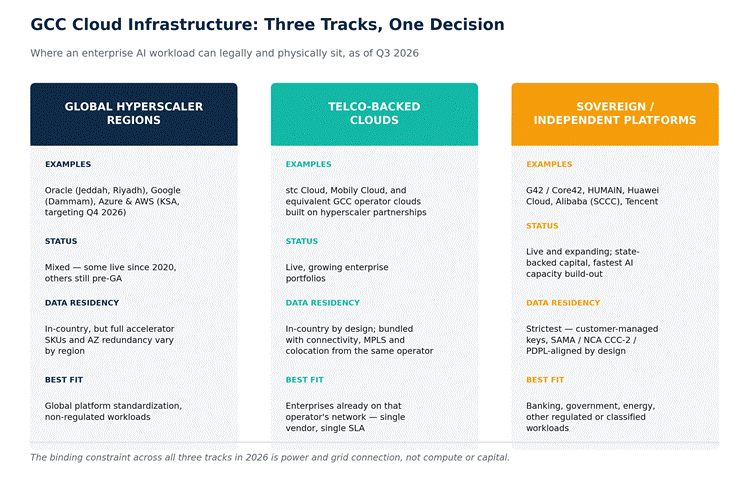
Figure 1: The three infrastructure tracks GCC enterprises choose between for AI workloads — now cross-referenced against the status table above.
The Real Constraint on GCC Cloud Providers: Power, Not Chips
The single most under-reported number in this market is capacity actually turned on versus capacity promised. A Q1 2026 audit found only 467MW operationalized across more than 60 Saudi facilities, against a 6.0–6.6GW target for 2030–2034 — a gap of 12.8 to 14.1 times. Independent research firm Madar Strategy audited 13 major Saudi and Emirati AI projects, representing roughly 4,000MW of public announcements, and found zero confirmed energized megawatts with public documentation — of seven headline projects, only one even defines its IT load explicitly, and none publishes a firm grid-connection point or energization date. Mehdi Paryavi, founder and CEO of the International Data Center Authority, put it directly: “Energy, not chips or capital, is the biggest constraint on AI growth.” The stc–HUMAIN joint venture, signed in December 2025, was extended rather than executed in June 2026, with regulatory and operational requirements still unmet. Large power transformers alone carry two-to-four-year lead times, and full grid delivery in constrained markets averages roughly four years — while a data hall itself can be built in 18 to 24 months. Near-term AI load, meanwhile, is running on gas: Saudi Arabia’s 2024 generation mix was 97.8% fossil fuel and 2.2% renewable (Madar Strategy project audit; IDCA; vision2030.ai reporting).
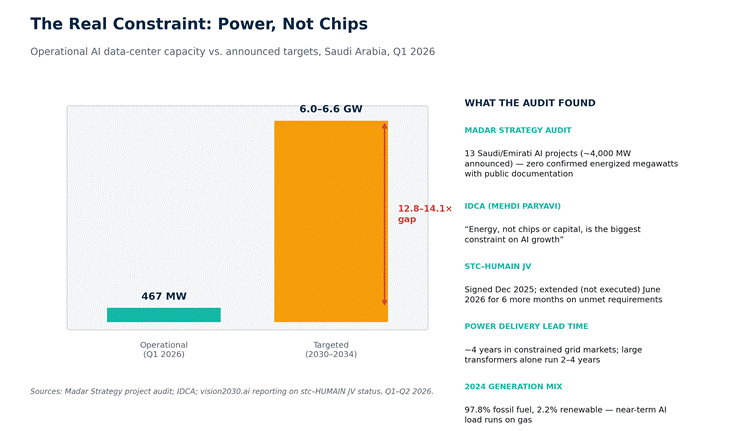
Figure 2: Saudi Arabia’s operational AI data-center capacity against its own announced targets, Q1 2026.
Building completes in 18–24 months. Securing the electrons to power it is running closer to four years. Every region-launch date in this market is downstream of that gap.
Kuwait: The GCC Cloud Providers Story Nobody Else Is Telling
For Kuwait market specifically, the practical picture is starker than the regional narrative suggests. Google Cloud announced a Kuwait region in January 2023, naming the Government of Kuwait and Alshaya Group as anchor beneficiaries (Google Cloud official blog); Microsoft announced an “AI-powered” Azure region for Kuwait in March 2025, bundled with a Technology Innovation Hub and Copilot rollout across government departments (Microsoft News Center EMEA; Data Center Dynamics). Neither announcement has been followed, as of this writing, by a disclosed launch date or investment figure — Data Center Dynamics’ own reporting states plainly that “details about timelines or an investment commitment… have not been shared by the company.”
That has not slowed the underlying market. Kuwait’s ICT sector is valued at USD 20.4 billion in 2025, projected to USD 34.37 billion by 2031 (9.08% CAGR), and cloud specifically is growing faster than the market overall at 14.05% CAGR, driven by a government Cloud-First Policy that requires ministries to prioritize cloud services. Kuwait’s regulator, CITRA, already governs licensed cloud providers with in-country data centers under its Cloud Computing Regulatory Framework (v2.4) (Mordor Intelligence, Kuwait ICT market report) — meaning the compliance apparatus for a local cloud sits ready, waiting on hyperscaler capacity that hasn’t been dated.
The practical implication: a Kuwait-based enterprise cannot build a 2026–2027 cloud strategy around “wait for Google or Microsoft’s Kuwait region,” because there is no public date to plan against. The workable options today are a live regional footprint elsewhere — Bahrain or the UAE for AWS, the UAE for Azure and Oracle, Dammam for Google — accepted with its latency and cross-border data-transfer implications, or an in-country telco/data-center option operating under CITRA’s existing framework. Whichever a given enterprise chooses, it is a decision to revisit the moment either vendor actually names a date, not a decision to defer until then.
What’s Actually Best for GCC Cloud Providers — By Enterprise Type
None of the three tracks is universally best. The honest answer depends on what the workload is, who regulates it, and what an enterprise already has under contract:
| Enterprise profile | Where the workload should sit today | Why |
| Regulated finance (banking, insurance) | Core/customer data: sovereign platform or in-country telco cloud. Non-regulated analytics: a live regional hyperscaler node under a data-transfer agreement. | UAE’s cloud market is already 21.6% BFSI by spend (Mordor Intelligence) — this model is proven at scale, but core ledgers still sit on the strictest residency tier. |
| Government / public sector | In-country telco cloud or an approved sovereign platform, today. Treat the Kuwait Google/Azure regions as a 2027+ migration path. | Neither Kuwait region has a disclosed launch date or investment figure as of this writing (Google: announced Jan 2023; Microsoft: announced Mar 2025) — a roadmap slide is not a procurement option. |
| Oil & gas, petrochemical, industrial | OT/SCADA and safety-critical systems stay on private/telco infrastructure with dedicated fiber. AI/analytics workloads move to a live hyperscaler region once data classification clears it. | This splits the workload by risk tier instead of forcing one platform decision for both — and avoids waiting on capacity that, per the Madar Strategy audit, has zero publicly documented energization yet. |
| Multinational subsidiary standardizing on HQ’s platform | Route through the nearest LIVE regional footprint (UAE for AWS/Azure/Oracle; Dammam for Google) rather than waiting on Saudi’s Nov/Dec 2026 launches or Kuwait’s undated ones. | UAE already concentrates 54.4% of cloud revenue across just four providers (AWS, Microsoft, Oracle, G42 — Mordor Intelligence), so global tooling and support are mature there now. |
| Digital-native / cost-sensitive scale-up | Whichever live hyperscaler has the most competitive published pricing and lowest latency to its customer base — usually AWS (Bahrain since 2019, UAE since 2022) or Azure (UAE, Qatar). | These are the most “battle-tested” regional footprints in the GCC — no pending-capacity risk, no undisclosed timeline. |
| Already contracted with a telecom operator for connectivity | Telco-backed cloud (e.g. stc Cloud via Center3, partnered with Oracle) under one bundled SLA. | One vendor, one contract, one throat to choke when something breaks — worth more than a marginally better GPU SKU elsewhere for enterprises without multi-cloud operational muscle. |
The Honest Summary
The 84%-adoption, 11%-value-realization gap McKinsey documents across the GCC isn’t primarily a model-selection problem — most organizations can stand up a pilot. It’s an infrastructure-and-governance problem, and cloud placement is the first structural decision inside it. Get the workload onto the wrong track — or defer the decision waiting for a region with no announced date — and every downstream investment in MLOps, data governance and change management inherits that mistake.
Which of these tracks is your organization actually building on right now — and does that decision survive contact with what’s live today, or was it made against a roadmap slide?