

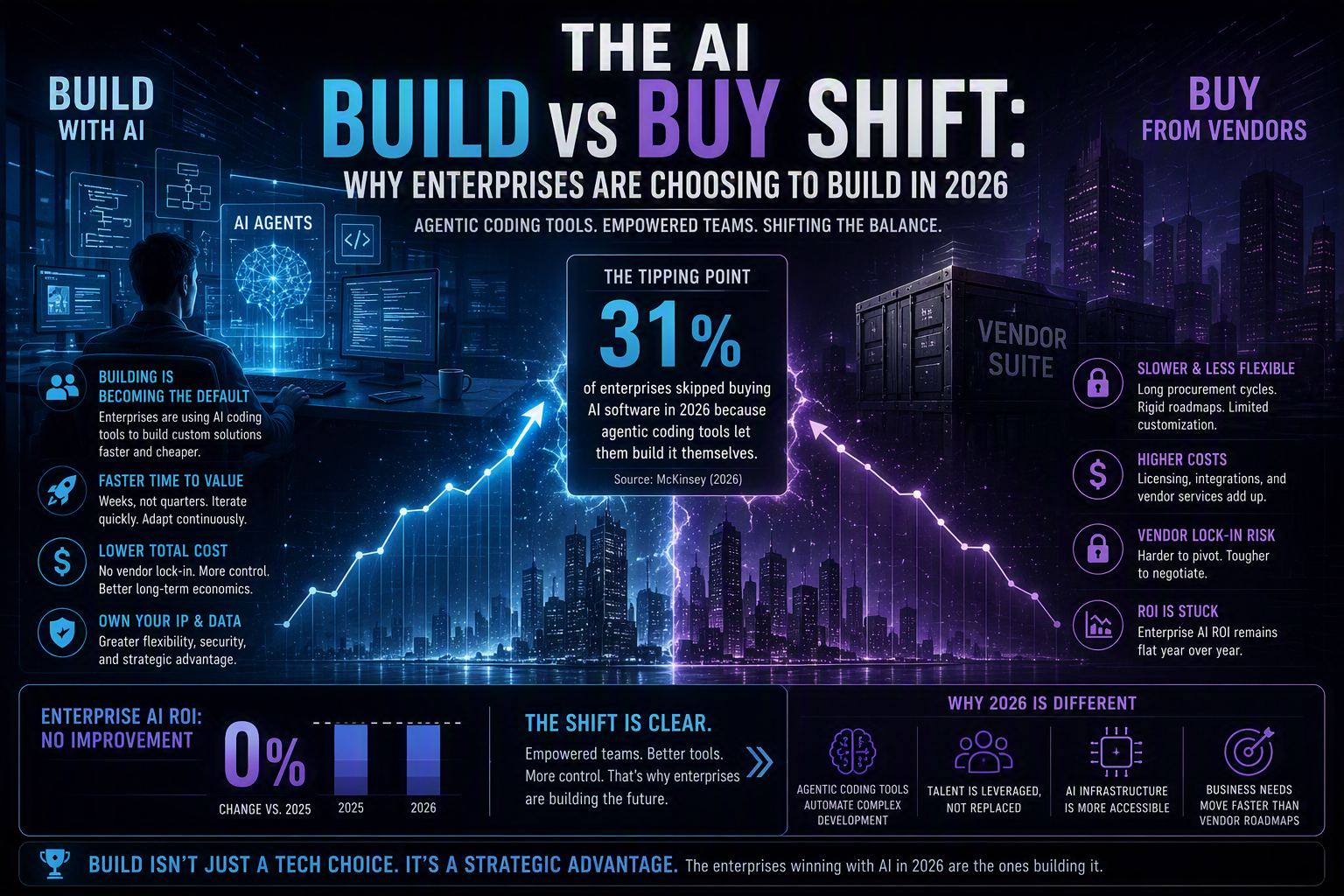
The AI build vs buy decision that CIOs have wrestled with for two decades just tipped, and McKinsey’s newest survey puts a hard number on how far it moved: nearly a third of enterprises skipped buying AI software this year because agentic coding tools let them build it themselves instead. That is not a rounding error. It is a structural shift in how large organizations deal with AI vendors, and it is happening at the exact same moment enterprise AI’s return on investment is stuck exactly where it was a year ago.
“32% of enterprises skipped buying AI software this year — not because budgets were cut, but because agentic coding tools made building it themselves the cheaper option.”
That single data point, buried in McKinsey’s August 2026 State of AI survey, deserves more attention than it has gotten. It reframes what “enterprise AI adoption” actually means going into 2027 — and it has direct implications for telecom operators, who have been running their own build vs buy experiment for longer than almost any other industry.
The AI Build vs Buy Numbers, from McKinsey’s Own Survey
McKinsey fielded its latest Global Survey on AI between May 4 and June 8, 2026, drawing 1,719 respondents across 97 countries, and published the results on August 25. Two findings sit side by side and, read together, tell the real story.
The first is the build surge. Forty percent of companies with $1 billion or more in annual revenue are now scaling AI agents in production, up from 27% in the prior survey — a 13-point jump in roughly a year. Of those organizations, 32% say they skipped purchasing software this year specifically because agentic coding tools let their own teams build the equivalent capability in-house, faster and cheaper than a procurement cycle would have delivered it.
The second is the profit gap that has not moved. Eighty percent of AI users report individual productivity gains, but only 37% of organizations report any enterprise-wide EBIT impact — unchanged from 2025. Just 6% qualify as “high performers” attributing 5% or more of EBIT to AI, also flat year over year. Twenty percent now cite AI operating costs as an active constraint on further deployment.
The build surge and the profit gap are happening at the same time — which is exactly the point. Enterprises are not building more AI because the ROI case suddenly got stronger. They are building more because building got cheaper, and that is a very different signal for a CIO to act on than a genuine profitability breakthrough.
Why Now: Agentic Coding Tools Changed the Math
Build vs buy has always been a cost-and-speed calculation, not a philosophical one. What changed in 2026 is the denominator: agentic coding tools compress the time and headcount needed to stand up a working internal tool from months to days, which is precisely the range where “just build it” starts beating a vendor contract, an integration project, and a renewal negotiation.
That is also why the topic has quietly become one of the most-written-about enterprise IT questions of the second half of 2026 — procurement teams, CIOs, and software vendors are all reacting to the same underlying shift at once. The risk sitting underneath the enthusiasm is what some governance researchers call “shadow AI”: business units standing up their own agents outside IT’s visibility, with no owner accountable for security patching, model updates, or what happens when the one engineer who built it leaves.
A cheap build today is only cheap until someone has to maintain it in year two.
The Telecom Angle: An Industry That Never Fully Bought Anyway
Telecom operators are a useful preview of where the rest of the enterprise world is headed, because the sector has built its own OSS/BSS stacks, network management systems, and automation logic in-house for decades. The network has always been treated as the competitive differentiator, not a line item to outsource — which is exactly the logic now spreading into the rest of the enterprise.
NVIDIA’s State of AI in Telecom 2026 survey shows the pattern accelerating industry-wide: 89% of telcos plan to increase AI spending in 2026, up from 65% a year earlier, and 35% expect budget growth above 10%. The leading return-on-investment use case is not customer service or back-office automation — it is autonomous network operations, cited by 50% of operators, with 65% already reporting AI-driven network automation in production and 77% expecting AI-native networks before commercial 6G arrives. Eighty-eight percent say they are already operating at TM Forum autonomy levels 1 through 3. Notably, 89% say open-source models and software are important to their AI strategy — a build-leaning signal in its own right — and 90% report that AI is already increasing revenue and reducing cost.
Telecom operators have spent decades building network management in-house because the network is the competitive moat, not a vendor line item. The rest of the enterprise world is only now discovering that the same logic applies to AI.
The Gulf’s Own AI Build vs Buy Moment
The build vs buy question is not confined to enterprise IT departments — it is playing out at the level of national AI strategy across the Gulf. Accenture’s regional data and AI lead, Abir Habbal, made the case in early September, drawing on the firm’s study “Architecting Sovereign AI in the Middle East,” covering Saudi Arabia, the UAE, and Qatar: after roughly $15 billion in AI investment announced at Riyadh’s LEAP conference, the region’s own build vs buy inflection point is now the application layer, not the infrastructure underneath it.
The survey of 185 executives found 60% describe their country’s AI sovereignty approach as “highly sovereign,” yet 62% admit local sovereign offerings still lag global hyperscalers — an honest gap between build ambition and build capability. More telling: only 7% of respondents pursue sovereign AI for monetization, versus 62% pursuing it for regulatory compliance, and just 10% have elevated AI sovereignty to a CEO or board-level priority. National champions like Humain (backed by Saudi Arabia’s Public Investment Fund) and G42 (backed by Abu Dhabi’s Mubadala) are the region’s most visible builds so far.
“The part that’s going to drive your AI economy is the application side, because this is where you allow it to impact every sector,” Habbal said — the same build-not-just-infrastructure argument McKinsey’s enterprise data is making from the opposite direction.
For enterprise and public-sector leaders in Kuwait and across the GCC, the practical read is this: the region is still largely buying its AI infrastructure from global hyperscalers while beginning to build its own application layer on top of it. That is a more defensible build vs buy split than trying to build everything, and it is worth stating deliberately rather than drifting into it.
The Risk Nobody’s Pricing In
None of this is an argument against building. It is an argument against building by default, without asking who owns the thing three years from now. Gartner and other governance researchers have already flagged a wave of agentic AI pilots being quietly cancelled or demoted once the initial build enthusiasm meets the reality of maintenance, security patching, and model drift — a pattern that hits homegrown builds harder than purchased software, because there is no vendor SLA to fall back on when it breaks.
The build vs buy decision that matters is not “can our team build this in a week,” it is “who owns this, and are they still here, in three years.”
What This Means for Enterprise and Telecom Leaders
Three questions cut through most build vs buy debates faster than a vendor comparison spreadsheet: Is this capability a genuine competitive differentiator or a commodity function every competitor will eventually have too? Does the organization have the engineering bench to own multi-year maintenance, not just the initial build sprint? And what is the honest total cost of ownership — patching, model updates, security reviews, key-person risk — against a vendor’s roadmap and contractual SLA?
Telecom operators already answer the first question correctly by instinct: the network is core, so it gets built. Enterprises now applying that same instinct to every AI use case, without asking the other two questions, are the ones most likely to show up in next year’s survey as the AI operating-cost constraint statistic instead of the productivity one.
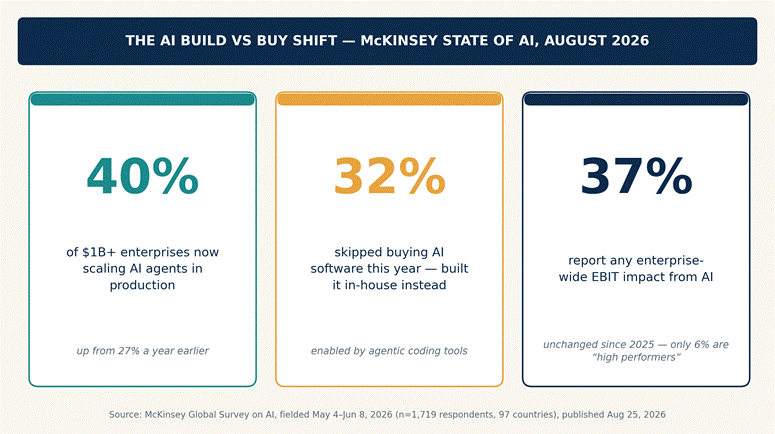
Figure 1: The build vs buy shift in McKinsey’s August 2026 State of AI survey — the agent-scaling surge and the flat EBIT line, side by side.
As agentic coding tools keep dropping the cost of building AI in-house, the real question for every enterprise and telecom leader is not whether you can build it — it is whether you should, and whether you are prepared to own it for the next three years. Which side of that build vs buy line is your organization actually on, and did you choose it deliberately?
Sources
McKinsey & Company, “The State of AI: Global Survey,” fielded May 4–Jun 8 2026, published Aug 25, 2026 (n=1,719, 97 countries).
NVIDIA, “State of AI in Telecommunications 2026 Survey Report.”
Accenture, “Architecting Sovereign AI in the Middle East” (Saudi Arabia, UAE, Qatar), via AGBI, September 2026.