

Two ideas are converging fast enough that most organizations haven’t updated their org charts or budgets to reflect the rise of digital employees.
Digital employees are moving from concept to headcount
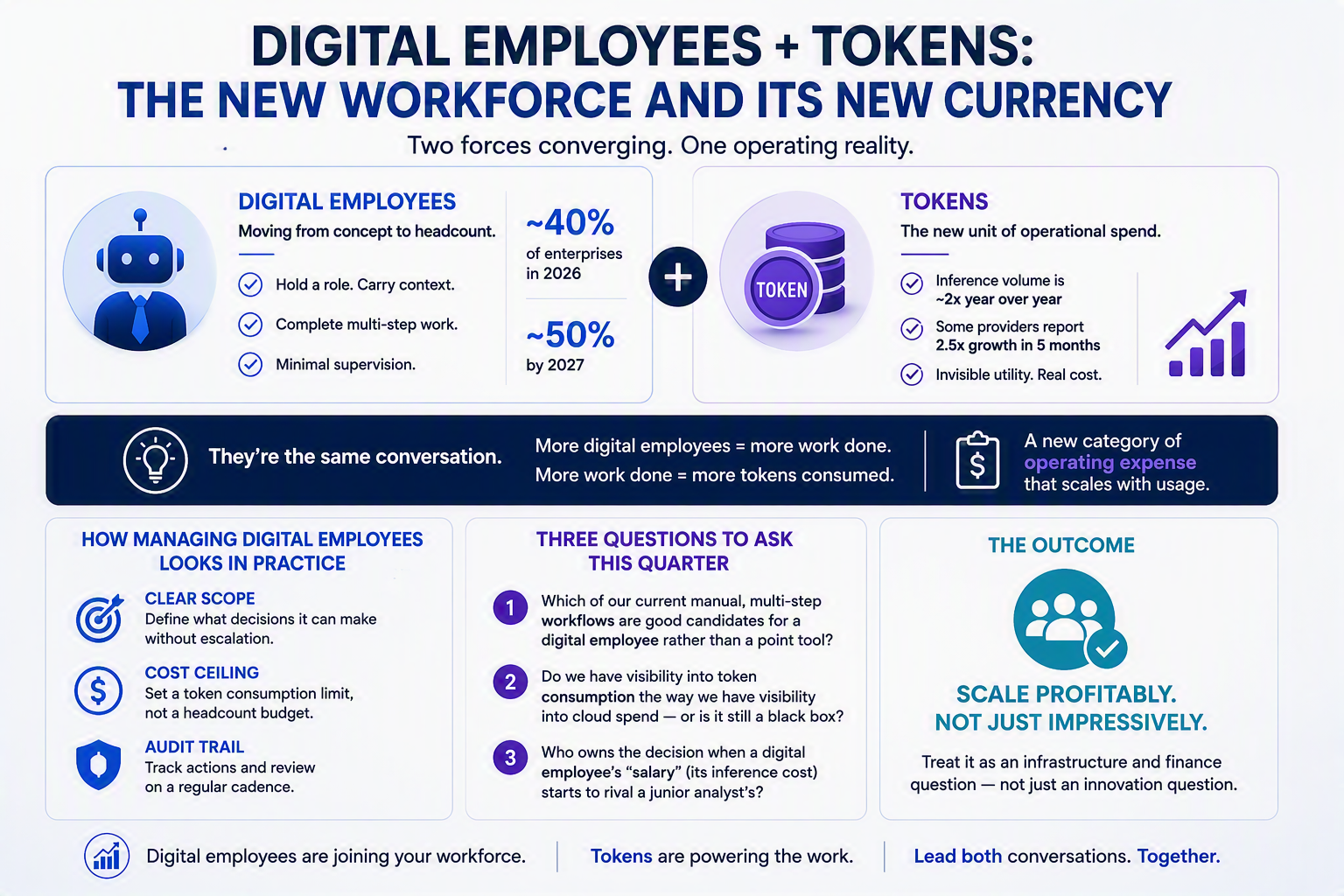
Not chatbots that answer questions when prompted — systems that hold a role, carry context across a workday, and complete multi-step work with minimal supervision. Recent industry projections put agent adoption at roughly 40% of enterprises in 2026, climbing toward 50% by 2027. That is not a pilot-program statistic. That is a workforce-planning statistic, and it means digital employees are quietly becoming a line item that finance, HR, and IT all need to own together rather than separately.
The second half of the equation: tokens are becoming the new unit of operational spend
Industry-wide inference volume is estimated to have roughly doubled year over year — from single-digit billions of tokens processed per minute to figures more than double that — with some individual providers reporting 2.5x growth in as little as five months. Tokens are quietly becoming what kilowatt-hours were to the industrial economy: an invisible utility cost that scales directly with how much work your systems are doing, whether anyone in finance is tracking it yet or not.
Why leaders should care about both at once
The mistake most organizations make is treating “hire more digital employees” and “watch the token bill” as separate conversations — one for the innovation team, one for procurement. They are the same conversation. A digital employee that acts on your behalf isn’t just a productivity gain; it’s a new category of operating expense with its own consumption curve, one that scales with usage in a way headcount never did.
What managing digital employees actually looks like in practice
Unlike a human hire, a digital employee doesn’t come with a fixed salary, a single manager, or a performance review cycle anyone’s built yet. In practice, managing one well requires three things: a clear scope of what decisions it’s allowed to make without escalation, a cost ceiling tied to token consumption rather than headcount budget, and an audit trail of its actions that someone actually reviews on a schedule. Organizations skipping straight to deployment without these three guardrails tend to discover the gaps only after a digital employee has already made an expensive mistake or run up an inference bill nobody budgeted for.
Three questions worth asking this quarter
- Which of our current manual, multi-step workflows are good candidates for a digital employee rather than a point tool?
- Do we have visibility into token consumption the way we have visibility into cloud spend — or is it still a black box?
- Who owns the decision when a digital employee’s “salary” (its inference cost) starts to rival a junior analyst’s?
The organizations treating this as an infrastructure and finance question — not just an innovation question — will be the ones who scale digital employees profitably instead of just impressively.