

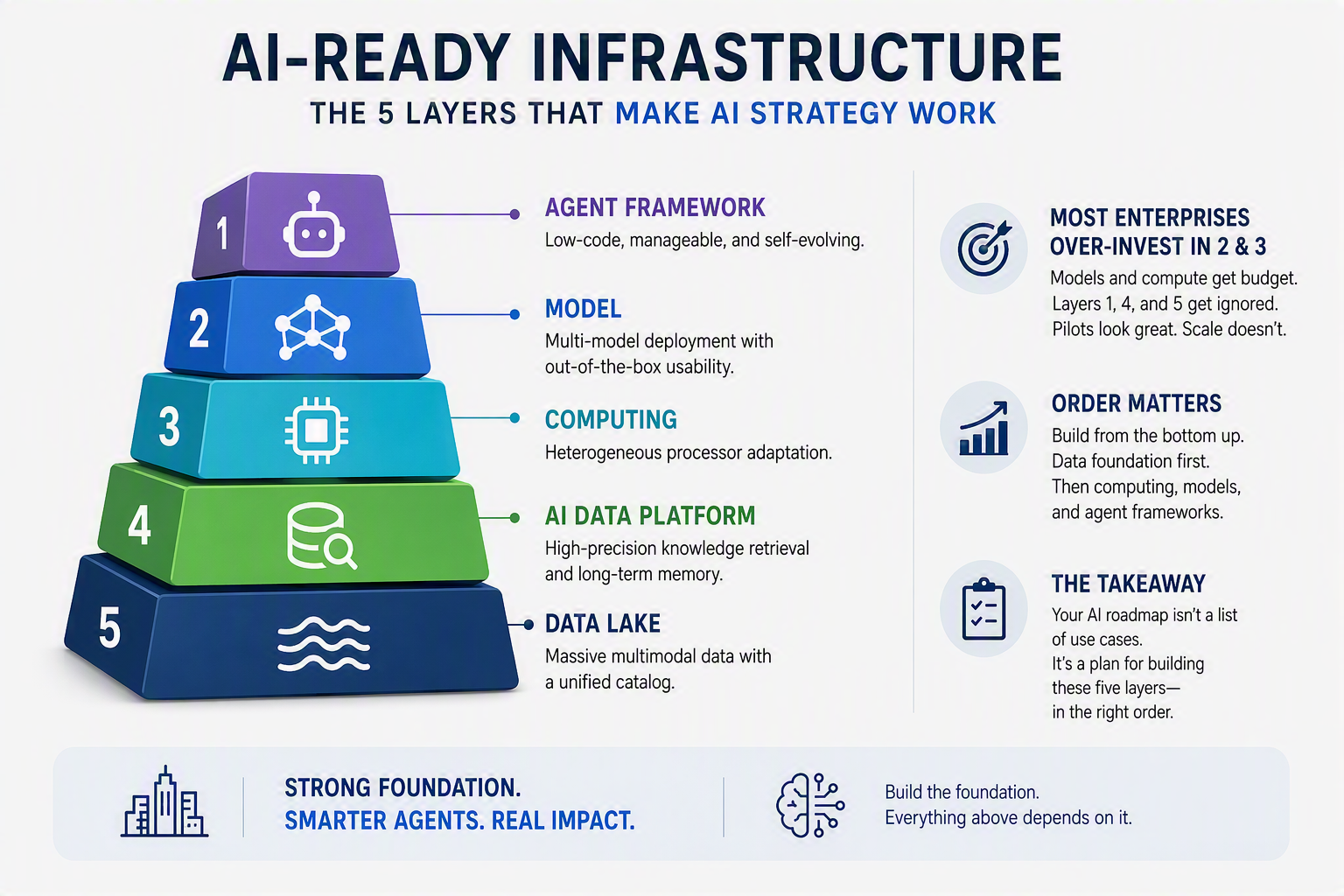
Every enterprise AI strategy eventually runs into the same wall: the model isn’t the hard part anymore. AI-ready infrastructure underneath it is. A useful mental model breaks that infrastructure into five layers, each solving a different bottleneck.
What AI-ready infrastructure actually consists of
- Agent Framework — low-code, manageable, and self-evolving. The layer that lets agents be built and adjusted without a six-month engineering cycle for every new use case.
- Model — multi-model deployment with out-of-the-box usability. Not betting the company on one model provider, but being able to route work to whichever model fits the task and swap providers without rearchitecting.
- Computing — heterogeneous processor adaptation. The ability to run workloads across mixed hardware rather than being locked into a single chip vendor’s roadmap.
- AI Data Platform — high-precision knowledge retrieval and long-term memory. This is what stops an agent from “forgetting” everything between sessions and re-solving the same problem twice.
- Data Lake — massive multimodal data with a unified catalog. The unglamorous foundation layer that determines whether everything above it actually works at scale.
Where most enterprises actually are
Most organizations have invested seriously in layers 2 and 3 — they’ve picked models and bought compute. Far fewer have built real AI-ready infrastructure at layers 1, 4, and 5. That’s the gap that turns an impressive pilot into a system that quietly stalls at 20% deployment: the agent framework isn’t manageable, the data platform has no memory, and the data lake is really just a set of disconnected silos wearing a new label.
Why the order of investment matters
Building these five layers in the wrong order is as costly as skipping one entirely. Enterprises that buy compute and pick a model before they’ve built the data platform end up with fast infrastructure that has nothing reliable to retrieve from — the equivalent of a powerful engine bolted to an empty fuel tank. The more durable sequence starts at the bottom: get the data lake and the data platform functioning first, since every layer above depends on what those two can supply, then layer computing, models, and agent frameworks on top once the foundation can actually support them.
The practical takeaway
If your organization’s AI roadmap is a list of use cases, it’s incomplete. The list that actually predicts success is a list of which of these five layers of AI-ready infrastructure you’ve built, in what order, and who owns each one. Skipping straight to “deploy agents” without the data and memory layers underneath is the single most common reason enterprise AI initiatives look great in a demo and disappoint in production.