

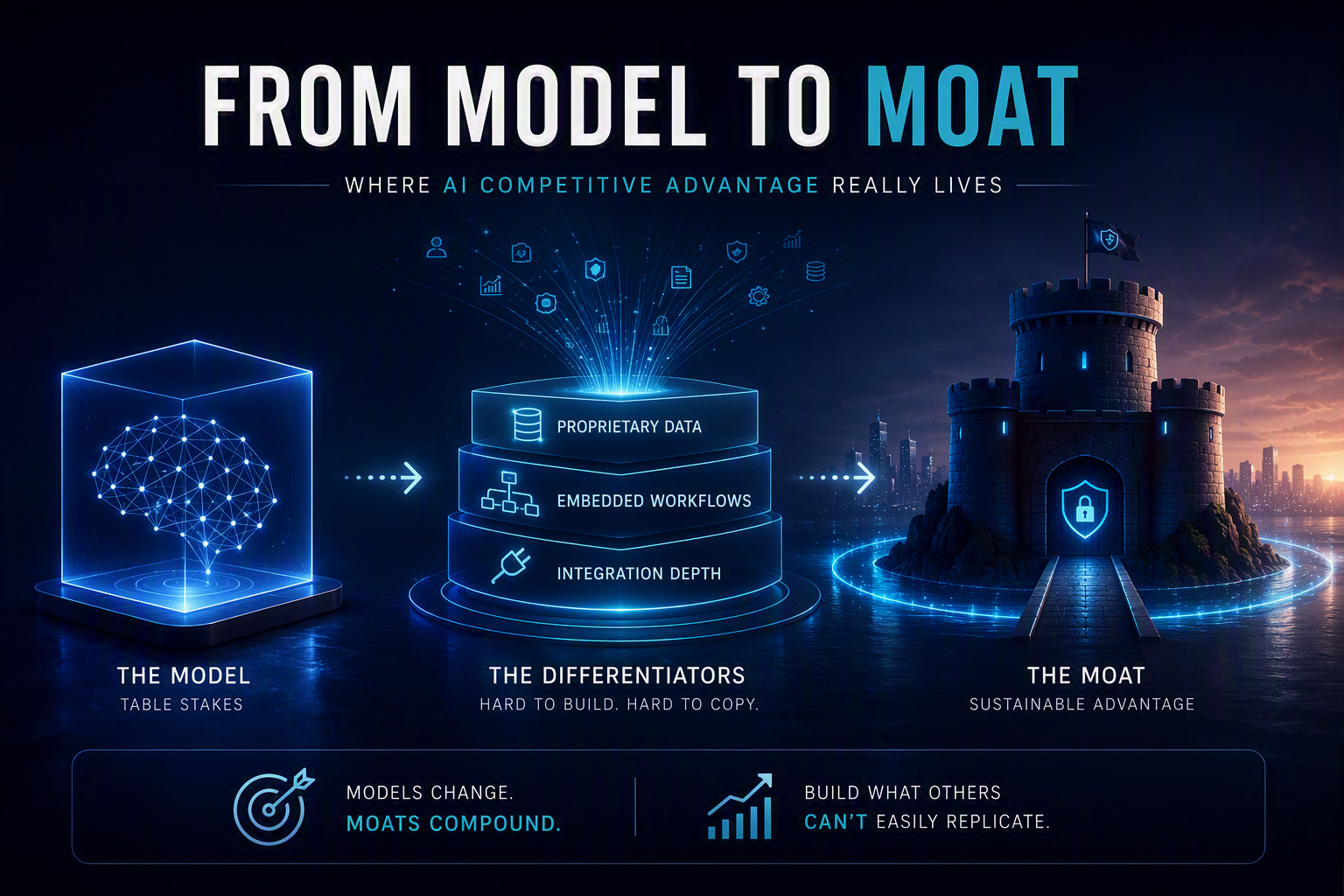
AI competitive advantage almost never lives in the model itself, no matter how much of the current strategy conversation centers on which one to license. Ask most executives what their organization’s AI strategy is, and the answer is usually a model name — which foundation model they’ve licensed, which one they’re evaluating, which one a competitor just announced a partnership with. It’s a natural place to focus, but it’s also increasingly the wrong one. Real advantage lives in everything built around the model, and that distinction is starting to separate the enterprises actually winning with AI from the ones that have simply adopted it.
Why the model stopped being the differentiator
Foundation models are converging in capability faster than most procurement cycles can keep up with, and they’re broadly available to any organization with a budget and an API key. If a competitor can license the same model an enterprise just spent a year integrating, the model was never the moat — it was table stakes. This isn’t a criticism of any particular model; it’s simply what happens when a capability commoditizes. The advantage moves elsewhere, the same way it did with cloud computing, and before that, with the internet itself.
Where the real advantage moves
Three places consistently show up in organizations that are actually pulling ahead with AI, rather than just deploying it:
- Proprietary data. Not data volume for its own sake, but data that reflects an organization’s specific customers, specific operations, and specific history — the kind no competitor can license or replicate, because it was generated by years of doing the work. A generic model fine-tuned on this kind of data behaves nothing like the same model running generic.
- Embedded workflows. AI that’s stitched into how work actually gets done — inside the CRM, inside the claims system, inside the network operations dashboard — beats AI that lives in a separate chat window employees have to remember to open. The advantage isn’t the intelligence; it’s the fact that nobody has to go looking for it.
- Integration depth. How tightly AI capability connects to existing systems, existing data pipelines, and existing decision rights determines whether it produces action or just produces suggestions someone still has to manually implement. Depth of integration is slow to build and even slower to copy — which is exactly what makes it defensible.
The strategic implication
This reframes what an AI strategy document should actually be arguing for. A strategy built around “which model should we standardize on” is optimizing for a decision that won’t matter in eighteen months, once the current model generation is superseded by the next one. A strategy built around “how do we make our proprietary data, our workflows, and our integration depth harder to replicate” is optimizing for something that compounds — and that a competitor licensing the identical model still can’t easily copy.
What this means in practice
Enterprises that get this right tend to spend disproportionately less time in model-selection committees and disproportionately more time on data governance, workflow redesign, and systems integration — the unglamorous work that never makes it into a vendor demo but is exactly what determines whether AI becomes a durable advantage or an expensive subscription that a competitor can match by next quarter.
How to tell which side of the line your organization is on
A quick diagnostic: pull up the last three AI project proposals your organization approved. If most of the discussion in those documents centers on model selection, benchmark comparisons, and vendor evaluation, the strategy is currently optimizing for a commodity. If most of the discussion centers on which proprietary data sources feed the system, which existing workflows it plugs into, and how deeply it’s wired into decision-making processes, the strategy is building toward genuine AI competitive advantage.
Neither approach is inherently wrong at the start — every AI initiative begins with a model choice, and that choice matters operationally. But the organizations pulling ahead treat model selection as a solved problem to move past quickly, not the centerpiece of the strategy. The real work, and the real moat, starts on the other side of that decision.
When your organization talks about its AI strategy, how much of that conversation is actually about the model — versus about the data, workflows, and integration decisions no competitor can simply copy?