

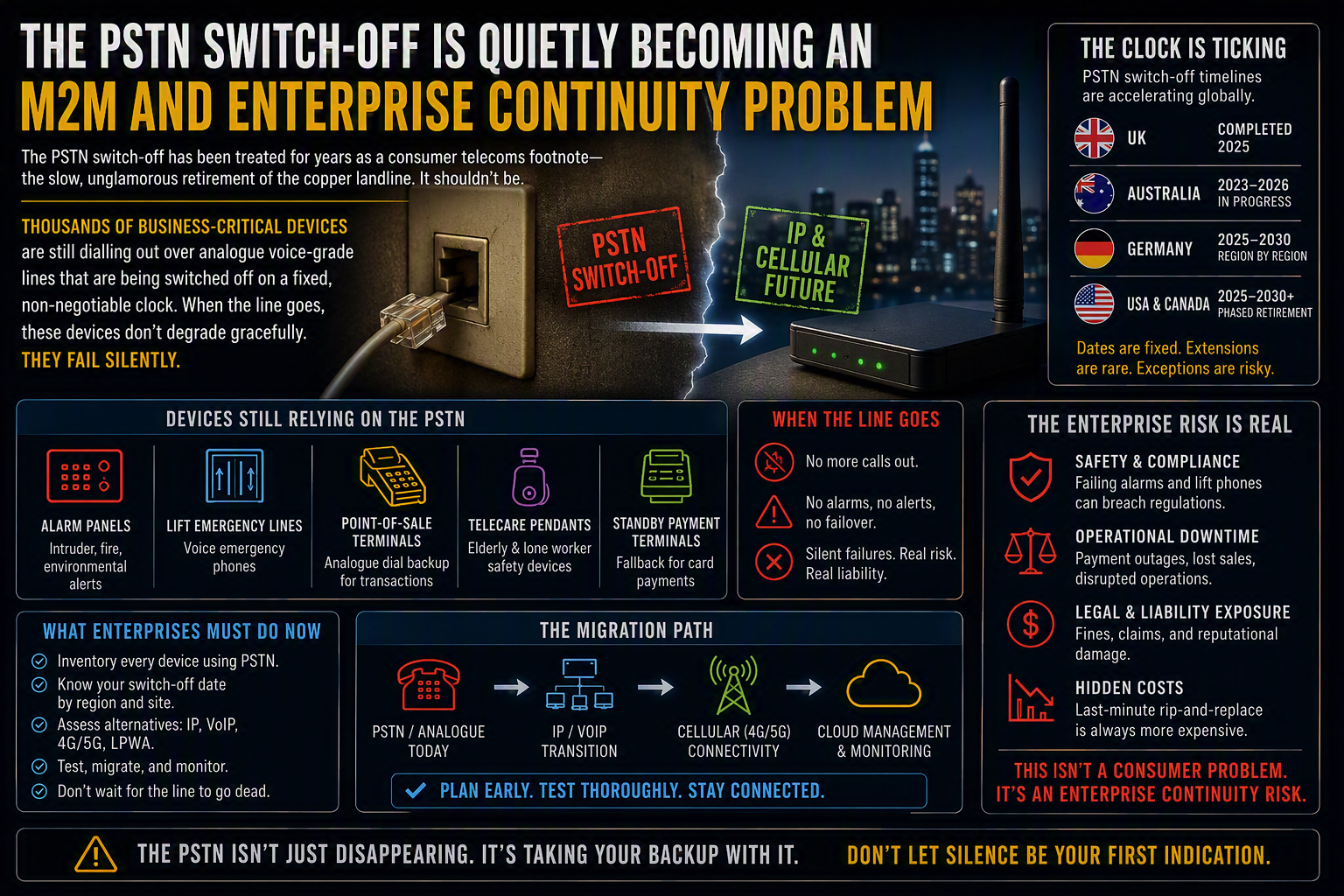
The PSTN switch-off has been treated for years as a consumer telecoms footnote — the slow, unglamorous retirement of the copper landline. It shouldn’t be. Buried inside that migration is a much sharper problem for enterprises: thousands of business-critical devices — alarm panels, lift emergency lines, point-of-sale terminals, telecare pendants, standby payment terminals — are still dialling out over analogue voice-grade lines that are being switched off on a fixed, non-negotiable clock. When the line goes, these devices don’t degrade gracefully. They fail silently.
This is not a 5G story, an AI story, or a subsea cable story. It’s a plumbing story — and plumbing stories are exactly the ones that get missed until something breaks.
The clock is already ticking, and it’s moving fast
In the UK, Openreach’s own numbers show how quickly the base is emptying. Active PSTN connections fell from roughly 5.2 million in July 2024 to 3.2 million in July 2025 — a drop of two million lines in a single year, according to the House of Commons Library’s research briefing on the digital landline switchover. The original 31 December 2025 deadline for a full switch-off was pushed back twice, largely over concerns about vulnerable customers and power-cut resilience, but Openreach has now positioned 31 January 2027 as locked in.
“Any alarm panel or CCTV system still dialling out over PSTN will go silent” once the infrastructure goes dark — and it typically fails silently, showing a fault indicator at best, with no obvious warning that monitoring has actually stopped.
That single sentence is the crux of the enterprise risk: no dramatic outage, no alert storm — just quiet, undetected loss of coverage.
The UK isn’t switching this off alone
What makes this worth writing about now, rather than treating it as a UK regulatory quirk, is that three separate clocks are running at once across three major markets:
United Kingdom — PSTN and ISDN connections are mandated to cease entirely by January 2027. As of the most recent count, 1,281 telephone exchanges covering 12.5 million premises — over half of all UK exchanges — have already entered “stop-sell,” meaning no new analogue or ISDN service can be ordered on those exchanges at all.
United States — The FCC adopted an order in March 2026 that grants carriers blanket authority to grandfather (stop offering to new customers) legacy copper voice and low-speed broadband services, and streamlines the network-change filings needed to retire copper outright. AT&T’s COO has publicly stated the company already has approval to stop selling new service at 85% of its more than 5,000 wirecenters, with roughly 30% cleared for full shutdown, targeting completion by the end of 2029.
European Union — A leaked draft of the EU’s Digital Networks Act reportedly resets the bloc-wide copper switch-off target to 2035, on a “mandatory but conditional” basis — five years later than an earlier proposal, reflecting how unevenly individual member states are progressing.
None of these dates line up, and that’s the point. A multinational enterprise with sites in London, Chicago, and Frankfurt is not managing one migration deadline — it’s managing at least three, on three different regulatory tracks, with three different definitions of “done.”
Why this lands squarely on M2M and enterprise voice, not just residential lines
The consumer framing of this story — will grandma’s landline still work — has obscured how much business infrastructure quietly rides the same copper. Categories exposed include:
Intruder and fire alarm signalling to monitoring stations, which in the UK must meet EN 50136 transmission-path standards and are now being pushed toward IP-based or cellular-failover signalling; lift emergency communication lines, a compliance requirement in most jurisdictions; point-of-sale and payment terminals in smaller retail and hospitality sites that still use dial-back or PSTN backup for card authorisation; telecare and fall-alarm pendants, which UK government officials flagged as a “serious incident” concern as far back as December 2023; and standalone EV charge points, barrier systems, and remote metering units that were provisioned years ago on the cheapest available line — analogue voice.
Underlying infrastructure reliability is also working against businesses that delay: UK PSTN network incidents rose 20% in 2023, with customer hours lost climbing 60% in the same period, as operators visibly deprioritise maintenance on a network they’re actively retiring. Waiting is not a neutral option — it’s a bet that a decaying network holds up until you get around to migrating.
The bottleneck nobody is pricing in: capacity, not technology
The migration paths are well understood and not technically difficult in isolation — IP-based alarm signalling over broadband, cellular (4G/5G) primary or failover connectivity, SIP trunking replacing ISDN for enterprise voice. The problem is scale and timing. Industry estimates suggest peak migration demand will hit in 2026, as the volume of UK businesses needing certified installers to re-terminate alarm panels, re-provision voice, and validate compliance (BS EN50131 grading, EN 50136) collides with a finite pool of qualified engineers. Large multi-site estates are being told to plan on a minimum six-month lead time — and that estimate predates the crunch actually materialising.
Chart 1 shows how far the UK base has already fallen — and how much runway is left before the January 2027 deadline forces the rest.
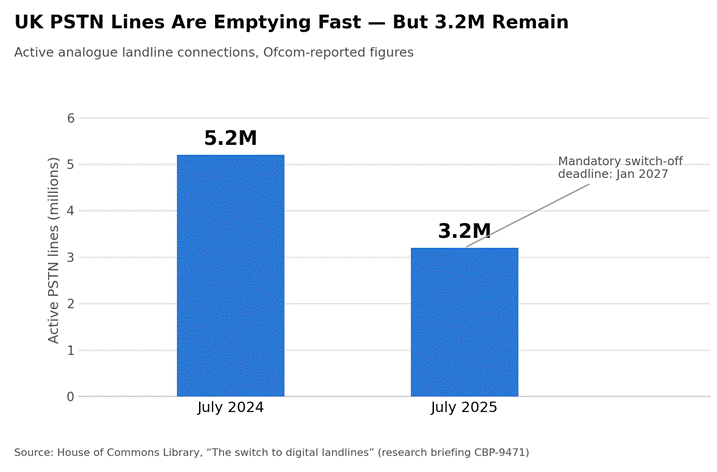
Figure 1. UK active PSTN lines, July 2024 vs. July 2025. Source: House of Commons Library (CBP-9471).
Chart 2 lays the three regulatory clocks side by side. The UK deadline is the nearest and firmest; the US shutdown is carrier-paced and extends toward the end of the decade; the EU has just bought itself until the mid-2030s.
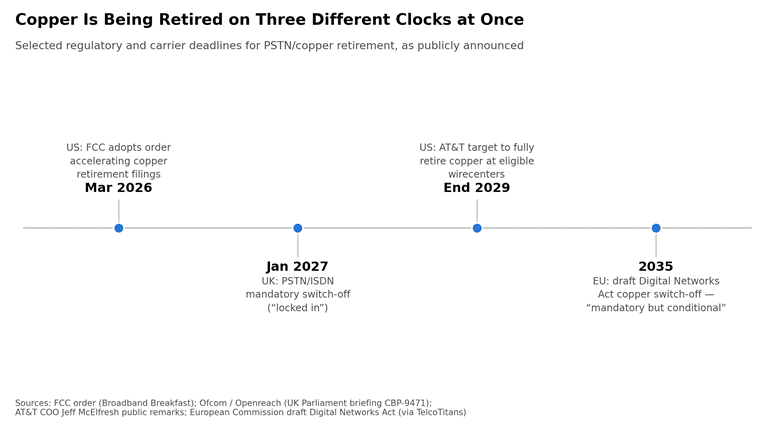
Figure 2. Selected regulatory and carrier deadlines for PSTN/copper retirement. Sources: FCC order (Broadband Breakfast); UK Parliament briefing CBP-9471; AT&T public remarks; European Commission draft Digital Networks Act (via TelcoTitans).
The liability question enterprises aren’t asking yet
A monitored alarm system that stops transmitting without triggering a visible fault is not just an operational nuisance — it’s a duty-of-care and insurance question. If a fire panel’s signalling path silently died six months before an incident because the site was still on an unmigrated PSTN line, the resulting exposure sits with facilities, security, and compliance teams who may not even know their monitoring vendor’s signalling technology depends on a network the operator has already scheduled for shutdown. The US order’s own comment record makes the same point from a consumer-protection angle: Public Knowledge’s Harold Feld warned the FCC’s order “puts people at risk,” cautioning that service quality could degrade for customers left on the copper network as investment stops flowing to it well before the final cutoff.
For enterprises running distributed estates — retail chains, logistics sites, facilities portfolios — the practical task is not glamorous, but it is urgent: inventory every device still dependent on an analogue or ISDN circuit, cross-reference it against the local regulatory and carrier deadline, and get in the queue for IP or cellular migration before 2026’s installer bottleneck becomes 2027’s compliance gap.
The underrated takeaway
Telecom coverage in 2026 is dominated by AI-RAN, subsea capacity, and 5G Standalone rollouts — all real, all important, and all well covered. The PSTN switch-off gets a fraction of that attention because it looks like housekeeping. But housekeeping that ends with silent alarm failures, stranded telecare pendants, and undocumented compliance gaps across thousands of enterprise sites is not a minor story — it’s a B2B connectivity and voice continuity issue hiding in plain sight.
Has your organisation actually inventoried which of its sites are still riding analogue lines — or is that a discovery still waiting to happen?
Sources: House of Commons Library, “The switch to digital landlines” (research briefing CBP-9471); AddSecure, “Alarm signalling after the PSTN switch-off”; Broadband Breakfast, “FCC Adopts Copper Retirement, Call Center Onshoring Orders”; TelcoTitans, “EU resetting copper switch-off to ‘mandatory but conditional’ 2035”; Wikipedia, “Telephony copper plant retirement in the United Kingdom.”