

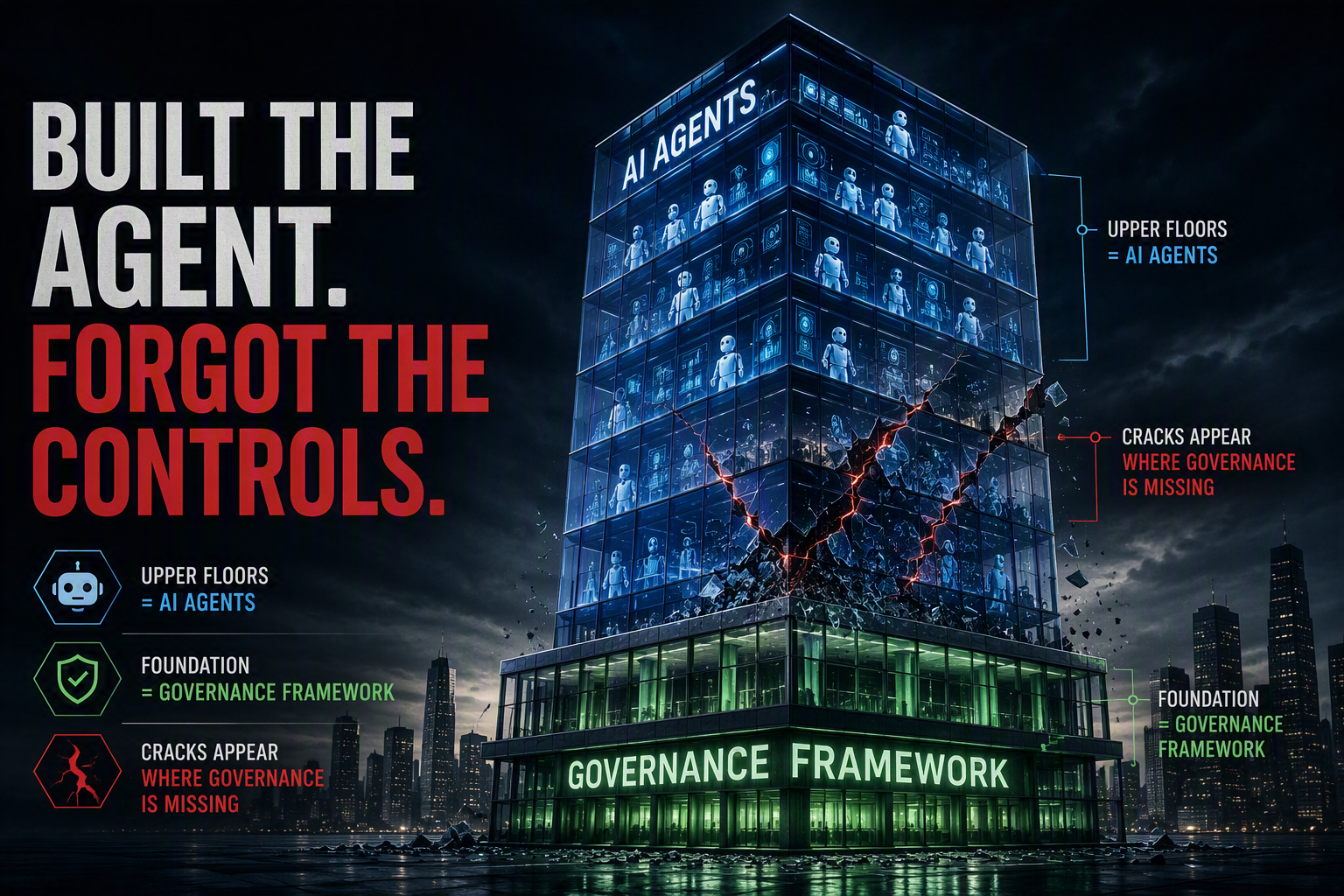
Agentic AI governance has quietly become the single biggest predictor of which enterprise AI agent projects survive past 2026 — and which get switched off. Not the model. Not the use case. Not even the budget. Gartner now expects more than 40% of agentic AI projects to be canceled outright by 2027, and a further 40% of the agents that do reach production to be demoted or decommissioned once governance gaps surface after deployment. Two different failure modes, one common root cause: enterprises built the agent before they built the controls around it.
By 2027, Gartner expects more than 40% of agentic AI projects to be canceled outright — and a further 40% of deployed agents demoted or shut down once governance gaps surface in production.
For business leaders, that is not a technology story. It is a program-management story. The agents themselves are, by most accounts, doing what they were built to do. What is failing is the layer around them: who approved what an agent is allowed to touch, how that scope is enforced, and how quickly it can be revoked when something goes wrong. Enterprises that treat that layer as an afterthought are the ones showing up in Gartner’s cancellation numbers.
Momentum Is Outrunning Readiness
The adoption curve explains why governance is under strain. By Gartner’s count, only about 17% of enterprises have actually deployed an AI agent into a live production process today — but more than 60% expect to have one running within two years. That is a fourfold jump in deployed agents, arriving faster than most enterprise governance, security, and audit functions can realistically absorb it.
The spending pattern tells the same story from a different angle. Sector research from IHL Group puts average AI-related spending growth at 27% year-over-year in retail alone, with organizations now naming system integration and data-quality gaps — not model selection — as their top blockers heading into next year. The pattern generalizes well beyond retail: budgets for agent pilots are being approved faster than the data foundations, access controls, and monitoring those agents will eventually need.
Only about 17% of enterprises have deployed an AI agent into production today; more than 60% plan to within two years. Governance maturity is not growing at the same rate.
Why Agentic AI Governance Is the Real Bottleneck
In May 2026, Gartner sharpened its warning considerably. Shiva Varma, Senior Director Analyst at Gartner, identified the specific mechanism behind the failures: enterprises are treating agent governance as a binary choice — either an agent is completely restricted, or it is fully trusted.
Agents operate at different autonomy levels and across different trust boundaries. When the same controls are applied indiscriminately, organizations encounter two common failure modes: over-restriction of simple agents, which slows delivery and drives shadow development, or under-restriction of more autonomous agents, which increases operational, security and compliance risk.
— Shiva Varma, Senior Director Analyst, Gartner
The root cause Gartner identifies is precise: most organizations conflate what an agent is technically capable of doing with what scope of access it has actually been granted. A model capable of rewriting a customer’s billing record is not the same risk as a model that has been scoped, permissioned, and monitored to only ever draft that change for a human to approve. Capability is a model property; scope is a governance decision — and enterprises that don’t separate the two end up either throttling harmless agents into uselessness or leaving powerful ones unsupervised.
Gartner’s proposed fix is proportional governance: classifying every agent into one of four autonomy levels and applying controls sized to each one, rather than one policy for the whole fleet.
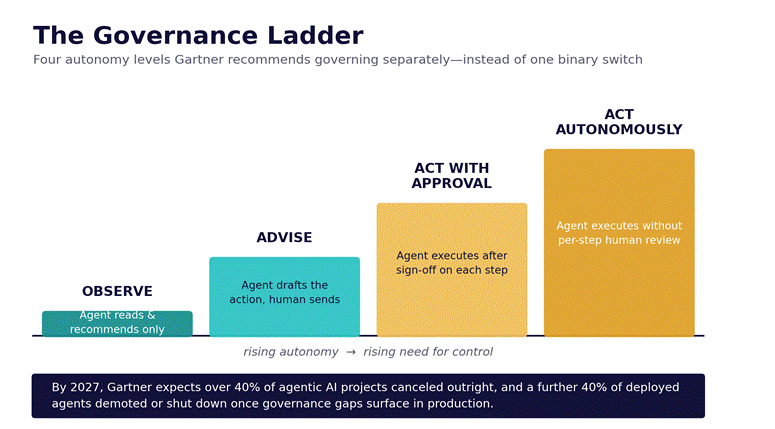
Figure 1: The governance ladder — Gartner’s four agent autonomy levels, from passive observation to unsupervised execution.
The fix is not more caution or less caution across the board — it is matching the control to the autonomy level, agent by agent, instead of applying one policy to every agent in the building.
The Pilot-Era Stack Problem
A separate Info-Tech Research Group study, published August 19, 2026, looked at the same failure pattern from the technology-stack side rather than the policy side. As agents move from chatbots to autonomous triggers of real workflows with access to sensitive enterprise data, Info-Tech identified five recurring vulnerabilities: integration brittleness between agents and existing systems, runaway costs without containment, reliance on stale or untrusted data, governance gaps that only appear at scale, and overlapping vendors creating control gaps nobody owns end-to-end.
Agent demonstrations look alike, but operational realities do not. The vendors worth betting on are the ones that make agents easy to observe, explain, debug, govern, and remove safely.
— Bill Wong, AI Research Fellow, Info-Tech Research Group
Info-Tech’s recommendation is a six-layer governance blueprint spanning the application layer, data and AI lifecycle management, the foundational models themselves, the agentic execution and orchestration layer, the data platform, and the underlying infrastructure. The point of naming all six is that most enterprise AI governance today only really covers one of them — the model — and treats the other five as someone else’s problem. As Info-Tech’s Andrew Kum-Seun put it, the critical architectural decision for IT leaders is building a stack “designed not for today’s answers, but for tomorrow’s unknowns” — meaning an agent’s access, logging, and kill-switch should be designed before its first successful demo, not after its first incident.
What the Survivors Look Like
The agentic AI deployments that telecom operators announced around MWC 2026 are a useful contrast. The network-operations and customer-care agents rolled out across du, Orange, NTT Docomo, and other operators were, without exception, narrowly scoped: a defined task, a defined autonomy tier, and a human decision point before anything touched a live network configuration or a customer account. None of them shipped as a general-purpose agent with open-ended authority — which is precisely why they are still running, while Gartner’s cancellation wave hits the more ambitious, less scoped deployments elsewhere.
For regulated enterprises — banks, government entities, energy majors — the discipline that data-residency and compliance requirements already impose is, unexpectedly, a governance head start on agentic AI, not a handicap.
That matters specifically for GCC enterprises. Sectors already operating under strict data-residency, financial-conduct, or critical-infrastructure regulation are, by default, closer to Gartner’s proportional-governance model than less-regulated peers — because they were already forced to classify systems by risk tier and control access accordingly. The organizations most exposed to the 2027 cancellation wave are the ones treating agentic AI as a green-field technology rollout instead of an extension of controls they already have to run.
What This Means for Enterprise and Telecom Buyers
Before scaling any agent pilot past a demo, enterprise and telecom buyers should be able to answer five questions about it: What autonomy level is this agent actually operating at — Observe, Advise, Act with Approval, or Act Autonomously? Who owns the decision to move it up a level? What is logged well enough to explain a specific action after the fact? Which of the six stack layers — application, data lifecycle, model, orchestration, data platform, infrastructure — actually has a named owner? And how fast, in practice, can this agent be turned off?
Vendors pitching agentic AI capability should be evaluated the same way Info-Tech suggests: not on how impressive the demo looks, but on how observable, explainable, debuggable, and revocable the agent is once it is running unattended in a live environment. A vendor that cannot answer the revocability question clearly is asking an enterprise to absorb the governance risk Gartner is now pricing into its cancellation forecast.
The organizations that get this right in 2026 will not be the ones running the most advanced agents. They will be the ones that can answer a simple question about every agent already running in their environment: what is it allowed to do, who approved that scope, and how fast can it be shut off?
Can you answer that question for every agent already running in yours?