

“Which AI model should we standardize on?”
I get asked this constantly — by peers, by leadership, by people who assume the answer is a single name. It’s the wrong question. And answering it wrong is an expensive mistake for any operator serving a real enterprise customer base.
The fragmentation is the point
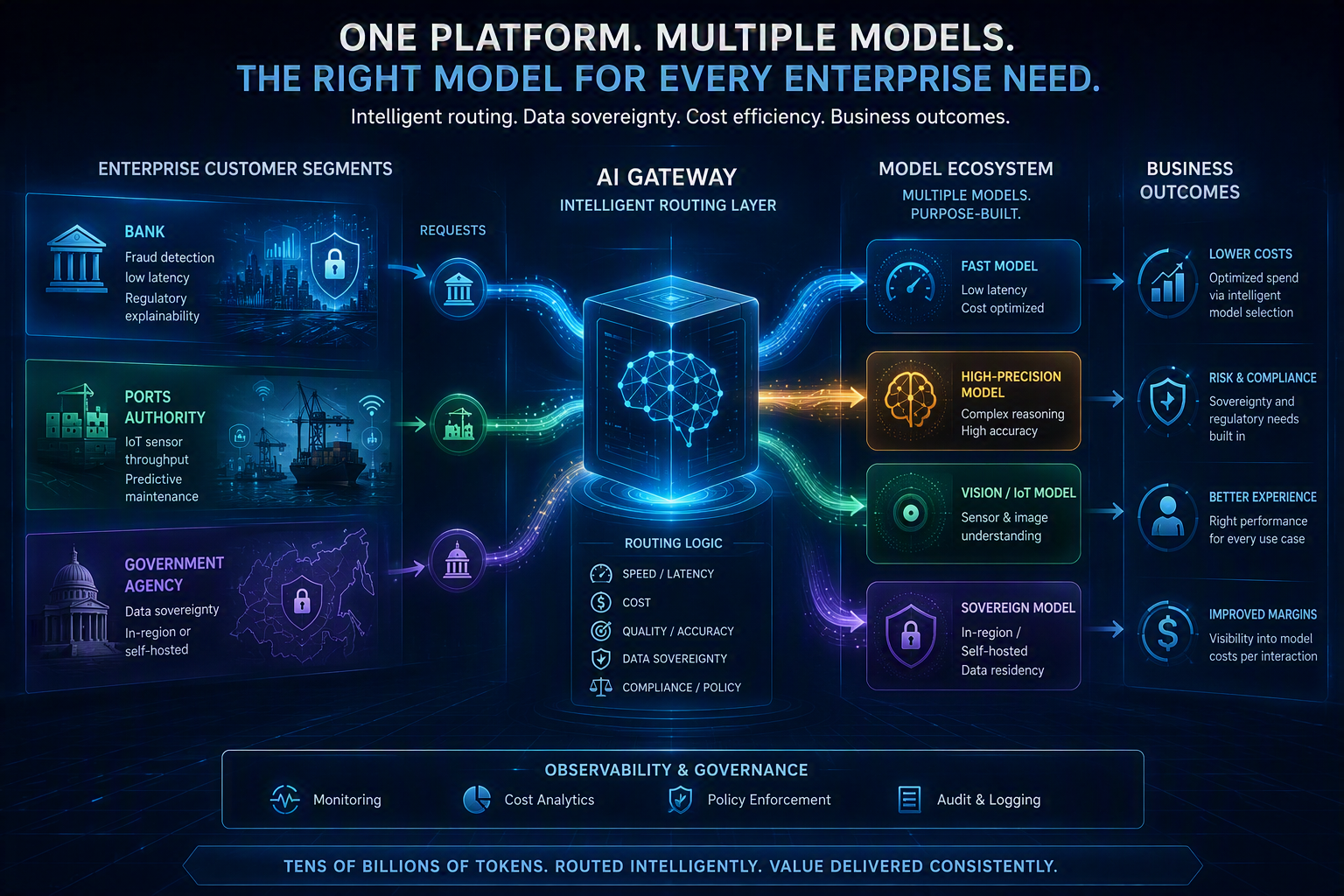
A telecom operator’s B2B book of business isn’t one customer segment — it’s several, each with fundamentally different needs.
- A bank cares about fraud detection latency and regulatory explainability.
- A ports authority cares about IoT sensor throughput and predictive maintenance.
- A government entity cares about data sovereignty above almost everything else.
A single foundation model, however capable, doesn’t serve all three equally well.
AT&T’s AI Gateway reportedly processes tens of billions of inference tokens daily — by routing requests across multiple models based on cost, speed, and quality, not by picking one “best” model and forcing every use case through it. That approach reportedly cut inference costs significantly.
The lesson generalizes well beyond one company: at enterprise scale, model diversity isn’t inefficiency — it’s the efficient design.
What this means for a B2B-heavy operator
If you’re building or evaluating an enterprise AI strategy for telecom, the real architectural question isn’t “GPT or Gemini or self-hosted?” It’s:
- What’s the routing logic? Which requests go to a fast, cheap model versus a slower, higher-precision one?
- Where does data sovereignty force a specific choice? Government and financial-sector customers often require in-region or self-hosted deployment, regardless of benchmark performance.
- Who owns the cost/quality tradeoff decision? This can’t be engineering-only — commercial teams need visibility into what a model choice costs per interaction, since it directly hits margin on managed AI services.
The commercial angle most technical strategies miss
Here’s what doesn’t get enough attention: for an enterprise sales organization, a multi-model architecture isn’t just a technical decision — it’s a sellable capability.
“We route your workload to the right model for your specific compliance and performance requirements” is a genuinely differentiated pitch to a CIO tired of being told to adopt whatever the vendor is pushing that quarter.
The operators who win here won’t be the ones who pick the “best” model. They’ll be the ones who build the routing discipline to use several well — and who can explain that architecture credibly in a boardroom, not just an engineering review.
What’s your organization’s approach — single model or routed? I’d be curious what’s driving that choice.