

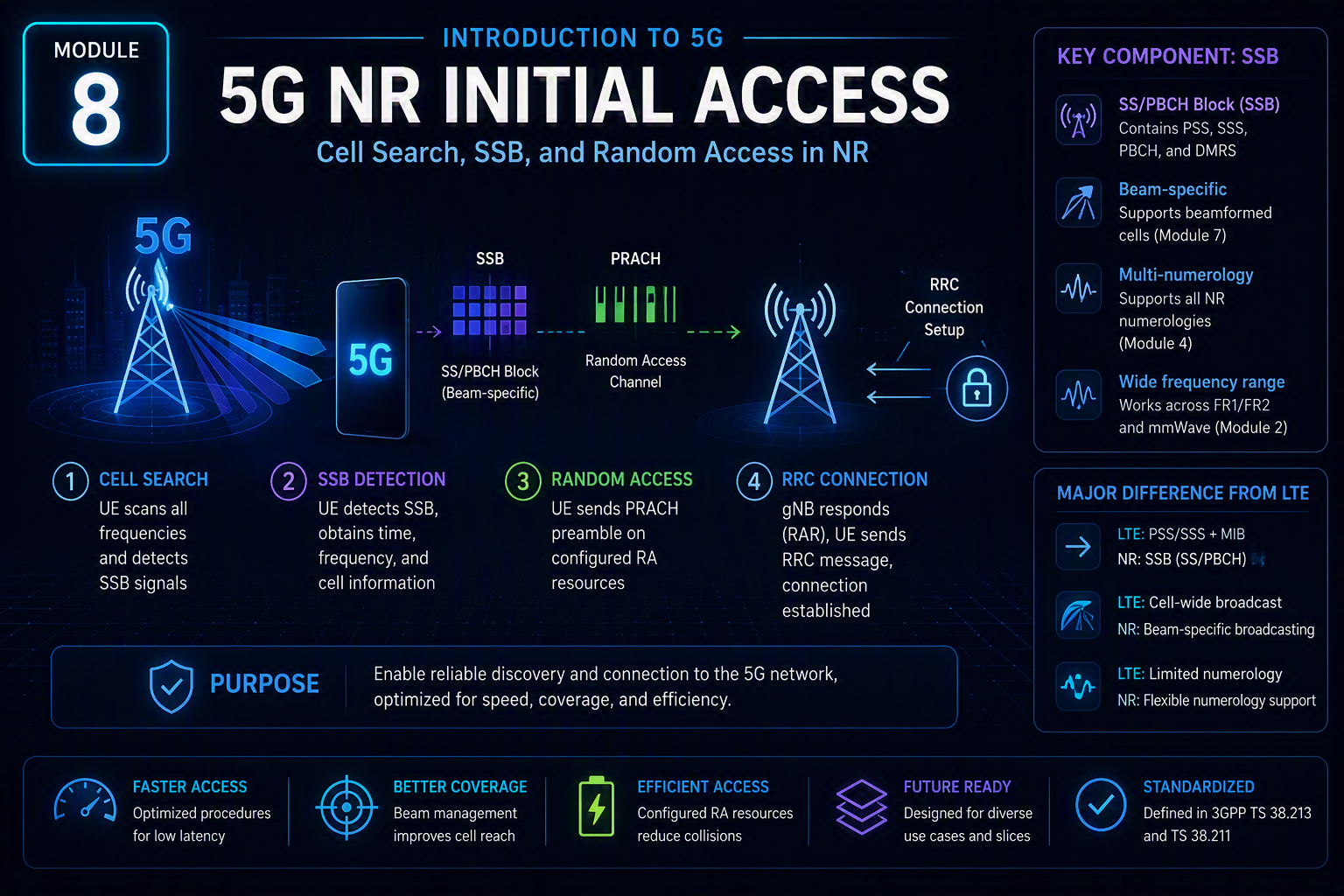
5G NR initial access SSB procedures are governed by 3GPP TS 38.213 and TS 38.211, and the mechanism is meaningfully redesigned from LTE’s PSS/SSS/MIB model — partly to support beamformed cells (Module 7), and partly to accommodate NR’s much wider range of possible numerologies (Module 4) and frequencies (Module 2).
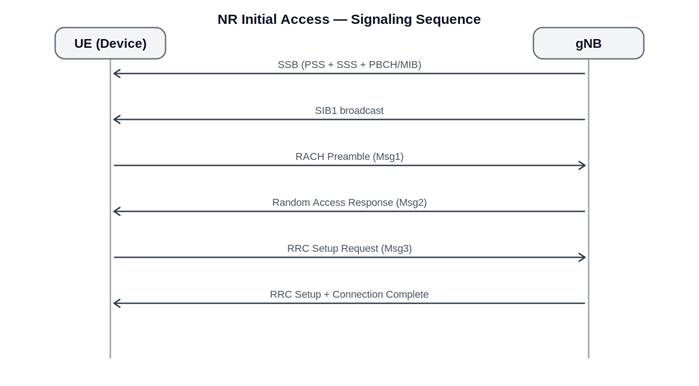
Diagram for Module 8
Diagram: 5G NR initial access SSB signaling sequence — from cell search to RRC connection.
The SSB: NR’s synchronization and broadcast bundle
Where LTE used separate PSS, SSS, and MIB transmissions with their own scheduling, NR bundles the equivalent functions into a single structure called the SSB (Synchronization Signal and PBCH Block), spanning 4 OFDM symbols and containing PSS, SSS, and PBCH (carrying the MIB). SSB periodicity is configurable — commonly 20ms for initial cell search, though the network can configure values from 5ms up to 160ms for connected-mode measurements, per TS 38.213 Section 4.1.
GSCN: how a device finds where to even look
Before a device can search for an SSB, it needs to know which frequencies to scan. NR standardizes this through the Global Synchronization Channel Number (GSCN), per TS 38.101-1 Annex A — a raster of specific frequency points across each band where an SSB might be transmitted, considerably coarser than the underlying channel raster to keep initial search times manageable. A device performs an initial cell search by scanning the GSCN points relevant to its supported bands, rather than an arbitrary continuous frequency sweep.
SSB sweeping: finding a cell when the cell itself is beamformed
Here’s where NR genuinely diverges from LTE. Many 5G cells use beamforming (Module 7), which creates an obvious problem for initial cell search: if the cell’s signal is concentrated into narrow beams, a device in a beam’s blind spot might never see a broadly broadcast synchronization signal the way it could in LTE’s uniform-broadcast model. NR’s answer is SSB sweeping: the network transmits the SSB repeatedly across a set of SS/PBCH block indices — up to 64 distinct beam positions in FR2, up to 8 in FR1 — cycling through beam directions so every direction around the cell receives at least one SSB transmission within the configured periodicity.
From SSB to connection: the full signaling sequence
- SSB detection — device finds PSS, SSS, decodes PBCH/MIB, obtaining basic timing and the Physical Cell ID.
- SIB1 decoding — MIB points to CORESET#0 and the search space for SIB1, which carries detailed cell configuration including RACH parameters.
- RACH Preamble (Msg1) — the device transmits a random access preamble. NR defines multiple PRACH formats (TS 38.211, Table 6.3.3.1-1) — long formats (0–3) reusing LTE-like preamble sequences for large cells, and short formats (A1–C2) with shorter sequences suited to small cells and higher numerologies.
- Random Access Response, Msg2 — the gNB responds with timing advance and an uplink grant.
- RRC Setup Request, Msg3 — the device requests connection establishment.
- RRC Setup and Connection Complete — the sequence completes into RRC_CONNECTED state, from which the device can be scheduled using the flexible slot structure from Module 6.
Why this matters practically
The SSB sweeping mechanism and the GSCN raster are direct, necessary consequences of beamforming (Module 7) being central to 5G’s capacity strategy rather than an optional add-on. A device experiencing unusually slow or inconsistent initial connection times in a beamformed deployment — particularly on mmWave with its 64-position sweep — may simply be catching the SSB sweep pattern less favorably, a phenomenon with no real LTE equivalent, since LTE’s synchronization signals were never designed around a beam-sweeping model.
Closing out the RAN portion of this course
Modules 4 through 8 have covered NR’s radio interface from the ground up: flexible numerology (TS 38.211), disaggregated RAN architecture (TR 38.801), flexible slot-based scheduling with formal preemption (TS 38.212/213/214), massive MIMO and beamforming with CSI-RS feedback (TS 38.211/214), and finally the standardized GSCN/SSB sequence for finding and connecting to a beamformed NR cell. From here, the course moves into the 5G Core.
Next in this series: Module 9 — 5G Core Architecture: Service-Based Architecture (SBA) Explained.
One thought on “Introduction to 5G — Module 8: 5G NR Initial Access — Cell Search, SSB, and Random Access in NR”