

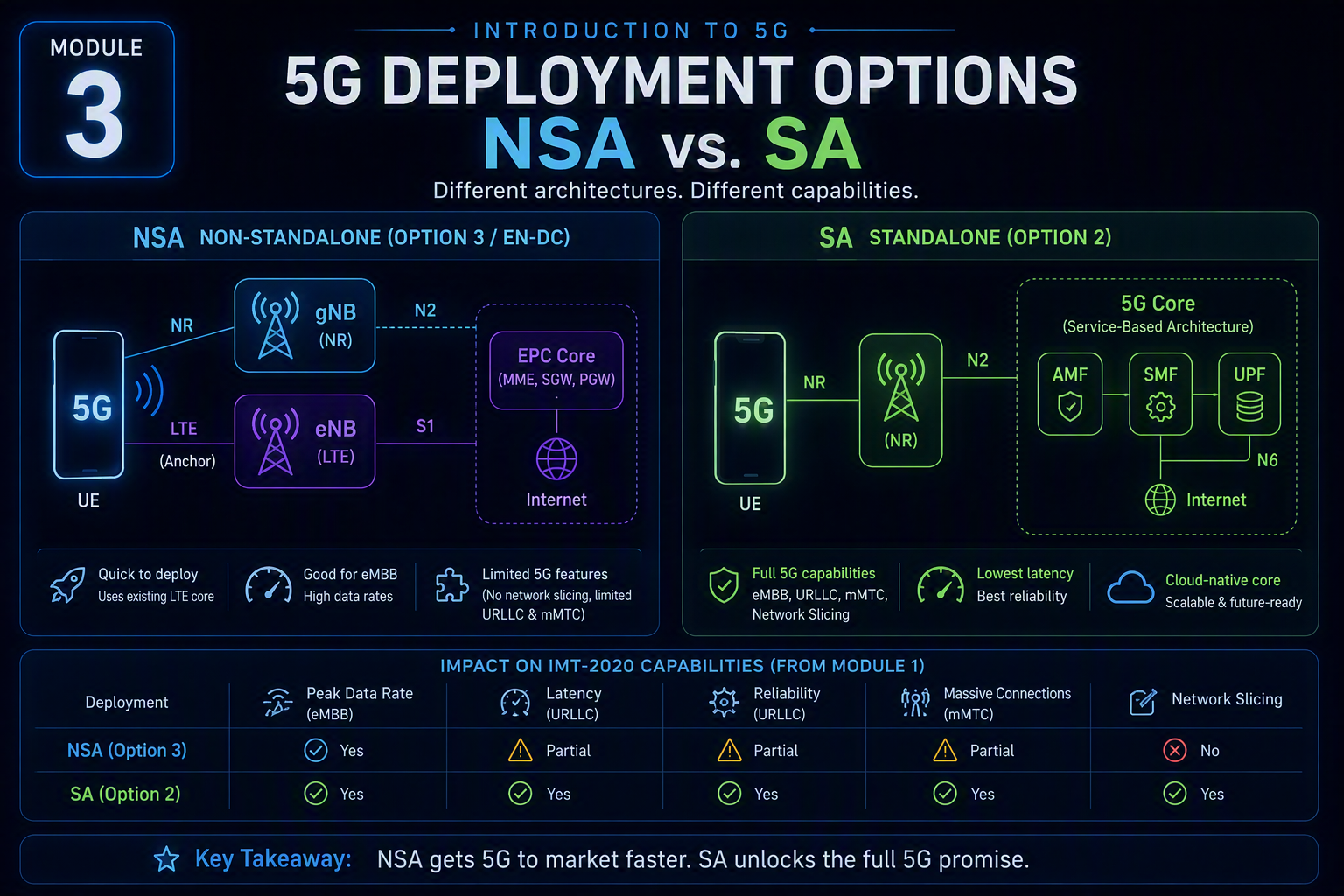
5G NSA vs SA isn’t just industry jargon for “early” versus “mature” 5G — 3GPP formally defined multiple specific deployment architectures in TS 37.340 and TS 23.501, each with a distinct option number, and the choice between them has direct, measurable consequences for which capabilities from Module 1’s IMT-2020 table a network can actually deliver.
The practical problem operators faced
Building an entirely new radio network is a massive undertaking on its own. Building an entirely new core network at the same time, before launching any commercial 5G service, would have delayed 5G rollouts by years. 3GPP’s response was to formally standardize multiple deployment options in Release 15, letting operators launch 5G radio capability without immediately replacing their entire core.
The formal 3GPP deployment options
3GPP TS 37.340 defines several specific dual-connectivity and standalone options, though the industry conversation usually simplifies to two categories:
| Option | Name | Core | Anchor | Status |
| Option 3 / 3a / 3x | EN-DC (the common “NSA”) | EPC (4G) | LTE (eNB) | Widely deployed globally from 2019 |
| Option 4 / 4a | NE-DC | 5GC | NR (gNB) | Rare, transitional |
| Option 7 / 7a | NGEN-DC | 5GC | LTE (ng-eNB) | Used in some hybrid rollouts |
| Option 2 | Standalone (SA) | 5GC | NR (gNB) | Growing since 2020–2021 |
Source: 3GPP TS 37.340, Section 4 (Architecture options).
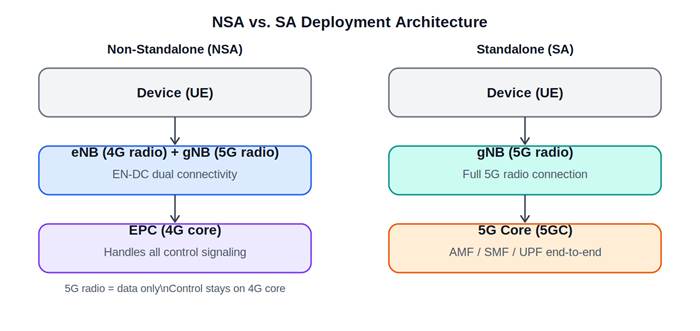
Diagram for Module 3
Diagram: 5G NSA vs SA — architecture comparison between EN-DC and full standalone deployment.
Non-Standalone (NSA): 5G radio, 4G core — Option 3 family
In the dominant NSA configuration — Option 3 (EN-DC, E-UTRA New Radio Dual Connectivity) — a 5G radio (gNB) is added alongside existing 4G infrastructure, but the device’s control-plane connection continues running through the existing 4G core (EPC) and 4G radio (eNB), which remains the anchor. The 5G radio adds a high-speed secondary data connection on top of the LTE anchor. The three sub-variants matter operationally: Option 3 routes both LTE and NR user-plane traffic through the eNB; Option 3a splits user-plane traffic so NR traffic goes directly to the core, bypassing the eNB; Option 3x splits it the other way, routing combined traffic through the gNB. Most commercial NSA deployments used Option 3a or 3x for better data-path efficiency.
Because control signaling still runs through 4G’s EPC, NSA cannot deliver 5G’s more ambitious latency targets — the 1ms URLLC target from Module 1’s IMT-2020 table is out of reach, since EPC’s control-plane procedures were never designed around it — and it cannot support 5G-native capabilities like network slicing (Module 12), which depend on 5G Core architecture that simply doesn’t exist in an EPC deployment.
Standalone (SA): 5G radio, 5G core — Option 2
Option 2 connects the device entirely to 5G infrastructure — gNB and 5GC — with no dependency on 4G infrastructure for control signaling. This is what most of 5G’s more advanced IMT-2020 targets actually require: sub-10ms latency for URLLC use cases, network slicing, and efficient support for massive mMTC device counts, all of which depend on architectural features specific to the 5G core (covered starting Module 9) that don’t exist in EPC.
SA deployment is a larger undertaking than NSA precisely because it requires the core network build that NSA was designed to defer — which is why SA rollouts have generally lagged NSA rollouts by a meaningful margin industry-wide since the first commercial 5G launches in 2019.
Why this distinction has direct, measurable consequences
- IMT-2020 target achievability tracks the deployment option directly. A device on an Option 3 NSA network, however fast its data connection feels, cannot experience URLLC-grade latency or be assigned to a network slice — those specifically require Option 2’s 5G core.
- “5G” as a public-facing marketing term covered both Option 3 and Option 2 without distinction for years, which is part of why early 5G experiences varied so widely between operators and regions.
- Migration has followed a consistent industry pattern: Option 3 first for fast time-to-market using existing EPC investment, followed by gradual Option 2 rollout as 5G core infrastructure matures, eventually retiring Option 3 as SA coverage becomes comprehensive.
What this means for the rest of the course
From here forward, this course generally describes 5G’s full architectural vision — the RAN modules (4 through 8) cover radio-side capability both Option 3 and Option 2 share, while the Core modules (9 through 11) cover 5G Core capabilities that are specifically an Option 2 (SA) story. When a feature sounds like it requires deep 5G core involvement, it implicitly requires Option 2, not Option 3’s EN-DC configuration.
Next in this series: Module 4 — New Radio (NR) Numerology, covering how 5G’s flexible subcarrier spacing replaced LTE’s fixed 15kHz design.
One thought on “Introduction to 5G — Module 3: 5G Deployment Options — NSA vs. SA Explained”