

Category: AI and Beyond
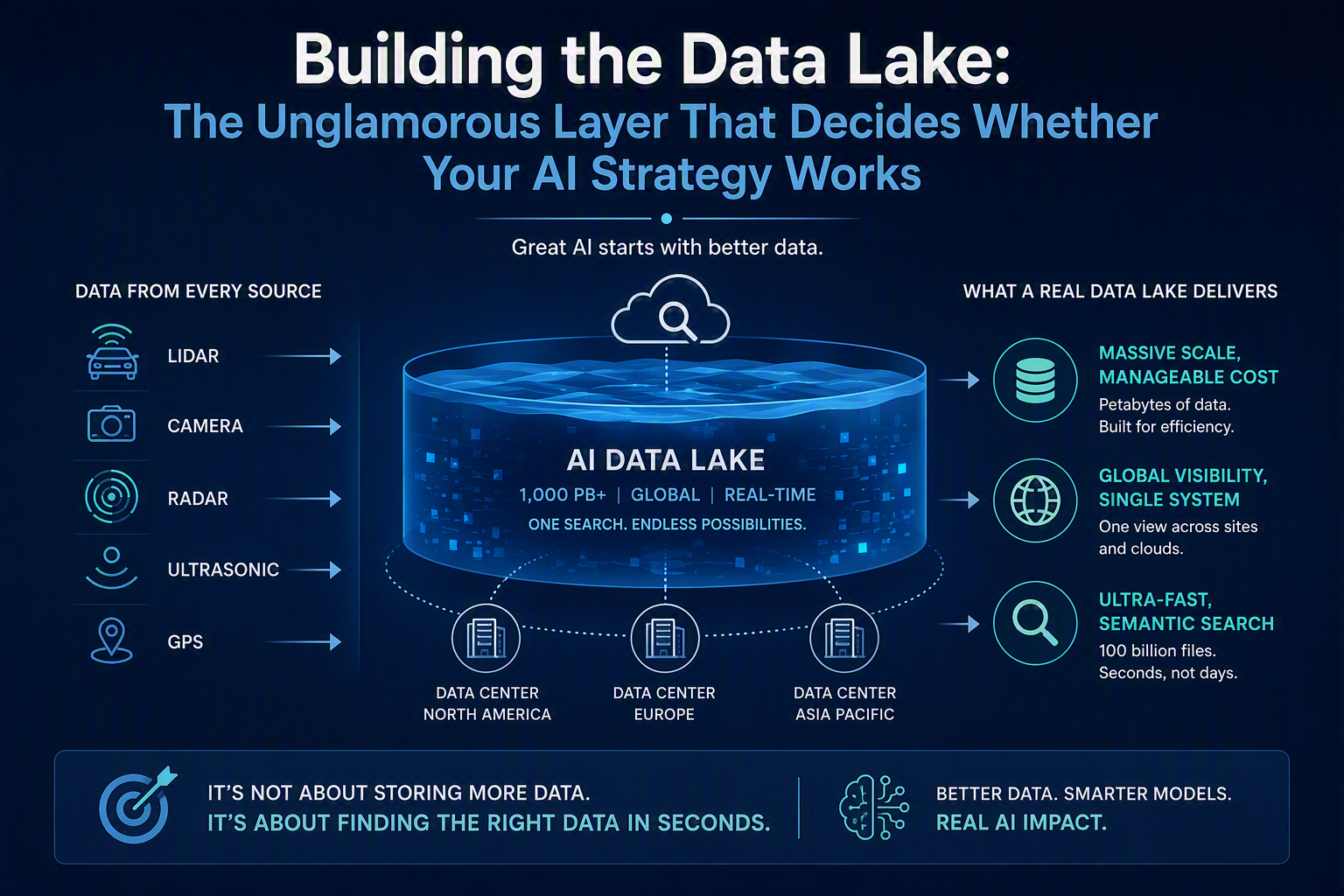
Consider what it takes for an autonomous vehicle company to train a system capable of removing the steering wheel entirely. The ambition — full autonomy — is the exciting part. The actual bottleneck is something far less glamorous: building an AI data lake that converges lidar, camera, radar, ultrasonic, and GPS data from every test vehicle into a single, searchable, multi-site training resource.
What a real AI data lake looks like in practice
One recent example described an AI data lake holding roughly 1,000 petabytes at a manageable total cost, with real-time visibility across multiple cities and data centers, and semantic search capable of pulling relevant footage — “a rainy day, traffic lights, and a running dog” — out of 100 billion files in seconds rather than days.
Why this is the real AI story, not the model
Every enterprise conversation about AI eventually gravitates toward models and agents because they’re visible and demoable. The AI data lake is invisible — until it’s the reason a project stalls. Three capabilities separate a functioning AI data foundation from a collection of storage buckets with a shared login:
- Massive capacity at genuinely usable cost. Scale without the infrastructure becoming its own multi-million-dollar line item.
- Global visibility and manageability. Data spread across sites and clouds that behaves like one system, not a scavenger hunt.
- Ultra-fast, semantic retrieval. The difference between “we have the data somewhere” and “we can find the exact right slice of it in seconds.”
A quick test for whether your data lake actually works
Ask three questions of whoever owns your data infrastructure. First: if someone needed every customer interaction related to a specific complaint type from the last six months, how long would it take to retrieve — minutes, hours, or days? Second: does the answer change depending on which system originally captured that data, or does it behave the same regardless of source? Third: could someone outside the data team run that search themselves, or does every request require an engineer to write a custom query? An AI data lake that passes all three tests can actually support an agent. One that fails even one of them is still, functionally, a set of disconnected archives — no matter how much total capacity it holds.
This test matters more than it sounds like it should, because capacity numbers are the easiest thing to put in a slide and the least predictive of whether the system will actually work. A data lake that stores everything but answers nothing in real time will quietly become the reason an otherwise well-funded AI initiative can’t ship.
Why most enterprise data lakes fail before they start
The common failure mode isn’t technical — it’s sequencing. Teams buy storage, migrate everything into it, declare the data lake “built,” and only discover months later that nobody can actually find anything useful inside it. A working AI data lake needs a catalog and retrieval layer designed in from day one, not bolted on after the migration is complete. That single design decision — building for retrieval first, storage second — is usually the difference between a data lake that agents can actually use and an expensive digital warehouse nobody visits.
The enterprise translation
Replace “autonomous vehicle company” with any large enterprise, and “lidar and camera footage” with contracts, network logs, customer interactions, or field service records. The pattern holds. Organizations that treat the AI data lake as a procurement checkbox end up with expensive digital hoarding. Organizations that treat it as a product, with real requirements around retrieval speed and semantic search, end up with something agents can actually use.
The uncomfortable truth for most transformation roadmaps: the AI data lake should usually be funded and built before the flagship AI use case, not alongside it as an afterthought.