

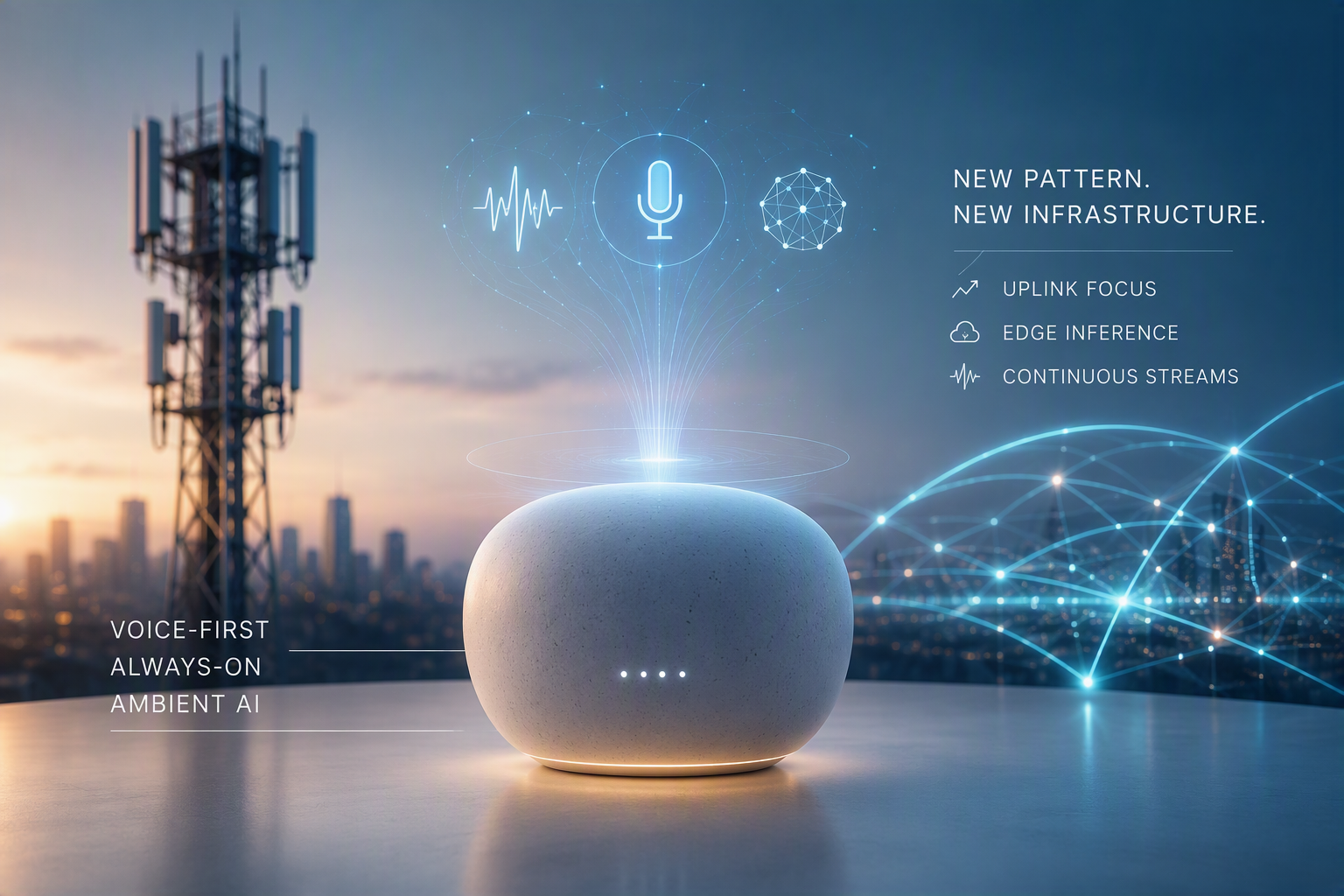
OpenAI is building hardware. Not an accessory, not a smart speaker refresh — a genuine attempt to define what a computer looks like in the AI era, backed by a roughly $6.4 billion acquisition of Jony Ive’s startup io in May 2025, and a stated goal of shipping devices at a scale most hardware companies never reach. That’s a serious enough bet that it’s worth asking a question most of the coverage skips: what does this actually mean for the networks these devices will run on?
What’s actually being built
Strip away the design-world excitement and the concrete facts are these: OpenAI’s device is reportedly screenless, voice-first, and built around ambient, always-on interaction rather than the tap-and-swipe model smartphones trained us on. The company has targeted a second-half-2026 launch, with manufacturing partner Foxconn reportedly geared up for an initial production run in the tens of millions of units. Ive himself, alongside former Apple hardware leads Scott Cannon, Evans Hankey, and Tang Tan, is running design across both companies. This isn’t a side project — it’s positioned as OpenAI’s attempt to own the full stack, hardware included, rather than live inside Apple’s or Google’s platforms.
Worth noting as of this writing: the ambition has also drawn a lawsuit from Apple alleging trade secret theft — a reminder that “we’re building the next iPhone-scale hardware category” invites exactly the kind of scrutiny you’d expect when the team doing it is largely ex-Apple.
The honest answer on traffic: not this device alone
Here’s the case for skepticism, and it’s a reasonable one. A single device category — even one that eventually ships tens of millions of units — doesn’t reshape telecom network load on its own. Smart speakers, smartwatches, and AR glasses have all launched with big ambitions and modest measurable impact on core network traffic patterns. Network planners have seen this movie before: a genuinely new device category takes years to reach the volume where it shows up meaningfully in aggregate traffic statistics, and even then, it usually rides on existing WiFi and home broadband more than it strains cellular capacity directly.
So if the question is “will this specific device spike telecom traffic in 2026 or 2027,” the honest answer is probably no — at least not on its own, and not immediately.
Why the pattern matters more than the device
The more interesting question isn’t about this device — it’s about what it signals. Three things worth watching:
1. Always-on, ambient AI changes traffic shape, not just volume. A smartphone’s data usage is bursty — you check it, you put it down. A device explicitly designed for continuous ambient listening and context-awareness implies a fundamentally different traffic pattern: smaller, more constant streams rather than large, infrequent bursts. Networks are generally provisioned and optimized around the bursty model. A meaningful shift toward always-on ambient devices — even gradually, across many device categories, not just OpenAI’s — pushes operators toward different capacity planning assumptions than the smartphone era trained them on.
2. The uplink question is the one worth actually watching. Most consumer traffic growth for the last decade has been overwhelmingly downlink — streaming video, app downloads, content consumption. A voice-first, always-listening, context-aware device is structurally different: it’s continuously sending audio and sensor context outward for processing, not just pulling content down. If ambient AI devices become a real category — not just this one product, but the pattern OpenAI, Google, and others are all chasing — that’s a genuine shift in the uplink/downlink ratio operators have to plan around, and uplink capacity has historically been the less-glamorous, less-invested-in side of network design.
3. “Full-stack AI company becomes device company” is the strategic move, and it’s not unique to OpenAI. The real story isn’t one gadget — it’s that the major AI labs are all converging on the same conclusion: whoever controls the interface controls the relationship with the user, and whoever controls the interface has strong incentive to also control (or heavily influence) the connectivity layer underneath it. That’s the strategic pattern telecom leaders should actually be tracking, not any single product launch date.
What this means for enterprise and carrier planning
For anyone in telecom infrastructure or enterprise network planning, the practical takeaway isn’t “prepare for an OpenAI traffic surge in Q3 2026.” It’s this: the assumptions baked into current capacity planning — bursty downlink-heavy consumer traffic, smartphone-centric usage patterns — are the assumptions of the last device era, not necessarily the next one. Ambient, always-on AI devices, if they become a genuine category rather than a niche experiment, would ask different questions of network architecture than anything currently in mainstream use: sustained low-latency uplink capacity, edge inference infrastructure to avoid round-tripping every interaction to a distant data center, and traffic shaping built around continuous small streams rather than occasional large ones.
None of that is urgent today. But “not urgent today” and “not worth planning for” are different things — and the gap between them is usually where competitive advantage in infrastructure gets built or lost.