

Here are all 5 posts in full:
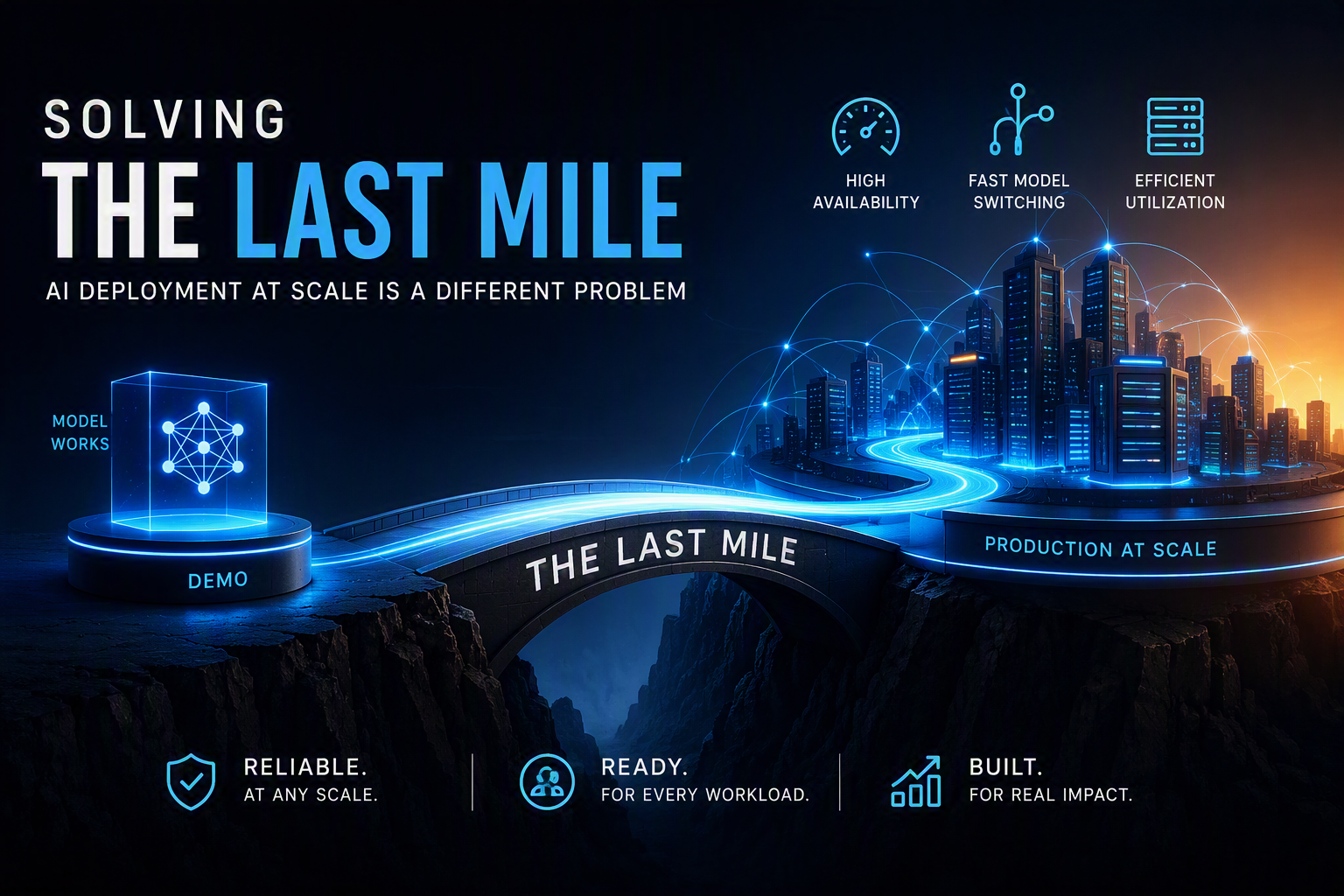
1. Solving the Last Mile: Why AI Deployment at Scale Is a Different Problem Than Getting a Model to Work
SEO Title: Solving the Last Mile: AI Deployment at Scale Explained
Meta Description: Why AI deployment at scale is a different milestone than getting a model to work — and the three capabilities that separate demos from production.
Focus Keyword: AI deployment at scale
URL Slug: ai-deployment-at-scale
Category: AI and Beyond
Somewhere in nearly every enterprise AI roadmap, there’s a slide that shows a model working beautifully in a demo, followed six months later by a status update that quietly avoids the word “delayed.” The gap between those two moments has a name, and it isn’t “the model wasn’t good enough.” It’s AI deployment at scale — and it’s a completely different engineering problem than the one most AI budgets are built around.
The demo-to-production gap
A working model answering ten test queries in a controlled environment tells you almost nothing about what happens when that same model needs to serve thousands of concurrent requests, across multiple business units, each with different latency tolerances and different data sensitivities. Getting a model to produce a correct answer once is a research problem. Getting it to produce correct answers reliably, at volume, within a cost envelope the business can sustain, is an infrastructure problem — and infrastructure problems don’t show up on a proof-of-concept slide.
Three deployment capabilities that actually matter
Enterprises that make it past the pilot stage tend to have solved for the same three things, regardless of industry:
- Out-of-the-box availability. The ability to deploy multiple models for different service lines without months of custom integration work per model. If every new use case requires a fresh six-month integration cycle, the organization isn’t scaling AI — it’s running a series of one-off projects that happen to share a vendor.
- Task distribution with fast model switching. Routing an inference request to the right specialist model in milliseconds rather than minutes, using on-chip memory rather than round-tripping to slower storage every time context needs to be pulled back in. This is invisible when it works and catastrophic for user experience when it doesn’t.
- Efficient hardware virtualization. Running many lightweight workloads on shared processors, or spreading a single heavy workload across many processors, so expensive compute isn’t sitting idle between tasks. Underutilized AI infrastructure is one of the fastest ways to turn a promising pilot into a budget line nobody wants to defend at renewal time.
Why this gets missed in planning
Most AI business cases are built around a single number: model accuracy. That number is necessary but nowhere near sufficient. It says nothing about how many concurrent calls the system can handle, how gracefully it degrades under load, or how quickly it can switch between the five or six specialized models a real enterprise workflow actually requires. Accuracy benchmarks answer “does this work in principle.” They don’t answer “does this work on a Tuesday afternoon when every regional office is hitting it at once.”
The enterprise lesson
“We deployed a model” and “we can run this in production at the volume our business actually generates” are two completely different milestones, and the distance between them is where most AI budgets quietly disappear. Before signing off on any AI initiative’s business case, the more useful questions aren’t about accuracy at all. They’re about calls per day, concurrent model count, and switching latency under real load — the numbers that tell you whether a system is production-ready, not just demo-ready.
The organizations getting this right aren’t necessarily the ones with the most advanced models. They’re the ones that treated deployment infrastructure as a first-class part of the AI strategy from day one, rather than an implementation detail to be sorted out after the pilot succeeded.
Where does your organization’s AI roadmap currently sit — still proving the model works, or already stress-testing what happens when everyone tries to use it at once?