

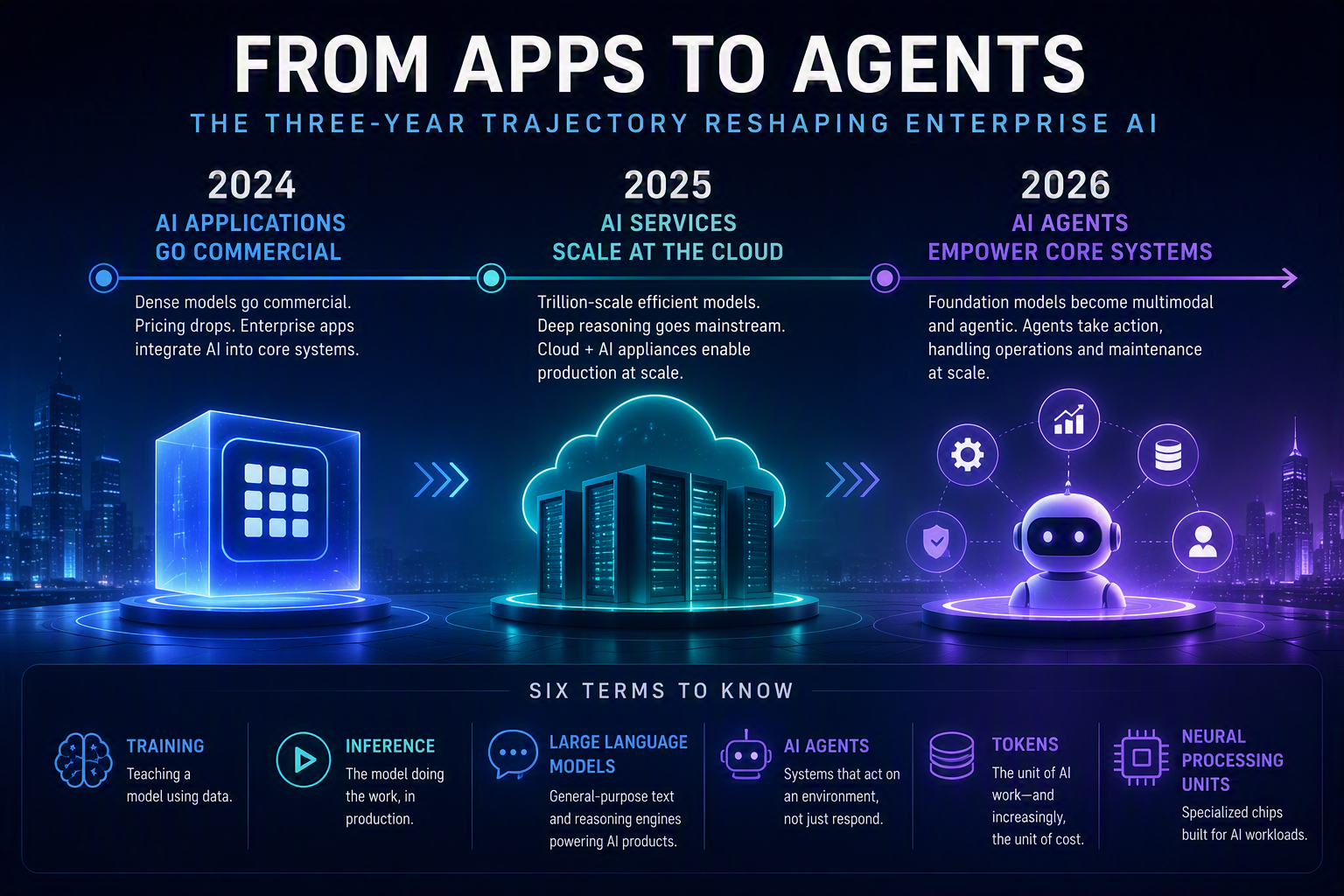
The enterprise AI trajectory from 2024 to 2026 didn’t happen in a single leap, no matter how the headlines make it look. It’s tempting to talk about enterprise AI as though it arrived all at once — as if 2023’s chatbots and 2026’s autonomous agents belong to the same conversation happening at different volumes. They don’t. This trajectory is a sequence, not a single event, and each year didn’t replace the one before it — it built on it. Understanding that sequence tells you more about what’s coming next than any individual product announcement does.
2024 — AI applications go commercial
Dense models with hundreds of billions of parameters left the research lab and entered products people actually paid for. Application pricing fell sharply as competition intensified, and major operators across industries began attempting to integrate AI directly into core systems rather than bolting it on as a separate, standalone app. This was the year AI stopped being a lab curiosity and started being a line item.
2025 — AI services scale at the cloud
Trillion-scale efficient models began coexisting with smaller, specialized ones built for narrower tasks, and deep reasoning capability went mainstream rather than remaining a research showcase. Cloud-plus-AI appliances made deployment fast and cost-effective enough that enterprises moved from isolated experiments to genuine production scale, with supply chains adapting to support that shift. 2025 was the year the infrastructure caught up to the ambition.
2026 — AI agents empower core systems
Foundation models are scaling up while simultaneously evolving toward multimodal, agentic capability — systems that don’t just answer questions but take action. Industry projections put agent adoption at roughly 40% of enterprises this year, climbing toward 50% by 2027, with agents increasingly handling operations and maintenance functions rather than sitting in a chat window waiting to be asked something.
The six words worth knowing cold
Regardless of where an individual sits in the org chart, six terms now come up in board-level AI conversations often enough to count as baseline fluency:
- Training — teaching a model using data.
- Inference — the model actually doing the work, in production.
- Large language models — the general-purpose text and reasoning engines underneath most current AI products.
- AI agents — systems that act on an environment, not just respond to a prompt.
- Tokens — the unit of AI “work,” and increasingly, the unit of AI cost.
- Neural processing units — specialized chips built for AI workloads rather than general-purpose computing.
A leader doesn’t need to be able to build any of these. They do need to recognize them fast enough to ask a sharp follow-up question in a vendor pitch or a board deck.
Why the sequence matters more than the vocabulary
Organizations still treating 2026 as “the year we finally deploy some AI” are running roughly eighteen months behind the industry’s actual trajectory. The real strategic question isn’t whether to adopt agents — the adoption curves already answer that question on their own. The real question is whether the data, infrastructure, and security foundations laid down during the 2024–2025 wave are solid enough to support what 2026 is now asking of them. Agents built on top of weak data foundations don’t fix the weakness — they amplify it, faster, and with less human oversight in the loop.
What this means for planning the next eighteen months
Mapping the enterprise AI trajectory this way has a practical use beyond historical interest: it gives leaders a diagnostic. Any AI initiative currently on the roadmap can be tested against the three phases. Is it still solving a 2024-era problem — proving an application works and finding a viable price point? Is it a 2025-era problem — getting genuinely production-ready infrastructure in place at cost-effective scale? Or is it a 2026-era problem — giving a system enough autonomy and reliable memory to act on the organization’s behalf?
Projects that skip phases tend to be the ones that stall. An agent initiative launched on top of infrastructure that never made it past the 2024 pilot stage will hit the same scaling walls that undermined the pilot in the first place, just with more autonomy and less human oversight to catch the failure early. The trajectory isn’t a marketing timeline — it’s closer to a maturity model, and organizations that treat it as one tend to make fewer expensive missteps than those chasing whichever term is loudest in this quarter’s conference keynotes.
If your organization mapped its own AI initiatives against this three-year sequence, would this year’s projects look like a natural next step — or like an attempt to skip straight to agents without the foundation underneath them?