

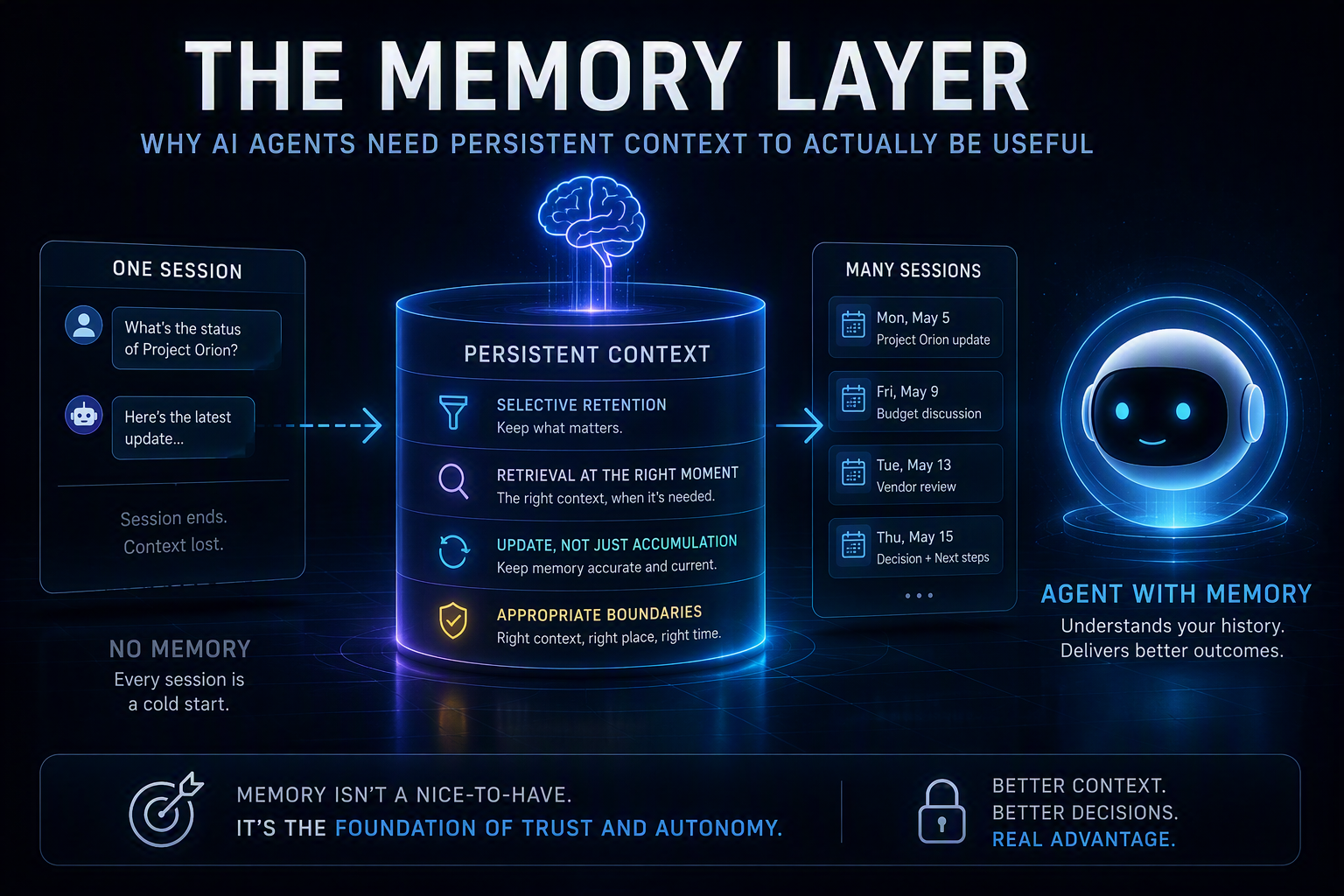
AI agent memory — the ability to retain context across sessions, not just within a single conversation — is quietly becoming one of the most consequential architectural decisions in enterprise AI. There’s a specific moment that undermines trust in a system faster than almost anything else: asking it to continue something from last week, and watching it start from zero. That failure is precisely why memory matters so much, and precisely why so much of the current generation of AI tools still gets it wrong.
The difference between a session and a relationship
A model that only remembers what happened in the current conversation is functioning as a very sophisticated calculator: powerful in the moment, blank the instant the window closes. That’s adequate for a one-off question. It’s completely inadequate for anything resembling ongoing work — a sales pipeline that needs tracking over months, a customer relationship that spans dozens of interactions, an operational process with steps that unfold over days rather than minutes. Without persistent memory, every single interaction with an AI system is a cold start, and the human on the other end ends up doing the actual continuity work the system should be handling.
What persistent context actually requires
Giving an AI system genuine memory isn’t just a matter of storing a longer transcript. It requires several distinct architectural pieces working together:
- Selective retention. Not everything from every interaction should be remembered — that produces noise, not context. Systems need a way to identify what’s actually relevant to retain versus what was incidental to a single conversation.
- Retrieval at the right moment. Stored information is only useful if the system reliably surfaces the right piece of it at the right time, without the human having to explicitly remind it. Memory that has to be manually triggered isn’t really memory — it’s a search bar.
- Update, not just accumulation. Circumstances change. A customer’s priorities shift, a project’s status moves forward, a fact that was once true stops being true. A memory system that only adds and never revises will eventually confidently act on stale information — often the most dangerous kind of AI failure, because it looks exactly like a correct answer.
- Appropriate boundaries. Not all context should persist indefinitely or apply in every setting. Memory systems that don’t distinguish between what’s relevant in one context versus another end up either oversharing or underdelivering, and getting this wrong erodes trust as fast as having no memory at all.
Why this matters more as agents take on more autonomy
As AI systems move from answering questions to actually taking action — the defining shift of the current wave of enterprise adoption — the cost of poor memory rises sharply. An agent that forgets a previous decision might repeat work that’s already been done. One that forgets a previous constraint might violate it without realizing. Memory isn’t a convenience feature at this stage; it’s a prerequisite for letting a system operate with any real independence at all.
The practical takeaway
Enterprises evaluating AI agent platforms are increasingly finding that the headline capability — what the model can do in a single interaction — matters less than how well the system remembers, updates, and applies context across many interactions over time. A slightly less capable model with genuinely reliable memory will often outperform a more capable model that starts from zero every session, simply because reliability compounds and cold starts don’t.
What to ask before adopting an agent platform
Most AI agent evaluations focus on capability: what can this system do in a single interaction, how accurate are its outputs, how well does it handle edge cases. Those questions matter, but they miss the dimension that determines whether the tool becomes genuinely useful over months rather than impressive for a single demo. The more revealing questions are about AI agent memory specifically: what does the system retain between sessions, how does it decide what’s worth keeping, how quickly does outdated context get updated or discarded, and can that memory be scoped appropriately so information from one project doesn’t bleed into an unrelated one.
A vendor that can answer these questions concretely — not with a marketing description of “personalization,” but with specifics about retention, retrieval, and update mechanics — is signaling that memory was treated as core architecture rather than a feature bolted on afterward. That distinction is usually invisible in a first demo and unmistakable after three months of actual use.
Does your organization’s current AI tooling actually remember what happened last week — or does every conversation start the relationship over from scratch?