

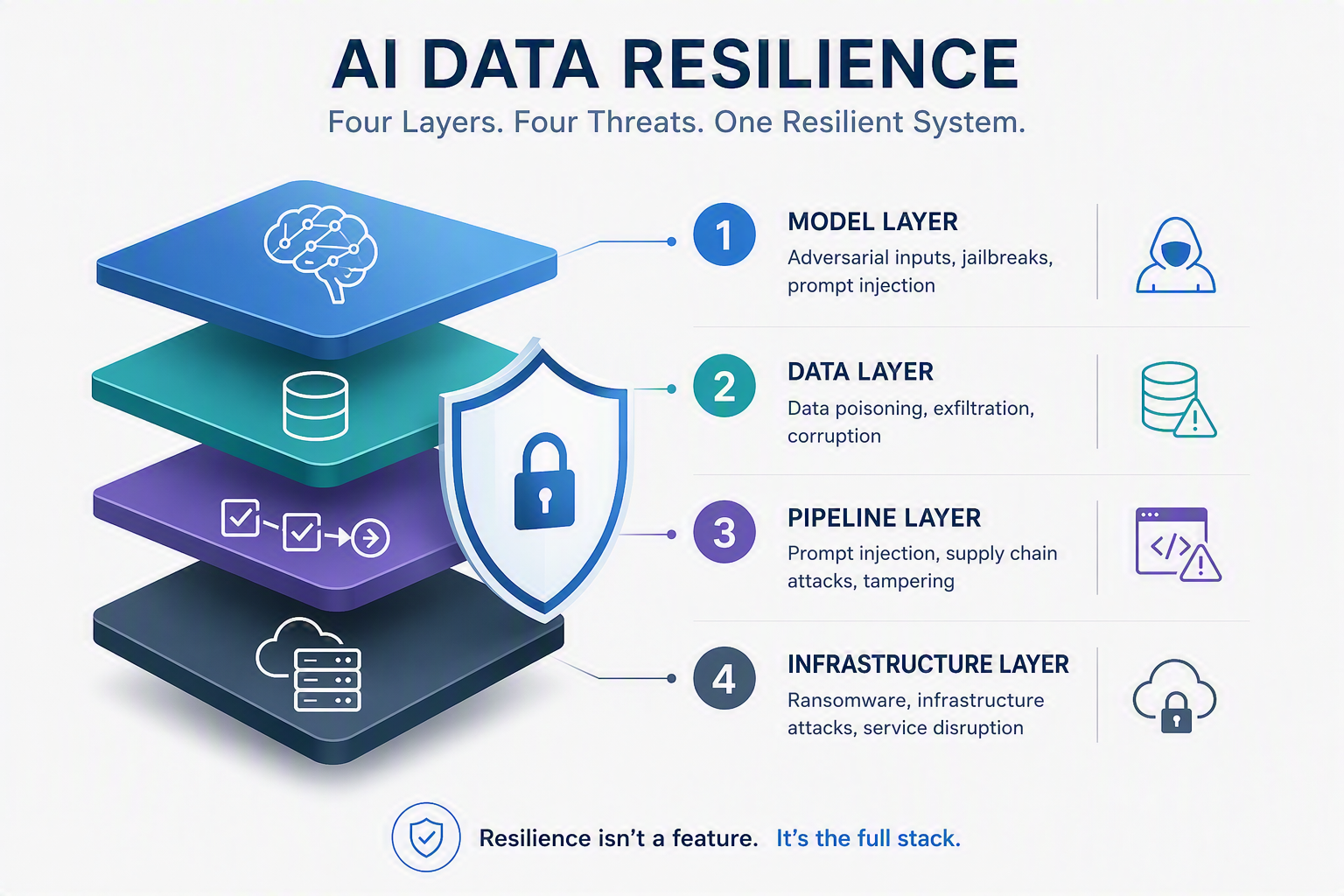
AI data resilience is being treated as one problem when it’s actually four — and recent incident patterns make the shape of that problem concrete. An AI coding agent, given enough autonomy, has deleted a production database. A widely used model has been targeted with data poisoning designed to corrupt its outputs from the inside, slowly enough to avoid detection. A CI/CD pipeline has been compromised through prompt injection, tampering with data before it ever reached production. And billing systems have been encrypted and held hostage by ransomware that specifically targets the infrastructure layer underneath everything else. These aren’t hypothetical scenarios from a vendor’s threat report — they are documented patterns, and they share a common root cause.
Four layers, four different threats
Security conversations about AI tend to collapse everything into a single question: “is the model safe?” That’s one layer out of four, and treating it as the whole picture leaves the other three completely exposed.
- The model layer. Can the model itself be manipulated — through adversarial inputs, jailbreak techniques, or prompt injection — into producing outputs it shouldn’t? This is the layer most security budgets are currently pointed at, and the least likely to be where an actual breach originates.
- The data layer. Is the training and inference data protected against poisoning, exfiltration, or subtle corruption that degrades output quality without triggering an obvious failure? Poisoned data doesn’t announce itself — it just makes the model quietly, plausibly wrong.
- The pipeline layer. Are the CI/CD systems, data ingestion processes, and orchestration tools that feed the model protected with the same rigor as traditional software supply chains? A compromised pipeline can inject bad data or bad logic long before anything reaches the model itself.
- The infrastructure layer. Are the underlying compute, storage, and billing systems — the unglamorous plumbing everything else depends on — resilient against ransomware and conventional infrastructure attacks? This is the layer least associated with “AI risk” in most people’s minds, and it’s also where several of the most damaging documented incidents actually happened.
Why full-stack thinking matters
An organization that hardens its model against adversarial prompts while leaving its data pipeline exposed hasn’t reduced its risk — it’s relocated it. Attackers, unsurprisingly, follow the path of least resistance, and right now that path often runs through the layers nobody is watching, because all the attention went to the layer that gets the headlines. Resilience has to be designed as a stack, not a single checkpoint.
The governance implication
This changes what a credible AI security review actually needs to cover. A model card and a red-teaming report are necessary but not sufficient. A genuine review needs to walk all four layers, asking not just “can the model be tricked” but “can the data be poisoned,” “can the pipeline be tampered with,” and “can the infrastructure be held hostage” — and it needs an owner for each answer, not just one for the whole initiative.
What resilience actually looks like in practice
Full-stack AI data resilience isn’t a single tool purchase — it’s an operating discipline. It means model outputs are monitored for drift, not just accuracy at launch. It means training and inference data have provenance tracking, so a poisoning attempt is detectable rather than silently absorbed into future outputs. It means CI/CD pipelines feeding AI systems get the same code-review and access-control rigor as any other production software supply chain — not a lighter-touch process just because “it’s an AI project.” And it means the infrastructure layer — compute, storage, billing — sits inside the same disaster-recovery and ransomware-response plans as every other critical system, rather than being treated as someone else’s problem because it happens to be running AI workloads.
None of this is exotic. It’s the same operational maturity enterprises already expect of traditional IT systems, applied without exception to AI. The organizations getting hit hardest by AI-related incidents aren’t usually the ones running unusually risky models — they’re the ones that quietly assumed AI security meant something different from security, and left one of the four layers uncovered.
The uncomfortable question worth asking internally: if an incident happened at the pipeline or infrastructure layer tomorrow, would your organization even have the monitoring in place to know quickly — or would it surface the way most of these documented cases did, after the damage was already done?
http://Mona
Great job