

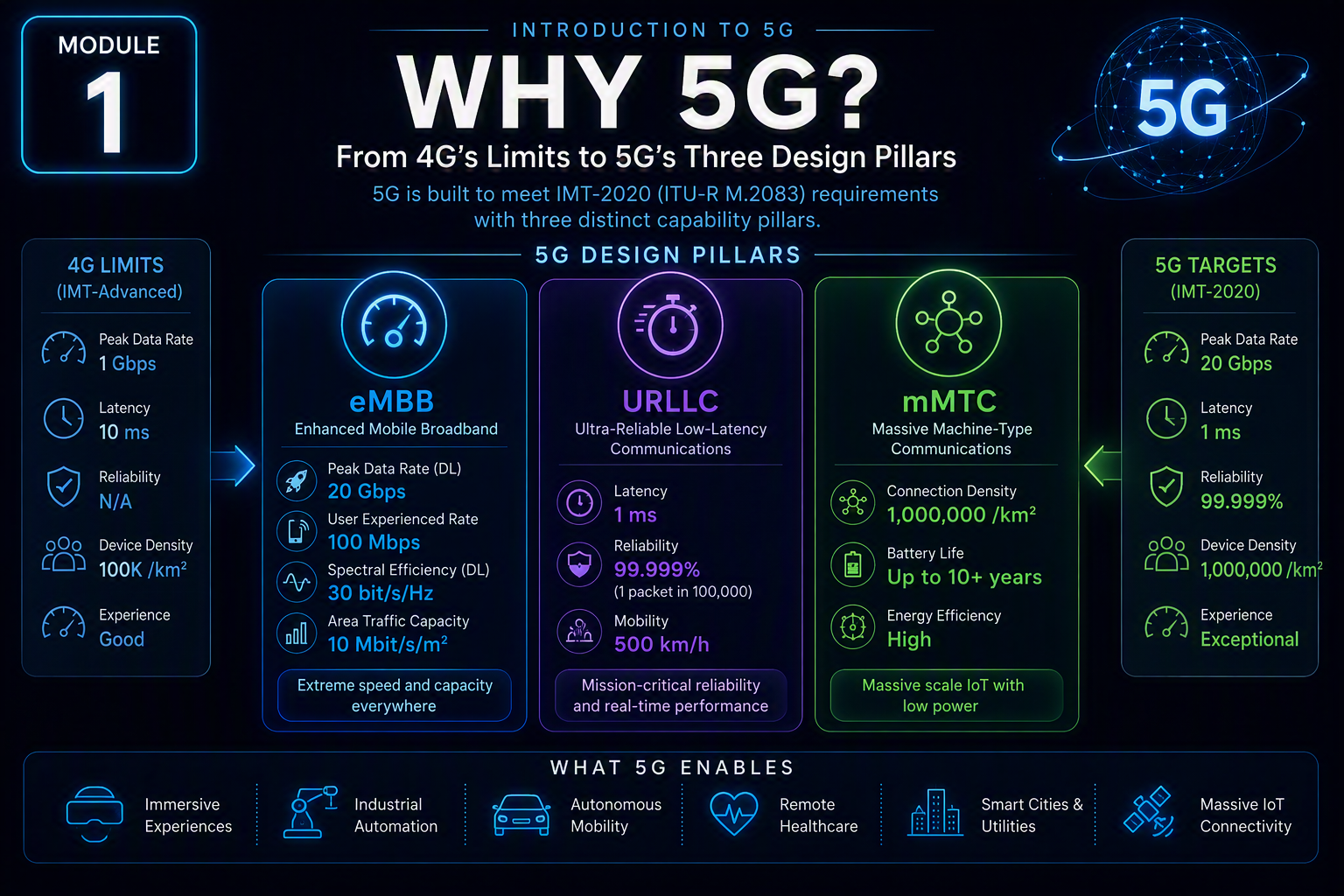
5G design pillars are not a marketing slogan — they are formal, numerically defined requirements set by the ITU-R under the IMT-2020 framework, published in Recommendation ITU-R M.2083, and subsequently translated into concrete 3GPP specifications starting with Release 15 in 2018. Understanding these three pillars precisely — not just their names, but the actual numbers behind them — is the right place to start a course on 5G, because nearly every architectural decision covered in the following thirteen modules exists specifically to satisfy one of these three requirement sets, or to resolve the tension between them.
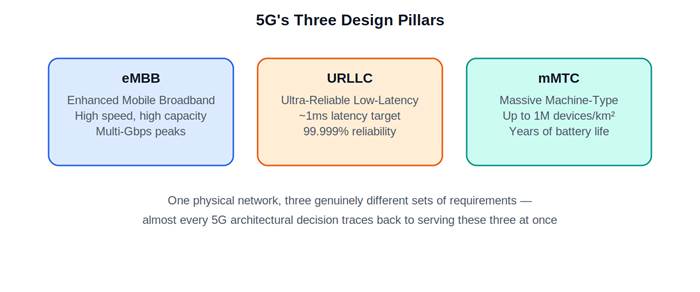
Diagram for Module 1
Diagram: The three 5G design pillars — eMBB, URLLC, and mMTC — and the requirement each one drives.
Why mobile networks needed a fundamentally different design brief
Every previous mobile generation had a relatively narrow design brief. 2G (GSM) was built for digital voice and text. 3G (UMTS/HSPA) was built to make mobile data viable. 4G (LTE) was built around a single, clear objective: mobile broadband fast enough to feel like a genuine internet connection. LTE succeeded at that brief decisively — Release 8 through Release 14 pushed peak theoretical downlink speeds from roughly 100 Mbps to over 1 Gbps under LTE-Advanced Pro, using techniques like carrier aggregation and higher-order MIMO.
But LTE’s architecture makes structural assumptions that work well for broadband and poorly for almost anything else. Its radio interface, control-plane signaling, and core network were tuned around a specific traffic profile: humans, on smartphones, consuming or generating content, tolerant of latency in the tens of milliseconds, with batteries charged nightly. By the early-to-mid 2010s, three separate industry pressures were converging on requirements LTE’s foundational design was never built to satisfy:
- Industrial and safety-critical automation needed latency and reliability guarantees an order of magnitude tighter than anything LTE targeted — robotics coordination, factory automation, and eventually vehicle-to-everything (V2X) communication where a late packet isn’t an inconvenience but a safety failure.
- Massive-scale IoT deployment needed to support device densities and battery lifespans that made sense for a utility smart meter or an agricultural sensor expected to run for a decade on a single battery — completely outside LTE’s assumption of a device charged nightly.
- Continued, compounding broadband demand — driven by video, and later AR/VR and cloud gaming — kept pushing raw throughput and spectral efficiency requirements upward, even within the use case LTE was already built for.
Trying to solve all three of these with LTE’s single-purpose design philosophy, the way LTE had solved one problem well, structurally could not work. This is the problem 5G’s three-pillar design brief was built to solve.
The formal ITU-R IMT-2020 requirements behind each pillar
The ITU-R didn’t leave “5G” as an undefined marketing term — IMT-2020 (Recommendation ITU-R M.2083, finalized in 2015, with detailed technical performance requirements in ITU-R M.2410) set specific, testable numerical targets across eight key capability dimensions, several of which map directly onto the three pillars:
| Capability | IMT-2020 (5G) target | IMT-Advanced (4G) baseline | Pillar |
| Peak data rate (downlink) | 20 Gbps | 1 Gbps | eMBB |
| Peak data rate (uplink) | 10 Gbps | 0.5 Gbps | eMBB |
| User-experienced data rate | 100 Mbps | 10 Mbps | eMBB |
| Peak spectral efficiency (DL) | 30 bit/s/Hz | 15 bit/s/Hz | eMBB |
| Area traffic capacity | 10 Mbit/s/m² | 0.1 Mbit/s/m² | eMBB |
| User-plane latency | 1 ms | 10 ms | URLLC |
| Reliability | 99.999% (1 packet in 100,000 lost within 1ms budget) | Not formally targeted | URLLC |
| Mobility (max speed with acceptable QoS) | 500 km/h | 350 km/h | URLLC |
| Connection density | 1,000,000 devices/km² | 100,000 devices/km² | mMTC |
| Energy efficiency | Significantly higher (network and device side) | IMT-Advanced baseline | mMTC |
Source: ITU-R Recommendation M.2083 (IMT Vision) and ITU-R Report M.2410 (Minimum requirements for IMT-2020).
These aren’t aspirational round numbers chosen for a press release — they were the formal bar every candidate 5G radio interface technology (including 3GPP’s NR submission) had to clear during the ITU-R’s IMT-2020 evaluation process, completed in 2020. Every module in this course maps back to one or more rows in this table.
eMBB (Enhanced Mobile Broadband)
eMBB is the direct evolution of what 4G already did well, pushed substantially further: more peak speed, more area capacity, better spectral efficiency, and more consistent performance at cell edges. This is what most consumers experience as “5G is fast” — and it’s the pillar closest to being fully realized in commercial networks today, particularly on mid-band FR1 spectrum (covered in Module 2).
eMBB’s demands drive several specific design choices covered later in this course: the extension into higher frequency ranges including mmWave (Module 2) to access the raw bandwidth 20 Gbps peak rates require; massive MIMO and beamforming (Module 7) to extract more spectral efficiency from existing spectrum; and flexible numerology (Module 4) tuned toward wider channel bandwidths in FR1 mid-band and FR2.
URLLC (Ultra-Reliable Low-Latency Communication)
URLLC is the pillar with no real LTE precedent — 4G’s 10ms latency target and lack of a formal reliability guarantee made it structurally unsuited to safety-critical, real-time control applications. URLLC’s 1ms latency and 99.999% reliability target opened up genuinely new use case categories: remote surgery, industrial closed-loop control, autonomous vehicle coordination, and smart grid protection systems, where a late or lost packet has consequences well beyond a paused video stream.
URLLC’s requirements drive some of 5G’s most structurally novel engineering: mini-slot scheduling and transmission preemption (Module 6), which let latency-critical traffic interrupt already-scheduled transmissions rather than waiting for a slot boundary; wider subcarrier spacing numerologies (Module 4) that shrink symbol duration; and — at the architectural level — Control and User Plane Separation (Module 11), which makes it practical to deploy user-plane processing physically close to where URLLC traffic originates, shaving off the propagation delay that centralized processing would otherwise add.
mMTC (Massive Machine-Type Communication)
mMTC targets a connection density LTE was never designed to approach efficiently: up to 1,000,000 devices per square kilometer, most transmitting small, infrequent payloads, expected to operate for years on a single battery. This is the pillar behind smart utility metering, large-scale agricultural sensor networks, and industrial asset tracking at a scale where per-device signaling overhead — negligible for a smartphone recharged nightly — becomes the dominant cost at scale.
mMTC’s requirements connect most directly to network slicing (Module 12), where an mMTC-tuned slice can be configured with signaling and scheduling optimized for infrequent, small transmissions rather than throughput, without that configuration compromising the eMBB or URLLC slices running on the same physical infrastructure.
Where the industry actually stands on all three, honestly
It’s worth being precise about commercial reality rather than repeating early 5G marketing uncritically: eMBB is mature and broadly deployed today, particularly on mid-band FR1. URLLC and mMTC are real, standardized in detail across 3GPP Release 15 through Release 17, and increasingly deployed — but adoption has concentrated in specific enterprise, industrial, and private-network contexts rather than achieving blanket consumer availability the way eMBB has. The three-pillar framework should be read as IMT-2020’s design target and 3GPP’s standardized capability set — not a claim that all three are equally mature in every commercial network today.
Why this framework matters for the rest of this course
Every module that follows traces back to satisfying one of these three rows in the IMT-2020 table, or to resolving a genuine tension between them. When a 5G mechanism seems more architecturally complex than its LTE equivalent — and several genuinely are — the useful diagnostic question is: which pillar, or which conflict between pillars, is driving that complexity? 5G isn’t more complicated than 4G for its own sake. It’s more complicated because IMT-2020 set three formally distinct, independently demanding requirement sets for one physical network to satisfy simultaneously, where 4G’s IMT-Advanced predecessor set essentially one.
Next in this series: Module 2 — The 5G Spectrum Story, covering FR1, FR2, and why 5G needed access to entirely new frequency bands to make eMBB’s peak-rate targets physically achievable.
One thought on “Introduction to 5G — Module 1: Why 5G? From 4G’s Limits to 5G’s Three Design Pillars”