

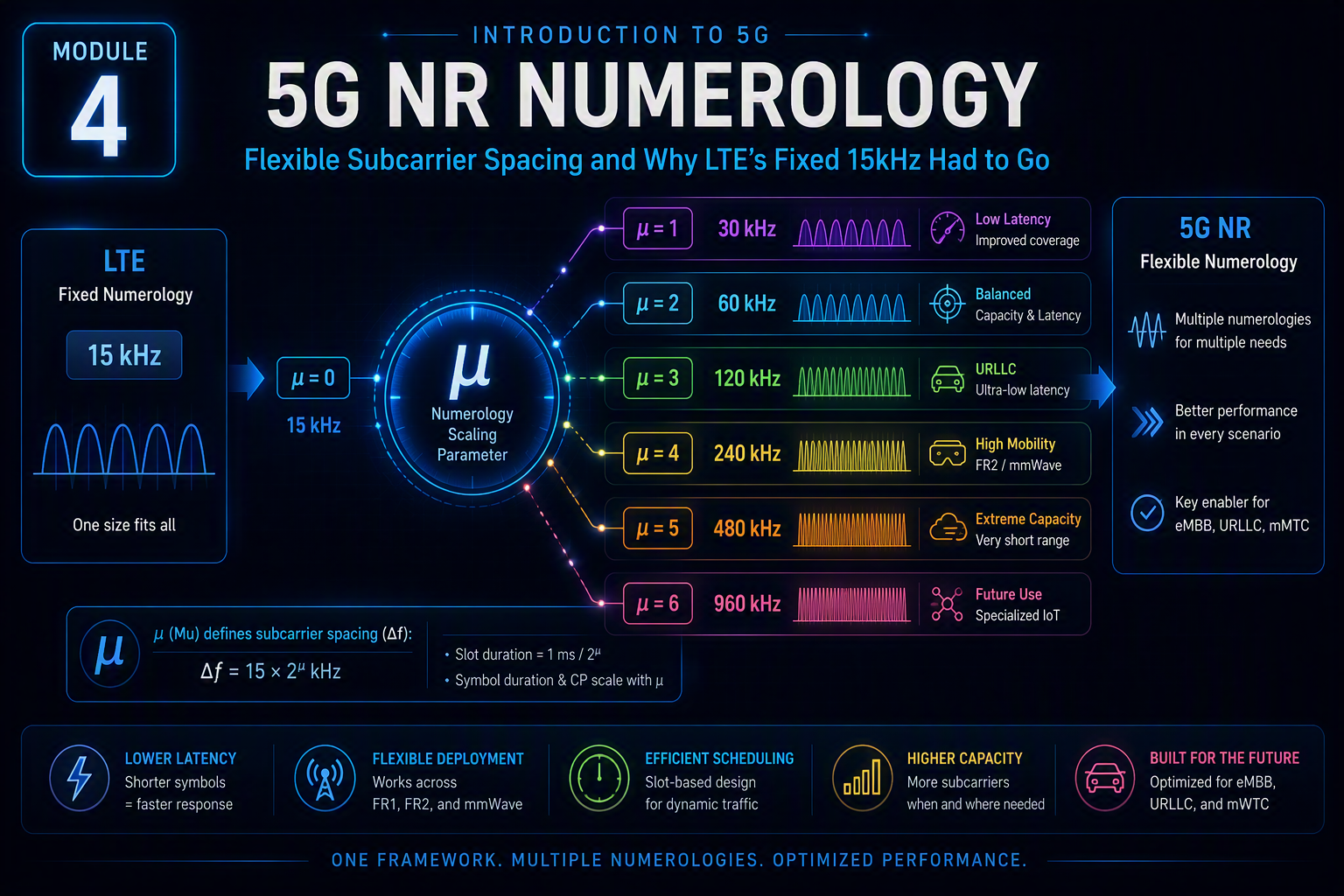
5G NR numerology is defined precisely in 3GPP TS 38.211, Section 4.2, as a scaling parameter μ that determines subcarrier spacing, symbol duration, and cyclic prefix — and unlike LTE’s single fixed value, NR now defines seven distinct numerologies across Releases 15 through 17, each serving a genuinely different deployment scenario.
LTE’s fixed grid: one size fits all
LTE’s entire radio interface is built on a single, fixed subcarrier spacing: 15 kHz, always, everywhere, producing a symbol duration of roughly 66.7 microseconds. This uniformity simplified LTE’s design and cross-vendor interoperability, but meant LTE couldn’t tune its radio timing to different use cases — a limitation that became a hard constraint once Module 1’s URLLC and mMTC requirements entered the picture.
The complete NR numerology table, per TS 38.211
3GPP defines subcarrier spacing as Δf = 2^μ × 15 kHz. As of Release 17, seven numerologies are defined:
| μ | Subcarrier spacing | Symbol duration (approx.) | Slots/subframe | Cyclic prefix | Frequency range | Typical use |
| 0 | 15 kHz | 66.7 µs | 1 | Normal | FR1 | Wide coverage, general use |
| 1 | 30 kHz | 33.3 µs | 2 | Normal | FR1 | General FR1 mid-band |
| 2 | 60 kHz | 16.7 µs | 4 | Normal or Extended | FR1/FR2 | FR1/FR2 boundary, extended CP for large delay spread |
| 3 | 120 kHz | 8.33 µs | 8 | Normal | FR2-1 | mmWave, low latency |
| 4 | 240 kHz | 4.17 µs | 16 | Normal | FR2-1 | SSB signaling only, not data |
| 5 | 480 kHz | 2.08 µs | 32 | Normal | FR2-2 | Added Release 17, 52.6–71 GHz |
| 6 | 960 kHz | 1.04 µs | 64 | Normal | FR2-2 | Added Release 17, 52.6–71 GHz |
Source: 3GPP TS 38.211, Table 4.2-1 and Release 17 changes for FR2-2 (52.6–71 GHz) support.
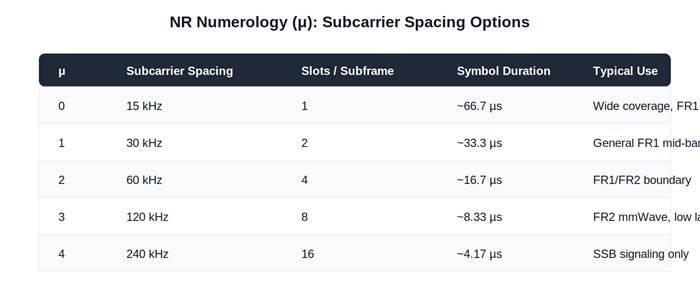
Diagram for Module 4
Diagram: 5G NR numerology — subcarrier spacing, slot count, and symbol duration by μ.
Two details are worth being precise about: μ=2 (60 kHz) is the only numerology in the original Release 15 set to support both Normal and Extended cyclic prefix, the latter used where multipath delay spread is severe enough to require more guard time between symbols. And μ=5 and μ=6 didn’t exist until Release 17, added specifically to support the FR2-2 extension to 71 GHz covered in Module 2 — a detail most 5G explainers written before 2022 miss entirely.
Why subcarrier spacing and symbol duration trade off
Doubling the subcarrier spacing halves the symbol duration — this isn’t an arbitrary trade, it’s the mechanism that lets NR tune its air-interface timing to Module 1’s competing requirements:
- Wider spacing (μ=3 through μ=6) produces shorter symbols and shorter slots, directly reducing achievable latency — well suited to URLLC and to FR2/mmWave, where wider channel bandwidths make wide subcarrier spacing practical and shorter symbols help combat FR2-specific propagation effects.
- Narrower spacing (μ=0, μ=1) produces longer symbols, more robust to multipath delay spread and more efficient for wide-area coverage — better suited to typical FR1 deployments prioritizing eMBB coverage over shaving off the last millisecond of latency.
Why this matters beyond the specification detail
This flexibility directly implements Module 1’s three-pillar tension. A single fixed numerology, the way LTE had it, would force every use case to accept the same latency/coverage tradeoff — precisely the limitation that made LTE structurally unsuited to URLLC. By making numerology a per-deployment, sometimes per-use-case configurable parameter, NR can serve an eMBB use case on FR1 mid-band with μ=1, while simultaneously supporting URLLC with μ=3 — potentially within the same deployment, depending on spectrum and configuration.
The tradeoff worth remembering
Supporting seven numerologies rather than one adds real complexity to scheduler design, to how different numerologies coexist in adjacent spectrum without interference, and to device implementation generally. This is a pattern worth carrying forward: 5G repeatedly trades implementation complexity for flexibility, because IMT-2020’s requirement set (Module 1) required giving up the simplicity of LTE’s one-size-fits-all radio design.
Next in this series: Module 5 — 5G RAN Architecture: gNB and the CU/DU/RU Split Explained.