

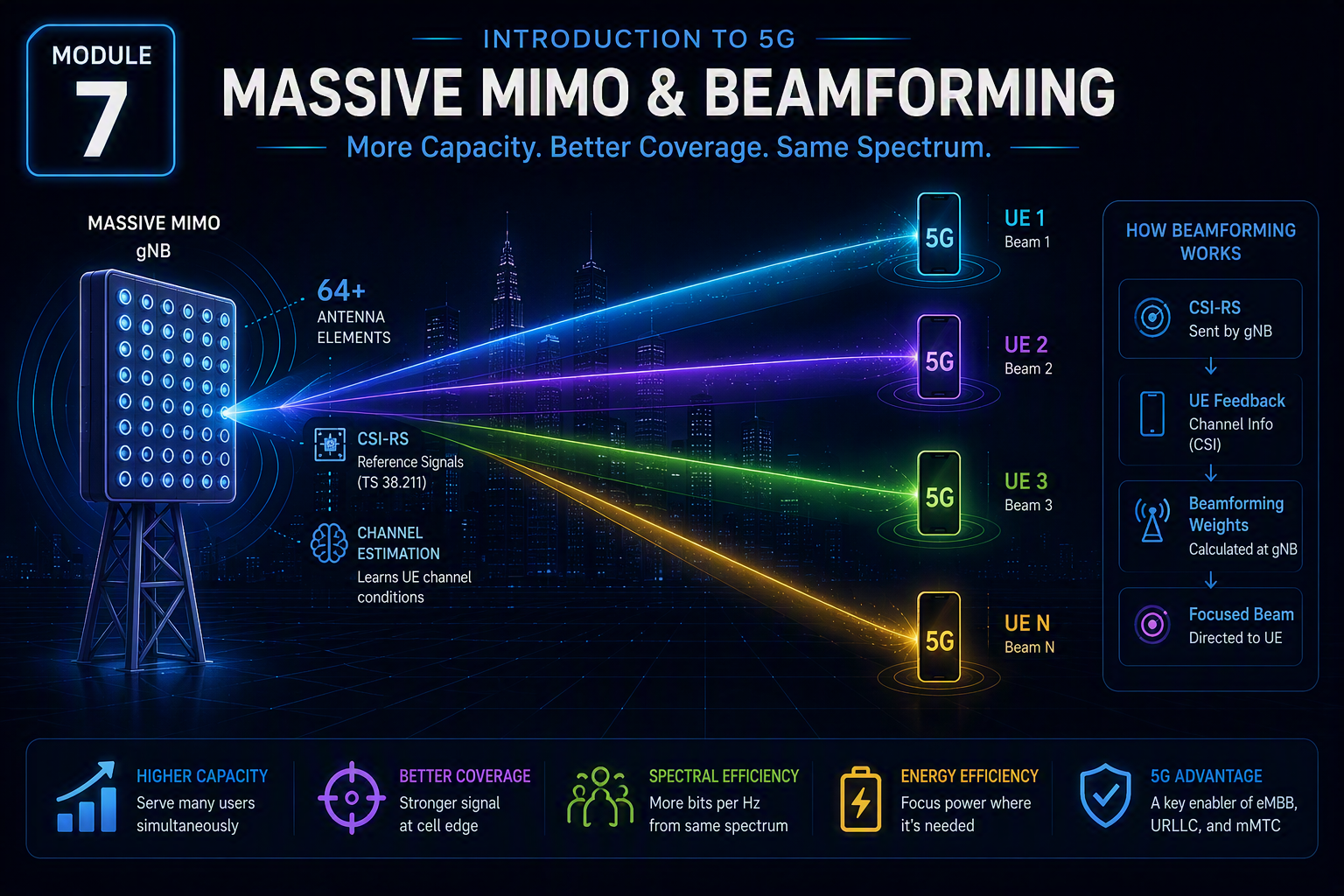
Massive MIMO beamforming 5G implementations rely on standardized reference signal feedback — principally CSI-RS, defined in 3GPP TS 38.211, Section 7.4.1.5 — to let a base station learn each device’s spatial channel well enough to form and steer a concentrated beam toward it. This is arguably where 5G’s most significant real-world capacity gains actually come from, and it’s a genuinely new capability class relative to LTE.
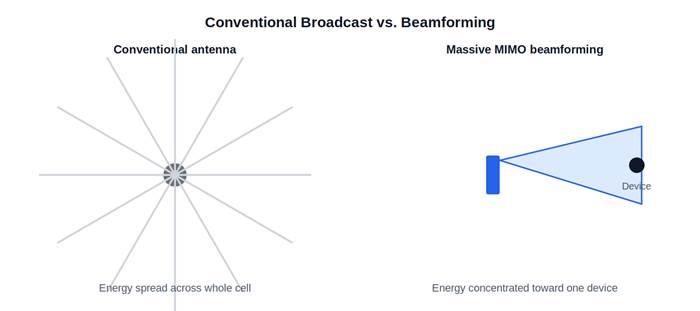
Diagram for Module 7
Diagram: Massive MIMO beamforming 5G — concentrated beam versus conventional broadcast.
From a handful of antennas to dozens
LTE base stations typically use 2, 4, or 8 antenna elements. Commercial 5G massive MIMO deployments on mid-band FR1 commonly use 32T32R or 64T64R arrays (32 or 64 transmit/receive chains) — a scale that enables fundamentally different spatial techniques than a small array can support, not merely “more of the same.”
Beamforming: directing signal instead of broadcasting it
A conventional antenna radiates signal broadly across a wide area. Beamforming uses a massive MIMO array to shape and steer a concentrated beam toward a specific device’s location, constructively combining signals from many antenna elements so they reinforce each other in the target direction. NR supports both analog beamforming (a single beam direction per RF chain, common in FR2 given hardware cost constraints) and digital beamforming (independent beam control per antenna element, common in FR1 massive MIMO), with hybrid beamforming — combining both — used in many practical FR2 implementations to balance cost against flexibility.
CSI-RS: how the network learns the channel
Beamforming and MU-MIMO both depend on the network having reasonably accurate, reasonably current spatial channel knowledge per device. NR standardizes this through the Channel State Information Reference Signal (CSI-RS), per TS 38.211 Section 7.4.1.5, transmitted by the gNB and measured by the UE, which reports back channel quality and precoding recommendations via CSI reporting (TS 38.214, Section 5.2). This is a meaningfully richer feedback framework than LTE’s CSI-RS equivalent, reflecting the larger antenna counts and more sophisticated beamforming NR was designed to support from the outset.
Multi-user MIMO: serving many devices simultaneously
Beamforming a signal to one device is valuable, but massive MIMO’s real capacity payoff comes from MU-MIMO: using the same time-frequency resources to simultaneously serve multiple devices by forming spatially distinct beams toward each one at once. Because the beams are directed differently in space, devices in different physical locations can effectively reuse the same resource block simultaneously without interfering — spatial multiplexing that a small, conventional antenna array doesn’t have enough elements to support effectively. Commercial deployments commonly support 8 to 16 MU-MIMO layers on a 64T64R array under good channel conditions, directly multiplying effective cell capacity on identical spectrum.
Why this matters more for 5G than it did for LTE
Two factors specifically make massive MIMO a bigger deal in 5G than it ever was practically in LTE. First, 5G’s mid-band and higher frequencies (Module 2) have physically smaller wavelengths, letting far more antenna elements pack into a practically sized panel — a 64-element array at 3.5 GHz (band n78) is manageable in a way a 64-element array at 800 MHz (band n5) simply isn’t. Second, IMT-2020’s eMBB capacity targets from Module 1 are ambitious enough that spectrum alone — even with FR2’s enormous available bandwidth — can’t deliver them cost-effectively everywhere; spatial reuse through MU-MIMO is a necessary complementary lever.
The takeaway
Massive MIMO and beamforming represent 5G extracting more capacity from existing spectrum through smarter spatial use, standardized through CSI-RS feedback and formalized precoding frameworks — a genuinely different lever than the frequency-range expansion covered in Module 2, and one that depends heavily on the higher frequencies and denser antenna arrays 5G’s spectrum strategy specifically made practical.
Next in this series: Module 8 — 5G NR Initial Access: Cell Search, SSB, and Random Access in NR.