

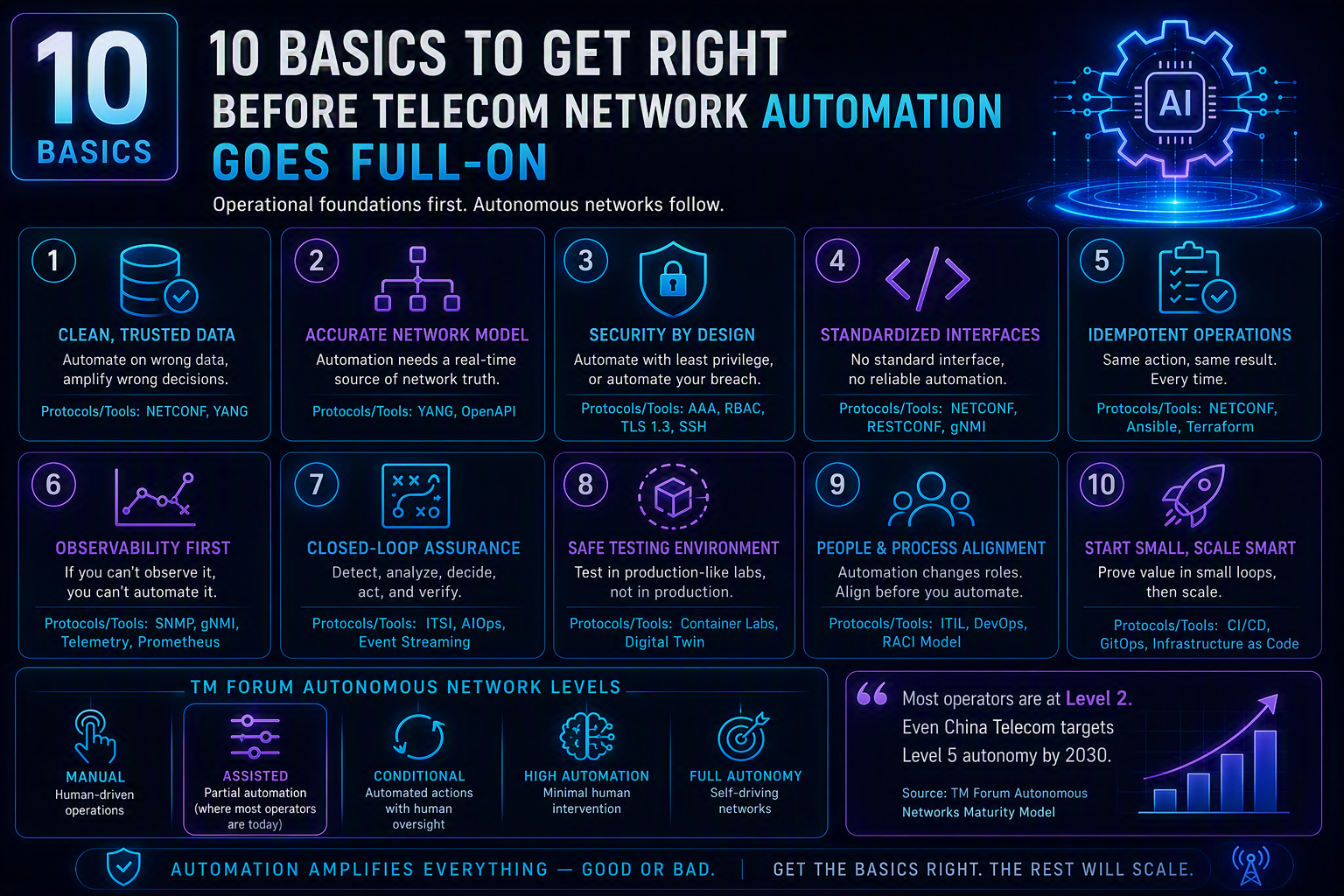
Telecom network automation almost never fails because the technology doesn’t work. It fails because operators skip the unglamorous operational groundwork underneath it — and a mistake that would cost one engineer one afternoon to fix manually now propagates to a thousand devices before anyone notices.
TM Forum’s own Autonomous Network Levels model — the industry’s standard maturity framework — puts most operators at Level 2, partial autonomy limited to known, repeatable scenarios. Even China Telecom, cited as one of the furthest along, isn’t targeting full Level 5 autonomy until 2030. The gap between the marketing language around “zero-touch networks” and where operators actually stand is exactly where these ten fundamentals live — along with the protocol-level mechanics that make them enforceable rather than aspirational.
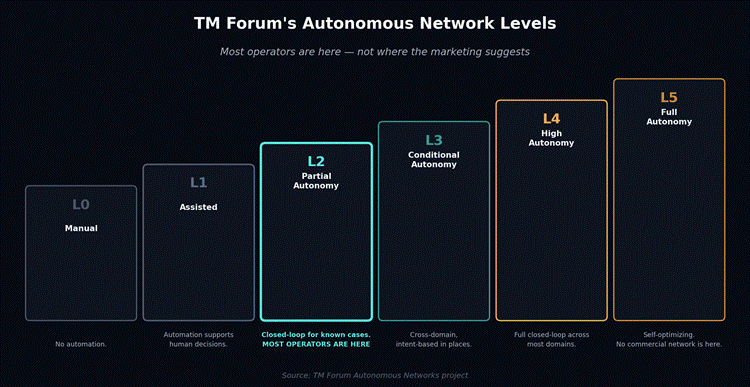
Most operators are still at L2 — automation for known cases, not full autonomy.
1. A golden configuration baseline, version-controlled
Before anything gets automated, there needs to be one authoritative, version-controlled definition of what a correctly configured device looks like. Without it, automation doesn’t eliminate configuration drift — it just distributes whatever inconsistency already existed across every device it touches, faster than a human ever could. In model-driven automation, this baseline is increasingly expressed as a YANG model — a vendor-neutral, machine-readable structure (standardized by the IETF, with OpenConfig maintaining widely-adopted shared models) that defines not just values but validation rules, so a candidate configuration can be checked for correctness before it ever touches a live device.
2. Change management and a rollback plan for every workflow
A small error in a shared template or script doesn’t stay small — it spreads across every device that template touches. This is the single most repeated warning across telecom automation literature, and for good reason: automation doesn’t just execute changes faster, it removes the natural friction that used to catch mistakes before they reached device 500.
3. Multi-vendor lab testing before any production rollout
Every vendor implements automation interfaces — ZTP, NETCONF, proprietary APIs — slightly differently. A workflow validated against one vendor’s gear can fail silently or behave unpredictably against another’s. In any network with mixed RAN or transport vendors, and most telecom networks are, this isn’t an edge case worth skipping in the test plan.
4. DHCP, DNS, and firewall prerequisites — verified, not assumed
This is the least exciting item on this list and also one of the most common real-world failure points. Zero-touch provisioning depends entirely on devices being able to actually reach the provisioning server the moment they power on. If DHCP scopes, DNS entries, or firewall rules weren’t validated ahead of the rollout, the failure looks like a mysterious automation bug when it’s really a network reachability problem underneath the automation layer.
5. Certificate-based authentication on every automation pipeline
An automation pipeline that can push configuration to thousands of devices is one of the highest-value targets in the entire network — and unverified configuration pushes are a real risk, not a theoretical one. Trusted-signature checks and certificate-based authentication on the provisioning pipeline itself aren’t optional hardening; they’re the same priority as securing the devices being provisioned.
The protocol layer underneath all of this: NETCONF, YANG, and confirmed-commit
The ten items above are operational discipline. But they only become enforceable — rather than a checklist someone can forget under deadline pressure — when the underlying protocol layer supports them mechanically. This is where NETCONF and YANG, the IETF standards that have largely replaced CLI scripting and SNMP for configuration management, actually matter.
NETCONF’s transactional model is the direct technical answer to Basic #2. A change is staged in a candidate datastore, separate from the running configuration actually forwarding traffic, and validated against the YANG model before it’s ever applied. Multi-device changes can be committed as a single atomic operation — either the whole set of devices updates, or none of them do, which prevents exactly the kind of partial, half-updated network state that’s hardest to diagnose at 2 a.m.
The specific mechanism worth knowing by name is the confirmed-commit pattern: a change is applied with a timer — commonly around 300 seconds — and only becomes permanent if the engineer or automation system sends explicit confirmation within that window. If confirmation never arrives, because the change itself broke connectivity to the device, the device automatically rolls back to its last known-good state on its own. This single mechanism is what prevents automation’s worst-case scenario: getting permanently locked out of a device by the very change meant to improve it.
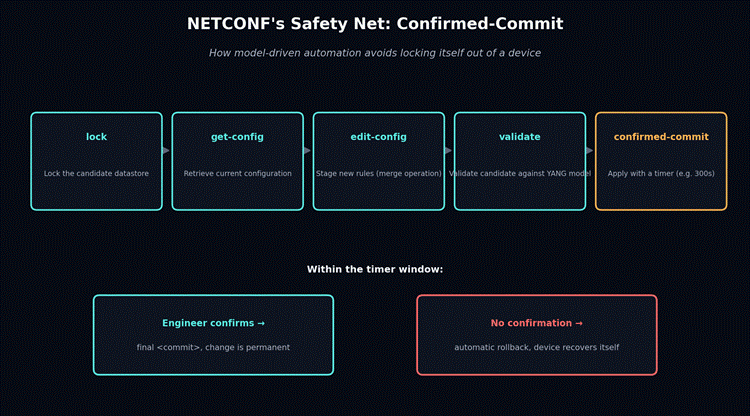
The exact sequence that keeps a bad push from becoming a permanent outage.
GitOps extends this same discipline to the template layer itself. Instead of scripts and configurations living wherever an engineer last saved them, the Git repository becomes the single source of truth — every change to a golden baseline is peer-reviewed, versioned, and auditable before it’s ever pushed to a device, which is the practical, tooling-level implementation of Basic #1.
6. One high-volume workflow first — prove ROI, then expand
The operators pulling ahead in 2026 aren’t necessarily the ones with the largest automation budgets. They’re the ones who started with a single high-volume, well-understood workflow, documented the actual return, and used that concrete proof point to justify the next investment — rather than attempting a platform-wide automation rollout on day one.
7. Know where RPA bridges you, and where it’s a dead end
For operators still running significant legacy infrastructure, robotic process automation is a legitimate way to automate around systems that can’t be replaced quickly. But RPA is a bridge, not a destination — it automates the interaction with a legacy system, not the underlying architecture. Treating it as the end state instead of a transitional step is a common and expensive planning mistake.
8. Explainability for any AI-driven remediation
AI-driven fault management can meaningfully cut mean time to repair — figures in the 50 to 70% range show up consistently in industry reporting. But the “black box” nature of many of these models is a genuine operational risk, not just a compliance checkbox: if an engineer can’t understand why the system took a corrective action, they can’t trust it during an incident, and they definitely can’t defend the decision afterward.
9. Audit logs and human override on every closed loop
Closed-loop automation — detect, decide, execute, validate, all without a human in the loop — is the operational end goal, defined formally in the ETSI ZSM framework. But every closed loop still needs a complete audit trail and a manual override path. The goal is removing routine human intervention, not removing the ability to intervene when something goes wrong.
10. A reskilling plan for the teams automation actually displaces
The organizational side of this list gets skipped more often than the technical side, and it shouldn’t. Automation doesn’t just change tooling — it collapses the specific manual tasks that used to define NOC and field engineering roles. Operators that plan the reskilling path alongside the technical rollout keep the institutional knowledge that made the network reliable in the first place; operators that don’t tend to relearn expensive lessons the automation was supposed to prevent.
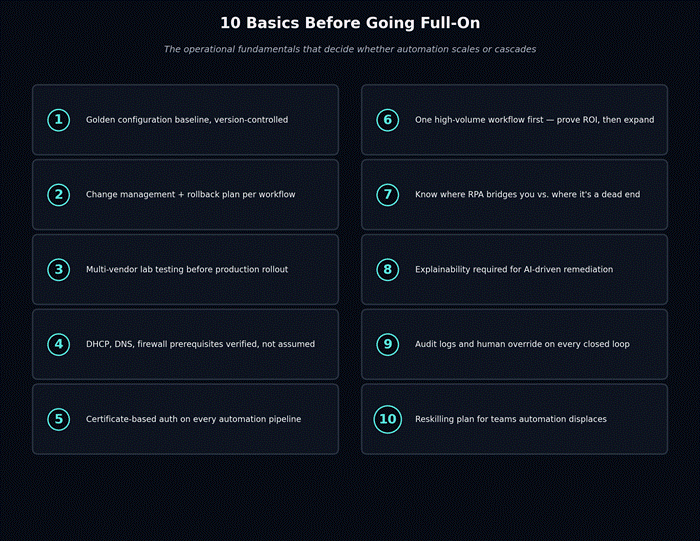
The ten fundamentals, side by side — none of them require exotic tooling.
Where to actually start
Put together, this isn’t a call to slow down — it’s a call to sequence correctly. Establish the golden baseline and version control first, prove the protocol layer’s transactional safety net on one contained workflow, then expand. Every operator cited earlier as further along the Autonomous Network Levels curve got there by compounding proven, narrow wins — not by skipping from L0 straight to a “zero-touch” press release.
Which of these ten has actually been the hardest to get right in your own network — the technical items, the protocol-layer discipline, or the organizational one?