

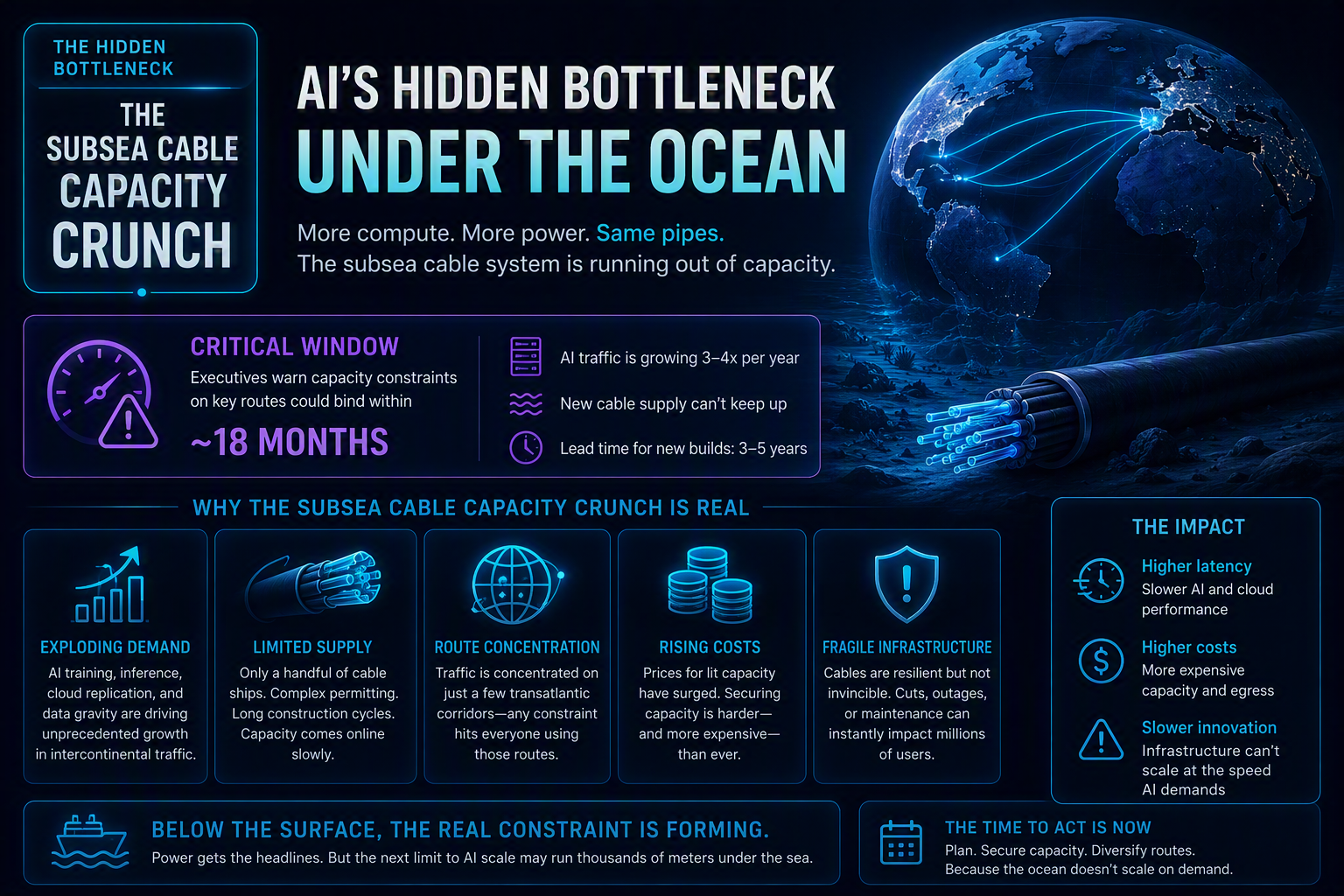
A subsea cable capacity crunch is forming a few kilometers below the surface of the Atlantic, and almost nobody outside the cable industry is talking about it. Everyone in telecom and AI circles is talking about power instead — gigawatt queues, substation delays, nuclear restarts, utilities rationing interconnection slots. The energy story has become the default explanation for why AI infrastructure can’t scale as fast as demand wants it to, and it’s a real constraint. But industry executives now say the ocean-floor bottleneck could bind on some of the world’s busiest data routes within about eighteen months.
Unlike power, which shows up in permitting dockets and utility filings that journalists know how to find, the international cable system is opaque by design — landing stations, consortium ownership structures, and capacity contracts rarely make headlines unless a cable gets cut by a ship’s anchor. That obscurity is exactly why this is the underrated story: the physical layer that AI training runs, inference traffic, and cross-border cloud replication actually travel on is tightening, and the tightening is happening for structural reasons that a few more power plants won’t fix.
The traffic is real, and it’s compounding
Start with the demand side, because the numbers are not hype. According to TeleGeography, which has tracked international bandwidth for over two decades, total international internet bandwidth in use has climbed from 997 Tbps in 2022 to 1,835 Tbps in 2025 — growth of 23% in the most recent year alone, and a four-year compound annual growth rate around 24%. Global bandwidth has nearly doubled in three years.
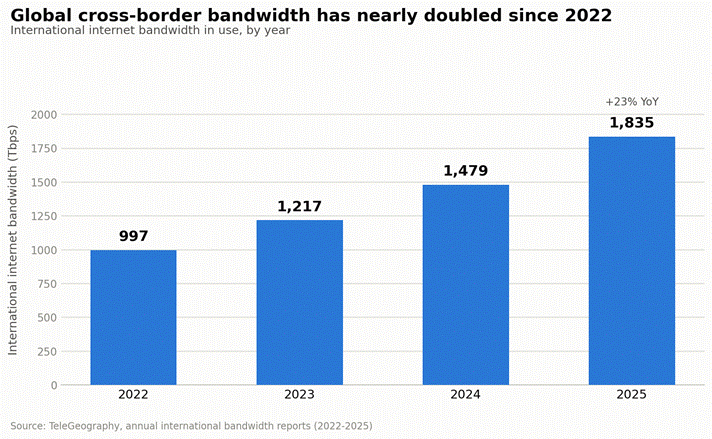
International internet bandwidth in use, 2022–2025. Source: TeleGeography.
That growth isn’t evenly distributed. TeleGeography’s regional breakdowns show Africa and the Middle East posting the steepest compound annual growth rates of any region as connectivity expands, while the most AI-relevant corridor — the North Atlantic route connecting U.S. hyperscaler campuses to European data centers — is seeing something more specific than general growth: a traffic surge concentrated in exactly the years AI workloads went mainstream. EXA Infrastructure, one of the wholesale carriers operating transatlantic capacity, told an industry panel that it carried four times more Atlantic traffic in 2025 than in 2022, 2023, and 2024 combined.
Why the Atlantic is the pressure point
The Atlantic is the world’s highest-traffic subsea route, and it is also its oldest. Cable capacity has scaled enormously since the first modern transatlantic system, PTAT-1, went live in 1988 — EXA puts the increase in per-cable capacity at roughly 279,000-fold. But scale isn’t the same as headroom. Of the 21 subsea cable systems currently active on the Atlantic route, 7 are approaching the end of their operational life, according to EXA Infrastructure’s presentation at a January 2026 industry event covered by RCR Wireless.
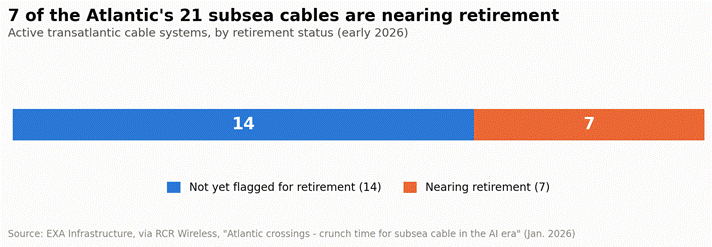
Active transatlantic cable systems by retirement status, early 2026. Source: EXA Infrastructure, via RCR Wireless.
That’s a third of the route’s capacity approaching retirement at the same moment traffic is compounding. EXA’s CEO, Jim Fagan, was blunt about the implication: “We’re facing a severe supply crunch in the Atlantic, probably late 2027,” pointing to hyperscalers’ growing preference for prioritizing their own internal capacity needs over supplying the wholesale market that everyone else — carriers, enterprises, smaller cloud providers — depends on. Google’s Nigel Bayliff, speaking on the same panel, framed the fix in equally blunt terms: more cables, largely on the same well-worn routes, because there isn’t a faster way to add capacity than building more physical fiber.
The deeper shift: hyperscalers are becoming cable owners, not customers
The more structurally important trend isn’t the traffic growth — carriers have absorbed bandwidth growth curves before. It’s who is paying for the new capacity and what they intend to do with it. Google now holds stakes in roughly 30 subsea cable systems, including Sol, Nuvem, Blue, Raman, Equiano, Tabua, and Honomoana. Meta holds interests in around 20. Amazon, which had previously bought capacity rather than building it, announced its first wholly owned subsea cable in late 2025: Fastnet, a transatlantic system connecting Maryland to County Cork, Ireland, engineered for more than 320 Tbps of capacity and expected in service by 2028. Microsoft and Meta remain partners on the existing Marea transatlantic route. New systems planned for delivery between 2026 and 2029 represent more than $16 billion in committed investment, according to reporting compiled by Fierce Network — and TeleGeography’s own ten-year forecast puts average annual submarine cable investment at roughly $5 billion a year through 2035, with intra-Asian routes alone drawing an estimated $11 billion and the active cable count on that corridor rising from 14 to 19 systems.
That capital is real and welcome — modern cables carry up to 24 fiber pairs, versus four on older systems, so new builds do materially expand capacity. But ownership matters as much as capacity. As Colt Technology Services executive Joe Scattareggia put it, describing why transatlantic demand has become so “hot”: “A lot of the models in the U.S. will have to get a lot of traffic to Europe, so we’re seeing a lot of activity on subsea.” When the entity building the cable is also the primary user of the cable, wholesale carriers, enterprises, and smaller cloud and AI providers increasingly compete for what’s left over — a dynamic AzerTelecom CEO Ana Nakashidze flagged directly, warning that hyperscaler-controlled maintenance and infrastructure agendas risk diminishing the role traditional network operators have played in keeping the internet’s backbone neutral and broadly accessible.
Why this deserves the same attention as the power story
The AI power narrative is compelling partly because it’s visible: gigawatt figures are easy to compare, and grid operators publish queue data. Subsea capacity is harder to see, which is precisely why it’s underrated rather than unimportant. A few reasons this belongs on the same watchlist as grid interconnection:
It caps AI’s geographic distribution, not just its total scale. Power constraints slow how much compute you can build in one place. A cable capacity constraint on a specific route — the Atlantic in particular — limits how fast that compute, once built, can synchronize model weights, replicate training data, or serve inference traffic across the U.S.-Europe corridor specifically. You can’t route around a full undersea cable the way you can, in principle, site a data center in a different power market.
It concentrates leverage. As hyperscalers shift from being subsea capacity’s biggest customers to being its owners, telecom carriers, enterprises with cross-border operations, and AI companies without hyperscaler balance sheets inherit more pricing and availability risk on exactly the routes they can’t avoid using.
It compounds with an aging asset base. Grid buildout is slow, but it’s additive — new substations don’t require retiring old ones on the same timeline that seven aging Atlantic cables are approaching end-of-life. Subsea capacity has a retirement clock running in parallel with a demand curve, and the industry’s own executives are now naming a specific window — late 2027 — when the two lines could cross on the world’s most heavily trafficked route.
What this means for telecom and enterprise IT leaders
None of this is a reason to panic, but it is a reason to build subsea capacity risk into planning the way power availability already gets built in. A few practical implications, independent of vendor:
For carriers and wholesale network operators, the strategic questions raised on that January panel — build private capacity versus continue serving the wholesale market — deserve board-level attention now, not in 2027. Diversifying route and landing-station exposure, rather than concentrating on the busiest Atlantic crossings, is a hedge worth pricing today.
For enterprises with transatlantic data flows — financial services, multinational SaaS providers, any organization doing cross-border AI training or inference — cable route diversity is becoming as relevant to resilience planning as multi-region cloud architecture already is. Ask cloud and connectivity providers which physical cables carry your traffic, and whether that capacity is wholesale or a hyperscaler’s private allocation.
For AI infrastructure planners, the assumption that compute and power are the binding constraints on global AI buildouts is increasingly incomplete. International bandwidth is not infinite, and on specific corridors, it may bind first.
The power grid will keep making headlines because it’s the more visible, more easily quantified constraint. But the fiber under the Atlantic — aging, increasingly hyperscaler-owned, and carrying four times the AI-era traffic it carried just two years ago — is the quieter story that telecom and enterprise tech leaders should be watching just as closely.
Sources
- TeleGeography, “International Internet Bandwidth Now Sits at 1,835 Tbps” — https://resources.telegeography.com/international-internet-bandwidth
- TeleGeography, “Total International Bandwidth Now Sits at 1,835 Tbps” (blog) — https://blog.telegeography.com/international-internet-bandwidth
- IEEE ComSoc Technology Blog, “TeleGeography: Global internet bandwidth rose by 28% in 2022” — https://techblog.comsoc.org/2022/09/19/telegeography-global-internet-bandwidth-rose-by-28-in-2022/
- TeleGeography, “Forecasting the Next 10 Years of Submarine Cable Investment and Kilometers” — https://resources.telegeography.com/forecasting-the-next-10-years-of-submarine-cable-investment-and-kilometers
- RCR Wireless, “Atlantic crossings – crunch time for subsea cable in the AI era” (Jan. 2026) — https://www.rcrwireless.com/20260128/network-infrastructure/subsea-cable-crunch-time-ai
- Fierce Network, “Subsea cables are becoming a hotbed of AI network activity” — https://www.fierce-network.com/cloud/subsea-cables-are-becoming-hotbed-ai-network-activity
- Fierce Network, “Major fiber vendors strategize for huge demand from AI in 2026” — https://www.fierce-network.com/broadband/major-fiber-vendors-strategize-huge-demand-ai-2026
- Capacity, “Subsea cable investment hits new heights as AI drives demand for ocean bandwidth” — https://capacityglobal.com/news/subsea-cable-investment-ai-drives-demand-for-ocean-bandwidth/
- Data Center Dynamics, “Amazon announces US-Ireland subsea cable” (Fastnet) — https://www.datacenterdynamics.com/en/news/amazon-announces-us-ireland-subsea-cable/
- S&P Global Market Intelligence, “New subsea cable developments, Q1 2026” — https://www.spglobal.com/market-intelligence/en/news-insights/research/2026/05/new-subsea-cable-developments-q1-2026