

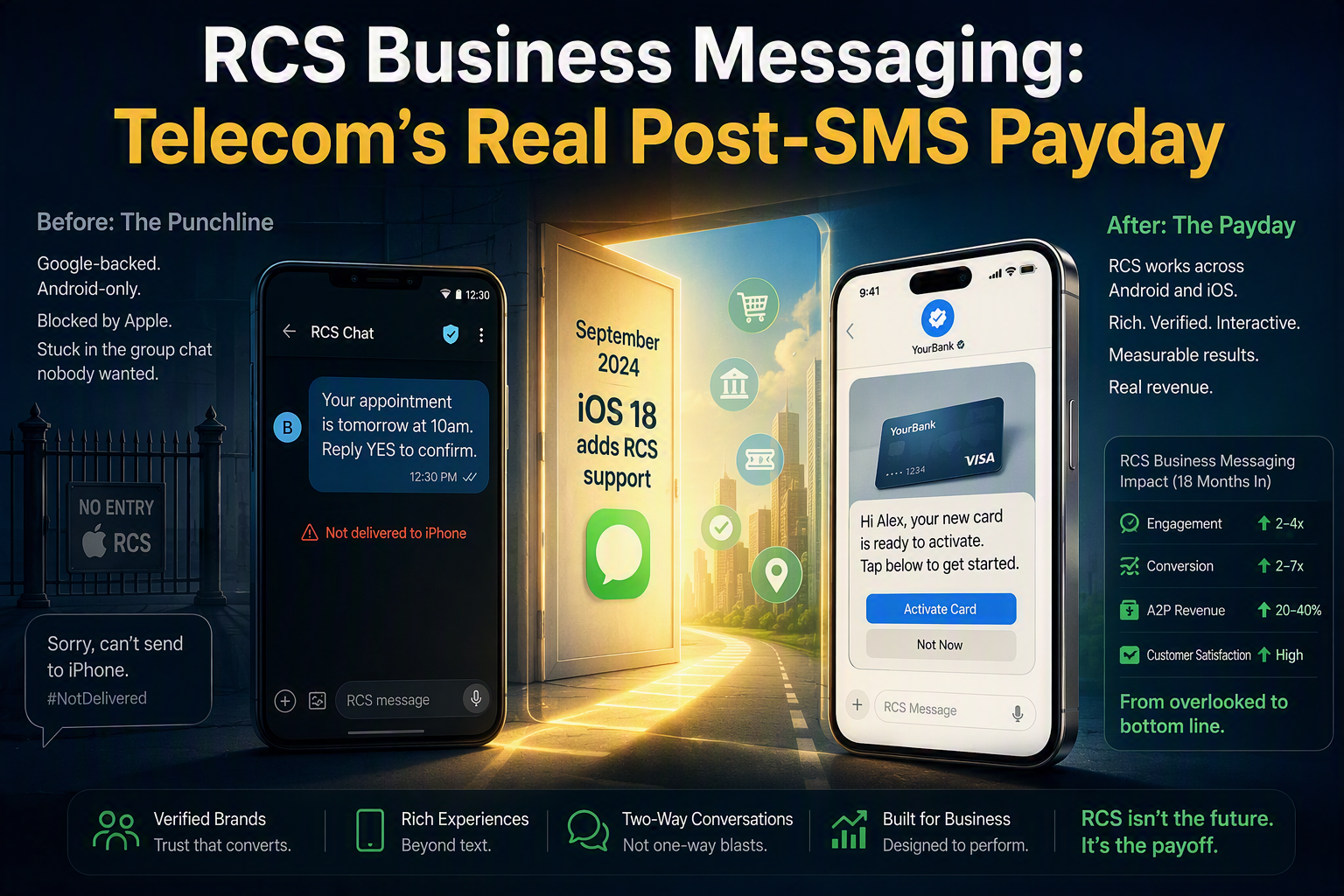
RCS business messaging spent nearly a decade as a telecom punchline — a Google-backed successor to SMS that never quite escaped Android, blocked at the door by Apple’s refusal to support it on iPhone. That changed in September 2024, when iOS 18 finally added RCS support, and the eighteen months since have quietly turned a stalled standard into one of the more concrete new revenue lines telecom operators have found in years. It hasn’t made headlines the way AI infrastructure or spectrum auctions have. It should.
The mechanics are simple enough: RCS (Rich Communication Services) is the GSMA-standardized successor to SMS and MMS, carrying read receipts, typing indicators, high-resolution images, and — for the “business messaging” variant this piece is about — verified sender branding, interactive buttons, and rich cards that let a bank, airline, or retailer send something closer to a lightweight app experience through the native messaging inbox rather than SMS’s 160-character text box. The technology itself isn’t new. What’s new is that, for the first time, it reaches nearly everyone.
The catalyst: Apple stopped saying no
Before iOS 18, RCS business messaging was a reach problem as much as a technology one — operators and brands could build rich, interactive campaigns, but a meaningful share of any contact list was on an iPhone that would silently fall back to plain SMS. Apple’s move to support the GSMA’s RCS Universal Profile changed the addressable market overnight in the markets that mattered most.
The device-penetration numbers reported by Infobip and Google’s Jibe platform tell the story bluntly: RCS-capable device penetration in the US jumped from roughly 4–5% before the rollout to around 70% after it; France went from about 25% to 80%; Germany from 50% to 80%; the UK from 35% to 70%. In North America specifically, RCS traffic on Infobip’s platform grew roughly 70-fold in 2025 alone, dwarfing the 4-to-7x growth seen in Europe, Latin America, and Asia-Pacific over the same period — a reflection of just how much pent-up demand had been sitting behind Apple’s holdout.
The revenue is starting to show up
Juniper Research, which tracks the category closely, put global operator RCS-for-Business revenue at $1.2 billion in 2025, forecast that to reach $3.1 billion by 2027 (150% growth in two years), and separately projects it climbing to roughly $7 billion by 2030 as message volume grows from an estimated 125 billion messages in 2026 to 485 billion by 2030. Juniper’s own researchers frame the current moment as a shift in what the hard problem actually is: “Historically, the biggest challenge with RCS for Business was cultivating demand for a channel with limited reach,” said senior analyst Molly Gatford. “Now, with RCS penetration surpassing 80% in markets such as the US and France, operators face a new challenge: establishing effective pricing models for conversational use cases to unlock new revenue.”
US carriers moved on that pricing question in January 2026, publishing separate per-message rates for authentication and utility messages versus richer marketing content — AT&T and T-Mobile both priced authentication messages at $0.0045, with Verizon slightly lower at $0.0040, while rich-media marketing messages ran from $0.006 at Verizon up to $0.0135 at US Cellular. The differentiated pricing matters: it signals operators treating RCS not as a flat commodity channel but as a tiered product, priced by the value of the interaction rather than just the bytes sent — a meaningfully different commercial model than SMS ever had.
Engagement data is a real part of the pitch to enterprise buyers, not just operators. Industry reporting from Infobip cites RCS open rates around 72%, click-through rates in the 15–30% range (with some campaigns reporting up to 51%), and conversion rates 60–70% higher than MMS with rich cards — the kind of numbers that let operators and messaging platforms argue RCS is additive spend rather than a like-for-like SMS replacement. Verticals are adopting unevenly: retail still generates the largest share of RCS traffic (projected above 30% through 2030, though down from a larger share in 2026 as other sectors scale), while healthcare and banking messaging volumes are forecast to grow the fastest — over 1,000% and 600% respectively by 2030 off smaller current bases.
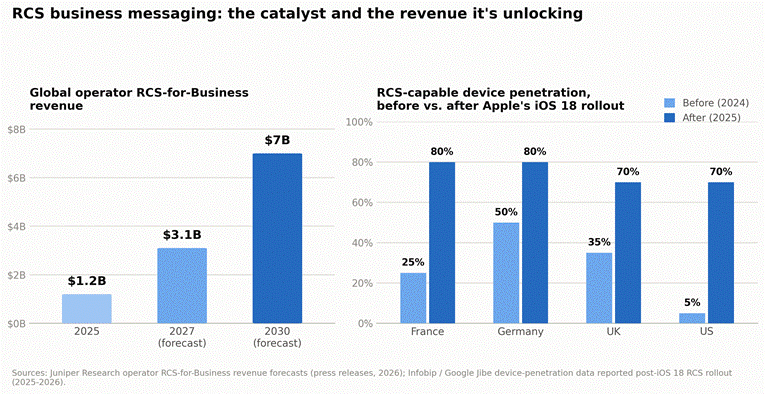
Apple’s iOS 18 RCS rollout drove device penetration past 70% in the US and 80% in parts of Europe within about a year — and operator revenue forecasts followed.
The vendor-neutral caveats worth sitting with
None of this makes RCS business messaging a clean win for operators, and a fair reading has to hold two things at once. First, a meaningful share of this growth is substitution, not addition: A2P SMS revenue has been under sustained pressure industry-wide as OTT channels and now RCS itself pull volume away from plain-text messaging, so some portion of the RCS revenue line is replacing SMS revenue operators were already earning rather than creating entirely new spend. Whether RCS nets out as genuinely incremental for a given operator depends heavily on how much of its message volume was previously billed as A2P SMS versus how much is new conversational and marketing use cases that wouldn’t have existed as SMS campaigns at all.
Second, distribution runs disproportionately through Google’s Jibe platform, which underpins RCS messaging for the large majority of Android devices and interoperates with Apple’s implementation — meaning operators, once again, are building a monetization layer on top of infrastructure a platform company substantially controls, echoing the aggregator dynamics already playing out in adjacent network-API markets. And pricing fragmentation across carriers — visible in the gap between Verizon’s $0.006 and US Cellular’s $0.0135 for the same rich-media message category — creates real friction for any brand or platform trying to run a single campaign across multiple US carriers, let alone globally.
Why this is worth watching now
For enterprise marketing and customer-experience teams, RCS business messaging has crossed from “interesting pilot” to “addressable at scale” in most major Western markets within about eighteen months — a genuinely fast shift for a channel that spent close to a decade stuck below meaningful reach. For telecom operators, it’s a rare example of a new per-message, tiered-pricing product line launching successfully after years of platform initiatives that didn’t monetize. For anyone skeptical of both extremes — the “RCS will replace SMS and print money” pitch and the “it’s just Google’s play, operators get nothing” dismissal — the actual numbers land somewhere more interesting: real, measurable revenue growth, arriving faster than most operator platform bets usually do, built on top of infrastructure operators don’t fully control and partially cannibalizing a channel they already monetized.
What to watch next: whether US carrier RCS pricing converges or stays fragmented as volume scales, whether Google adjusts Jibe’s commercial terms as operator revenue grows, and whether the healthcare and banking growth Juniper is forecasting actually materializes — those are the verticals where trust and verified-sender badges (which 88% of consumers say increase their trust in a message, per industry survey data) matter most, and where RCS’s case over SMS and email is strongest on paper.
Sources
- Operator RCS for Business Revenue to Reach $3 Billion Globally by 2027, Growing 150% in Two Years — Juniper Research
- Business RCS Messaging to Reach 485 Billion by 2030 as Operator Revenue Tops $7 Billion — TelecomLead
- RCS for Business Market Report 2026-2030 — Juniper Research
- Key RCS statistics and market insights for 2026 — Infobip
- RCS deployment is here, but is monetisation? — Openmind Networks
- A2P SMS revenues are collapsing — Afina DMP