

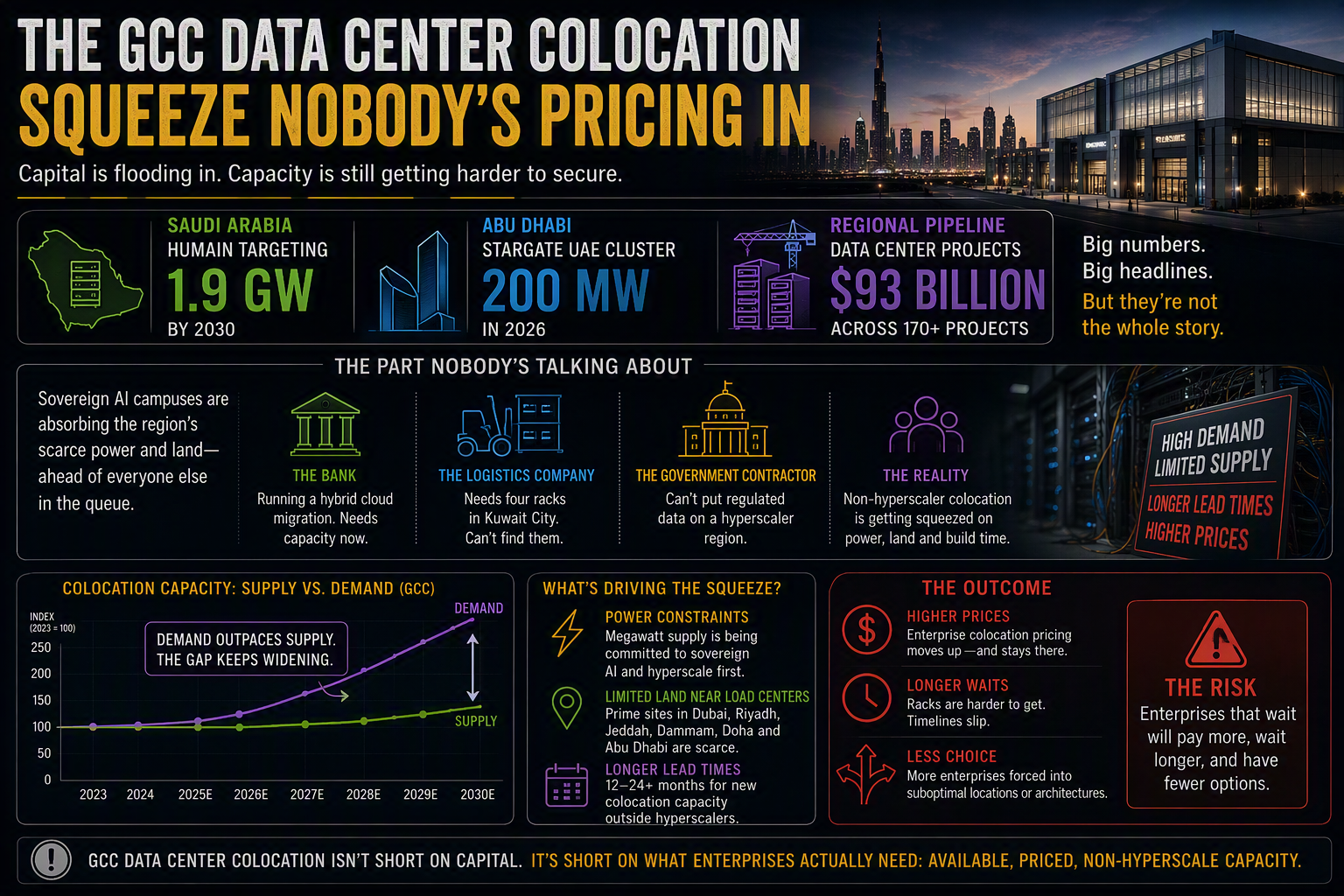
GCC data center colocation is having a strange year: capital is flooding in, and capacity is still getting harder to secure. Every headline out of the Gulf right now is about the same handful of numbers — Saudi Arabia’s HUMAIN targeting 1.9 gigawatts by 2030, Abu Dhabi’s Stargate UAE cluster aiming for 200 MW in 2026, a regional data center pipeline now valued near $93 billion across more than 170 active and planned projects. Those are real, and they matter. But they’re also the story everyone in enterprise IT is already reading. The one nobody’s writing yet is what happens to the ordinary enterprise customer — the bank running a hybrid cloud migration, the logistics company that needs four racks in Kuwait City, the government contractor that can’t put regulated data on a hyperscaler region — while sovereign AI campuses are absorbing the region’s scarce power and land ahead of everyone else in the queue.
The bottleneck moved, and it isn’t chips anymore
For most of the last two years, AI infrastructure conversations centered on GPU supply. That constraint has eased — TSMC roughly doubled its CoWoS advanced-packaging capacity, and chip lead times have come down. What hasn’t come down is the time it takes to get a large load connected to a grid. Uptime Institute’s 2026 operator survey now ranks power availability as a top-tier strategic constraint alongside cost, and the lead times behind that ranking are brutal: grid interconnection studies now typically run 24 to 72 months, and large-load connections in constrained markets are being quoted at five to seven years. Transformer delivery — the unglamorous equipment that actually gets power from the substation to the rack — has stretched to 24–36 months as standard, and up to four years for large high-voltage units, as demand for generator step-up transformers grew 274% between 2019 and 2025.
None of that is GCC-specific data; it’s drawn from US interconnection queues (America’s queue alone holds over 2,000 GW waiting for a grid connection, with only a quarter carrying an executed or draft agreement). But the mechanism is universal, and it’s exactly the mechanism now playing out in the Gulf: when a sovereign AI campus and a mid-sized enterprise colocation deployment are competing for the same substation capacity, the enterprise deployment is not the one that wins the queue position.
Where the region’s power is actually going
Saudi Arabia’s operational data center capacity has gone from 68 MW in 2021 to roughly 440 MW by the end of 2025 and about 467 MW in the first quarter of 2026 — a nearly sevenfold increase in five years. That’s the good-news version of the story. The harder-to-find version is who that capacity is built for: HUMAIN’s 2030 interim target of 1.9 GW already runs 27% ahead of the Kingdom’s own official national target of roughly 1.5 GW, and its longer pipeline through 2034 is pointed at 6.6 GW. Saudi Arabia is now projected to capture more than 65% of the GCC’s upcoming data center power capacity, even as the UAE still holds over 45% of the region’s current operational IT power. The center of gravity is visibly shifting, and it’s shifting toward capacity that is being built primarily for sovereign AI training and inference, not for the general-purpose enterprise colocation racks that a corporate cloud migration actually needs.
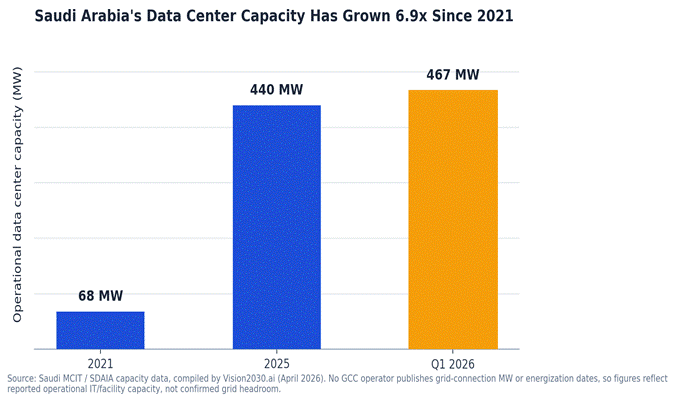
Saudi Arabia’s operational data center capacity, 2021 → Q1 2026. Source: Saudi MCIT/SDAIA capacity data, compiled by Vision2030.ai (April 2026).
That gap matters because none of the region’s operators currently publish grid-connection megawatts, confirmed interconnection points, or energization dates. MCIT’s own capacity figures don’t specify whether they measure IT load or gross facility power, and third-party estimates for Saudi Arabia alone range from 222 MW (colocation-only, Arizton) to over 410 MW (Mordor Intelligence) to 300+ MW (S&P Global), depending on what’s being counted. If a market’s own capacity accounting can’t agree within a factor of two, an enterprise buyer has almost no way to independently verify how much genuinely available headroom sits behind a colocation provider’s sales quote.
The mega-deals are the visible 10%. The invisible 90% is every enterprise colocation contract now being negotiated in the shadow of a queue it can’t see.
The smaller markets feel it first
The squeeze isn’t only a Saudi or UAE story — it’s arguably sharper in the GCC’s smaller colocation markets, where there’s less spare capacity to absorb a delay. Kuwait’s colocation market is tiny by regional standards — about $16 million in 2024, across just six existing facilities and four more in development — but it’s forecast to grow at a 34.57% compound annual rate through 2030, reaching roughly $95 million, with facility occupancy projected to climb to around 90%. That’s a market with room for very little slack. The established operators — Zain, stc Kuwait, Ooredoo, and KEMS Zajil Telecom — are being joined by regional colocation specialists including Agility, Gulf Data Hub, Khazna Data Centers, and ZEUUS, all competing for a limited base of white floor space and grid-connected power in a market where 90% occupancy by 2030 leaves almost no cushion for a customer who didn’t plan ahead.
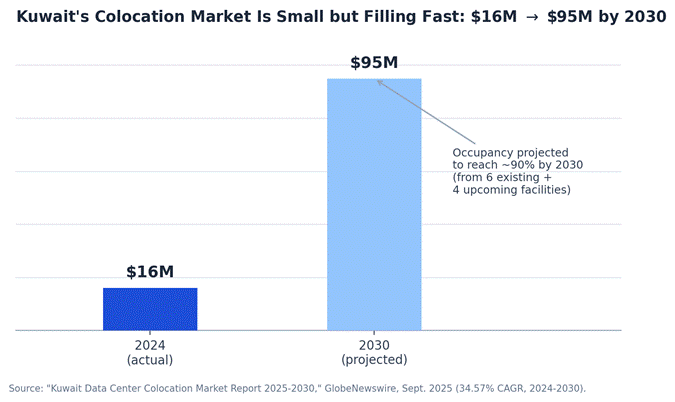
Kuwait’s colocation market value, 2024 (actual) vs. 2030 (projected). Source: “Kuwait Data Center Colocation Market Report 2025-2030,” GlobeNewswire, September 2025.
The same dynamic plays out in Qatar, Bahrain, and Oman, each running smaller colocation footprints than their Saudi and UAE neighbors while facing the same regional pull on transformers, contractors, and grid-connection engineering talent that the mega-campuses are drawing on first.
What this actually means for a cloud migration plan
Enterprise colocation pricing is already responding to tighter supply. Colocation rents for 250–500 kW deployments — a realistic band for a mid-size enterprise consolidating on-premises infrastructure or supporting a hybrid cloud migration — reached about $184 per kilowatt per month in the first half of 2025 in benchmarked markets, and requirements above 10 MW saw price increases of up to 19% over the same period. Rack density is climbing too: AI training clusters now routinely draw 30–100+ kW per rack against a more modest 10–20 kW for AI inference, which means a facility retrofitting for liquid cooling to win AI tenants is, by definition, reallocating engineering and power headroom away from standard enterprise racks.
None of this means enterprises should abandon colocation-based migration strategies — regulated and mission-critical workloads are still moving toward colocation specifically because it offers cost and compliance advantages that public cloud can’t always match. It means the diligence has changed. A cloud migration RFP or a colocation contract negotiated in the Gulf in 2026 without an explicit, written commitment on power availability — not just floor space, not just a service-level agreement on uptime, but confirmed grid-connected megawatts with a firm energization date — is being negotiated on faith. The floor space was never the constrained resource. The power behind it always was, and now everyone in the queue knows it.
Enterprise IT and procurement teams evaluating colocation or hybrid cloud partners in Kuwait or across the GCC should be asking a different first question than they were eighteen months ago: not “what’s your rack price,” but “what’s your confirmed, contracted grid-connection capacity, and when was it energized.” If a provider can’t answer that with a date and a number, the rack price quoted today may not reflect the capacity actually available when the migration is scheduled to go live.
So the real question for anyone planning a data center move in this market isn’t which provider has the best per-kilowatt rate this quarter — it’s whether they can prove, in writing, that the power to run your workload will still be there in eighteen months.