

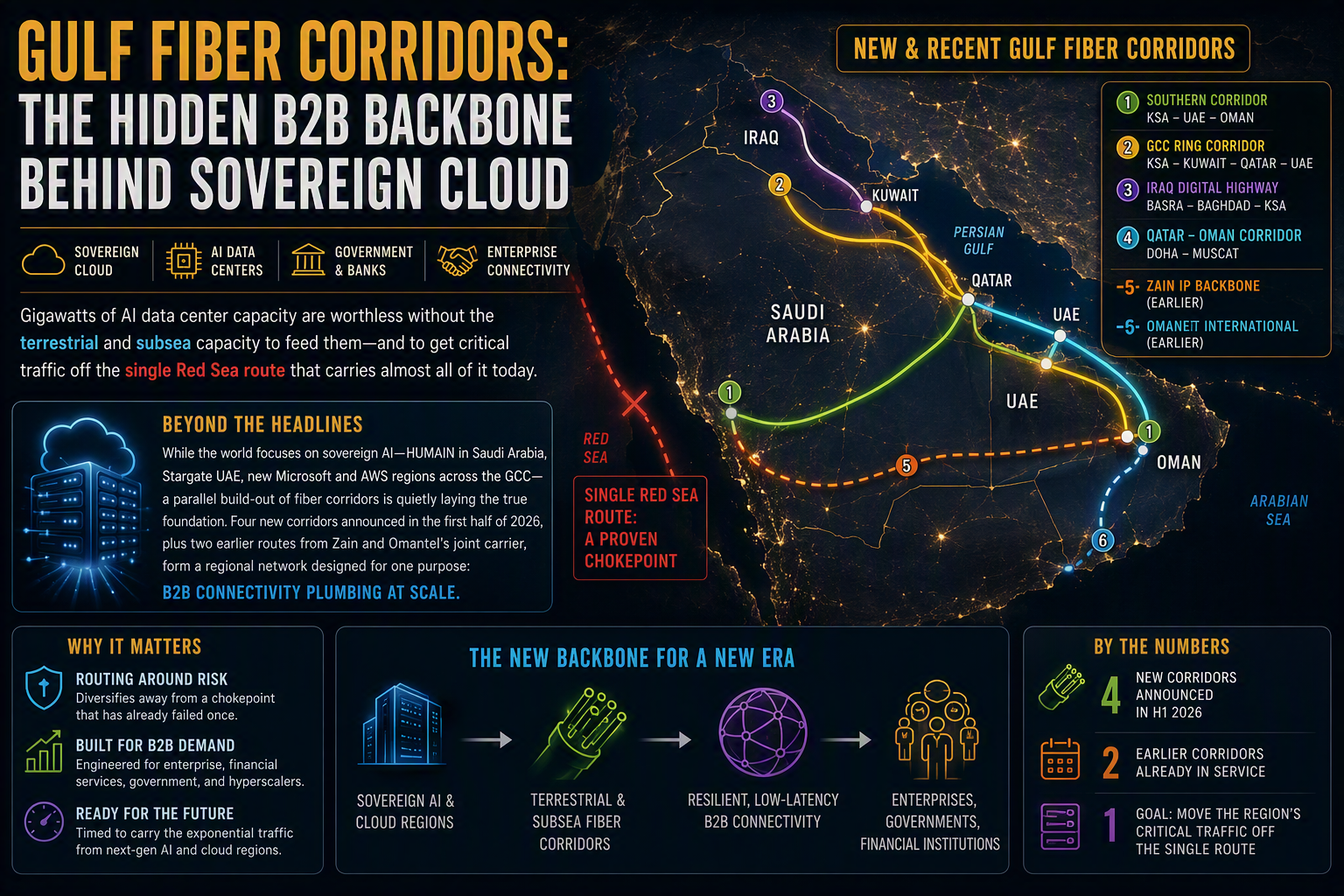
The new Gulf fiber corridors being announced across Saudi Arabia, Qatar, Oman, Iraq, and the UAE rarely make it past the trade press, yet they are the piece of infrastructure that decides whether the region’s sovereign cloud ambitions actually work — because gigawatts of announced AI data center capacity are worthless without the terrestrial and subsea capacity to feed them, and to get enterprise, government, and bank traffic off the single Red Sea route that carries almost all of it today.
Every headline this year has gone to the sovereign AI story: HUMAIN in Saudi Arabia, Stargate UAE, new Microsoft and AWS regions across the GCC. Underneath that story, and getting almost none of the coverage, is a parallel build-out of terrestrial and subsea fiber corridors — four of them announced within the same six-month window in 2026, plus two earlier ones from Zain and Omantel’s joint carrier that belong in the same picture — whose entire purpose is B2B connectivity plumbing: routing enterprise, financial-sector, and hyperscaler traffic around a chokepoint that has already failed once, and doing it in time to carry the traffic these new data centers will generate.
Why this matters more than the data center headlines
Today, more than 90% of data traffic between Europe and Asia flows through Egypt and the Red Sea corridor toward the Suez Canal and the Bab-el-Mandeb strait, according to Ooredoo Group CEO Aziz Aluthman Fakhroo — a single geographic chokepoint carrying annual traffic growth of roughly 30%, with effectively no major new capacity added to the route in five to seven years before this current wave of projects.
That concentration risk is not theoretical. On September 6, 2025, the SMW4 and IMEWE subsea cable systems were cut near Jeddah, degrading internet connectivity across Saudi Arabia, the UAE, Pakistan, and India — Microsoft reported increased latency on Azure services in the affected region, and NetBlocks logged slow speeds and intermittent access for hours. For any enterprise running latency-sensitive workloads, cross-border payment rails, or a call center on the wrong side of that outage, it was a preview of what a bigger cut would look like at gigawatt-scale AI data center demand.
Sovereign cloud capacity is a hardware story. Sovereign cloud reliability is a fiber-route story — and the fiber-route story is the one nobody outside wholesale carrier circles is covering.
Six corridors, one purpose: routing around the chokepoint
Between February and August 2026, four large terrestrial and subsea fiber projects were announced or advanced across the Gulf and its immediate neighbors, all explicitly framed around bypassing the Suez/Bab-el-Mandeb route and shortening the path between Asia, the Gulf, and Europe. Two more — both built by Zain Omantel International — were announced earlier (2024 and 2025) but are now being tracked by industry analysts as part of the same structural shift:
| Corridor | Partners | Route | Distance | Timeline |
| FIG | Ooredoo Group (Qatar) | Oman → Iraq → Turkey → Europe | ~2,000 km | Late 2027 |
| SONIC | stc Group + Ooredoo Oman | Jeddah landing stations → Riyadh → Muscat | 1,931 km | Phase 1: 12 mo; full: 24 mo |
| SilkLink | stc Group (Saudi Arabia) | Saudi Arabia → Syria → Tartus (Mediterranean) | 4,500 km | Phase 1 starts in 18–24 mo |
| WorldLink | Iraqi–UAE consortium | UAE → Al-Faw (Iraq) → Kurdistan → Turkey | n/d | Phased over 5 years |
| ZOI–Telecom Egypt | Zain Omantel Int’l + Telecom Egypt | Oman → Saudi Arabia → Egypt (Red Sea subsea) → Mediterranean; extendable to Kuwait, Bahrain, Iraq, Jordan | n/d | Announced Jan 2024; still expanding |
| ZOI–Horizon Scope–ITPC | Zain Omantel Int’l + Horizon Scope (Iraq) + ITPC | Middle East → Iraq → Turkey → Frankfurt | n/d | Announced May 2025 |
| ZOI–Telecom Egypt | Zain Omantel Int’l + Telecom Egypt | Oman → Saudi Arabia → Egypt (Red Sea subsea) → Mediterranean; extendable to Kuwait, Bahrain, Iraq, Jordan | n/d | Announced Jan 2024; still expanding |
| ZOI–Horizon Scope–ITPC | Zain Omantel Int’l + Horizon Scope (Iraq) + ITPC | Middle East → Iraq → Turkey → Frankfurt | n/d | Announced May 2025 |
On disclosed dollar figures alone, SilkLink, WorldLink, and FIG represent more than $2 billion of new capacity commitments — before accounting for SONIC, whose investment size has not been disclosed. The chart below shows the three projects with public figures side by side.
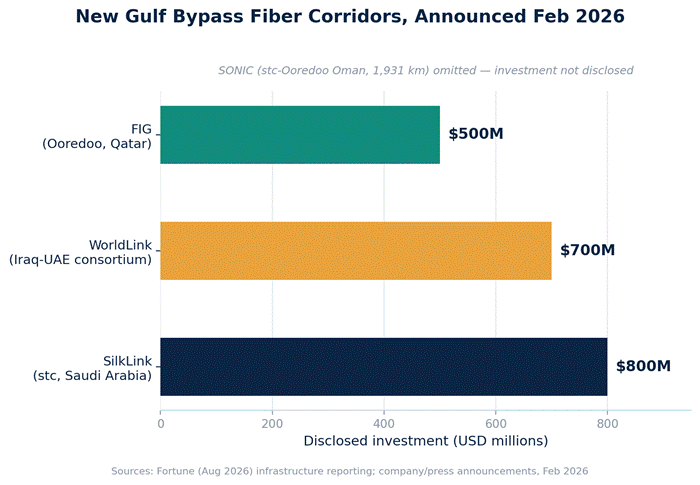
New Gulf bypass fiber corridors by disclosed investment (SONIC omitted — no public figure). Sources: Fortune (Aug 2026); company and press announcements, Feb 2026.
The piece most coverage misses entirely: Zain Omantel International
There is a fifth and sixth entrant in this table that predates the Feb–Aug 2026 wave but belongs in the same story: Zain Omantel International (ZOI), the wholesale international carrier jointly owned by Kuwait’s Zain Group and Oman’s Omantel. ZOI signed a corridor agreement with Telecom Egypt (announced January 2024, and still being actively extended) running terrestrial fiber across Oman and Saudi Arabia into a Red Sea subsea link to Egypt and on to the Mediterranean — explicitly designed to be extendable into Kuwait, Bahrain, Iraq, and Jordan through ZOI’s own network. Separately, ZOI partnered with Iraq’s Horizon Scope Telecom and the Iraqi Telecommunications and Post Company (ITPC) in May 2025 on a second terrestrial route running Middle East → Iraq → Turkey → Frankfurt, marketed explicitly as an alternative to subsea routes through unstable waters.
Neither ZOI corridor has a disclosed investment figure, distance, or capacity number — which is why they are listed but not charted here rather than estimated. What is verifiable: a 2026 industry roundup of Gulf overland cable projects (Rest of World) grouped the ZOI–Telecom Egypt corridor alongside SilkLink, WorldLink, and FIG as part of the same structural shift away from Red Sea/Suez dependency, and ZOI has kept expanding through 2026, including a March 2026 interconnect and roaming corridor agreement with Pakistan’s Zong. For a Zain enterprise audience specifically, this is the one entry in the table that isn’t a competitor’s infrastructure play — it’s your own group’s wholesale carrier arm already positioned inside this exact trend.
The capacity these corridors are actually built to feed
The reason so many operators are racing to lay this much fiber in the same window is on the other end of the pipe: the Gulf’s collective AI and sovereign-cloud data center ambitions now run into gigawatts, not megawatts. The UAE has outlined a 5 GW planned AI compute campus; Saudi Arabia’s HUMAIN program targets 1.9 GW of capacity by 2030, with further expansion under discussion; and Qatar’s Ooredoo Syntys is targeting 120 MW of installed capacity by the same year. Collectively, industry estimates put UAE, Saudi Arabia, and Qatar’s AI compute ambitions at 8–10 GW.
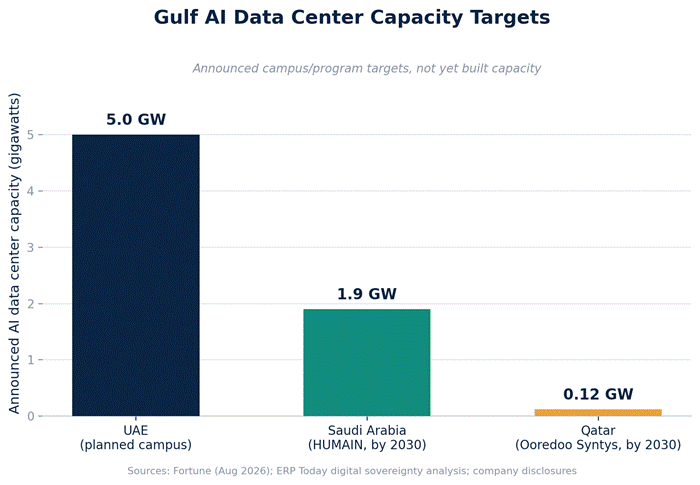
Announced Gulf AI data center capacity targets by country/program — figures are announced targets, not built or operational capacity. Sources: Fortune (Aug 2026); ERP Today; company disclosures.
Those targets only translate into usable sovereign cloud services if hyperscalers can actually stand up regions on top of them. That is already happening: Microsoft confirmed in March 2025 that it would build an AI-ready Azure region in Kuwait aligned with Kuwait’s Vision 2035 strategy (financial terms undisclosed), completed construction of its Saudi Arabia region in December 2024 with customer availability confirmed for Q4 2026, and already operates regions in Qatar and the UAE. Google Cloud has a data-residency region live in Dammam and another in Qatar. AWS already runs a region in Bahrain, with a Saudi Arabia region planned. Oracle has deployed a sovereign AI supercluster in Abu Dhabi. None of that capacity means anything to an NBK-style bank or a government ministry bound by data-residency rules if the wholesale fiber connecting those regions to each other — and to global exchange points — can’t carry the load without single-point-of-failure risk.
What this means for enterprise buyers, not just carriers
- Data residency compliance gets easier, not just cheaper. A Kuwait-based bank or government entity that has been waiting on a genuinely local Azure or Google Cloud region now has a credible delivery timeline attached to real regional capacity — not just a press release.
- Route diversity becomes a real RFP question. Enterprises and carriers negotiating wholesale capacity or diverse-path SLAs into the Gulf should be asking providers which of these new corridors (or none) sits behind their resilience story, given the September 2025 Red Sea cable cut is now a live precedent rather than a hypothetical.
- The build cycle is short. Phase 1 windows on SONIC (12 months) and the broader 18–24 month timelines on SilkLink put new alternate capacity in service well before most of the announced GW-scale data center campuses are fully energized — meaning the connectivity layer, for once, is not the bottleneck it usually is in Gulf digital infrastructure builds.
- Wholesale telecom operators are becoming AI infrastructure landlords. stc, Ooredoo, the Iraqi-UAE WorldLink consortium, and ZOI (Zain-Omantel) are all underwriting these corridors on the expectation of hyperscaler and telecom-operator demand — the same dynamic playing out globally in tower and colocation economics, just one layer down in the stack, in fiber.
The honest caveat
Announced capacity is not delivered capacity. SONIC’s own timeline is a 12-month first phase inside a 24-month full build; SilkLink’s first phase does not even start construction for 18–24 months from its February 2026 announcement; and WorldLink is explicitly phased over five years. Enterprises building 2026–2027 cloud migration or connectivity plans around these corridors should treat them as directionally reducing Red Sea concentration risk over the next two to three years — not as capacity available today. The safest planning assumption is that the existing Suez/Red Sea route remains the primary path through 2027, with these corridors becoming genuine alternates only as each phase actually lights up.
The bottom line
The sovereign cloud headlines get the AI story right but miss the connectivity story underneath it. Six fiber corridors — four announced in a single 2026 wave, two already built by Zain and Omantel’s joint carrier — over $2 billion in disclosed investment, and a hard lesson from September 2025 are quietly doing the unglamorous work of making Gulf sovereign cloud commitments deliverable rather than aspirational. For enterprise IT and connectivity buyers in the region, that is the trend worth tracking now — well before it becomes the obvious headline everyone else is writing.
Sources
- Fortune — The Gulf’s AI boom is driving the race to control the data highways (Aug 12, 2026)
- ERP Today — How Gulf States Are Approaching Digital Sovereignty
- Data Center Dynamics — Microsoft to develop Azure cloud region in Kuwait
- Telecom Review Middle East — stc Group and Ooredoo Oman Partner to Revolutionize Regional Connectivity (SONIC)
- Al Jazeera — Internet disruptions in Middle East and South Asia after Red Sea cable cuts (Sept 7, 2025)
- Microsoft News Center EMEA — Microsoft confirms Saudi Arabia datacenter region available Q4 2026
- TheFastMode — Zain Omantel International (ZOI) and Telecom Egypt Forge New Digital Corridor
- Iraq Business News — New Partnership to Connect the Middle East and Europe via Iraq (ZOI, Horizon Scope, ITPC, May 2025)
- Rest of World — Gulf states race to build overland data cables to Europe as war threatens submarine routes (2026)