

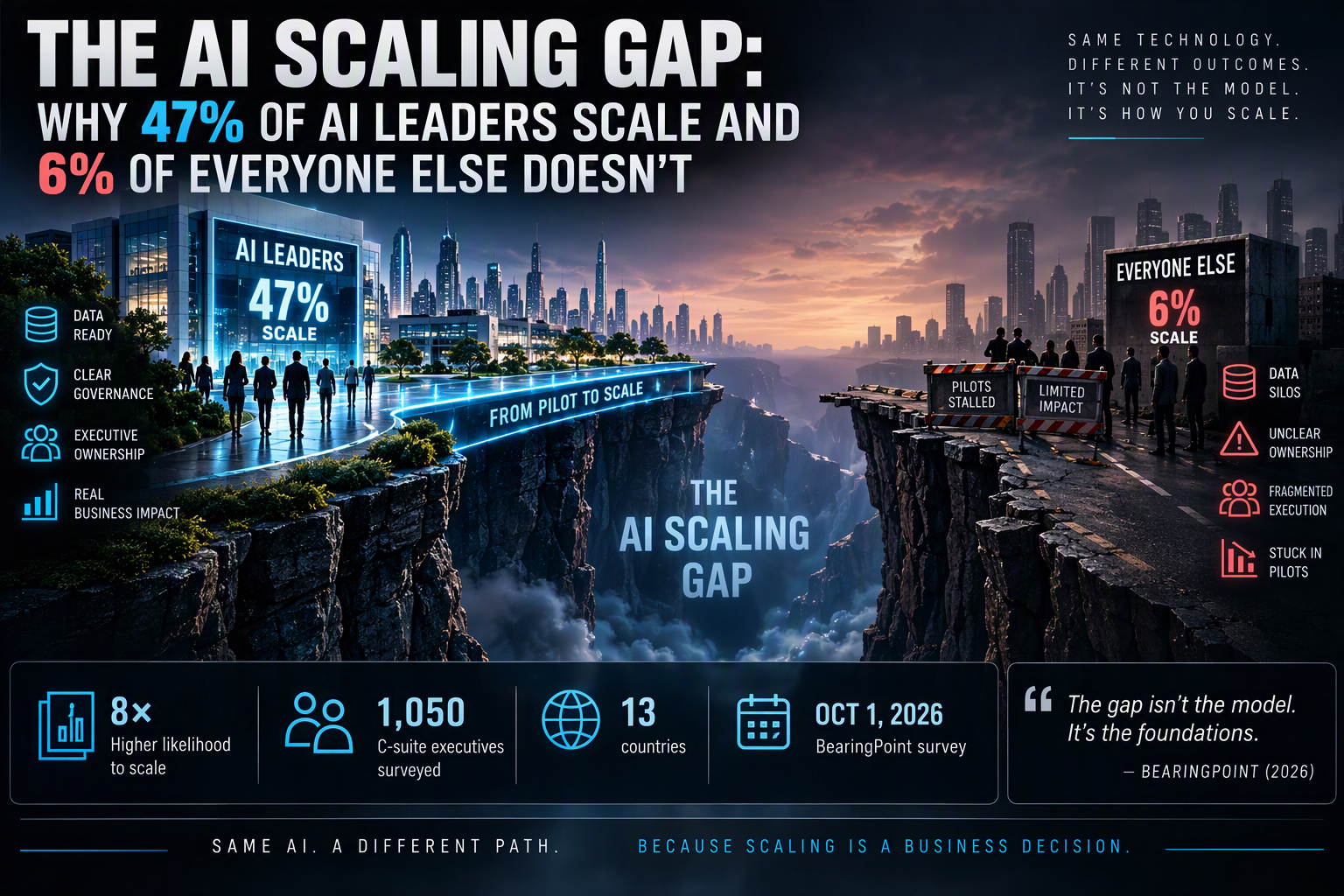
The AI scaling gap is no longer a matter of opinion. A new BearingPoint survey of 1,050 C-suite executives across 13 countries, published October 1, 2026, puts a hard number on it: organizations it classifies as AI “Leaders” scale their AI initiatives fully eight times more often than the “Implementers” who make up over half of the market. Three years into the generative AI build-out, the question for most enterprises has quietly shifted from whether AI works to why their own rollout isn’t working as well as the case study next door. The honest answer, this data suggests, has little to do with which model a company licensed and everything to do with decisions made long before procurement — about data, governance, and who owns the outcome.
Only 13% of organizations scaled AI fully aligned with their original business case. Averaged across the whole market, that number is almost meaningless — it blends an 11% group succeeding at 47% with a 54% group succeeding at 6%.
In this post
- The AI Scaling Gap, By the Numbers
- Where the Value Actually Lands
- What’s Actually Blocking the Climb
- The Workforce Side Nobody’s Pricing In
- The AI Scaling Gap in the Gulf
- What This Means, By Stage
The AI Scaling Gap, By the Numbers
BearingPoint’s August 2026 survey sorts enterprises into four maturity stages. Explorers (15% of respondents) are testing isolated use cases. Experimenters (20%) are running pilots without enterprise commitment. Implementers (54%, the largest group by far) have AI live in production somewhere in the business. Leaders (11%) have it running enterprise-wide with governance and financial accountability built in from the start.
The gap shows up at the top of that ladder. Implementers — the group most enterprises in this reader’s position will recognize themselves in — scale AI fully aligned with the original business case only 6% of the time. Leaders do it 47% of the time. That is the 8-to-1 ratio the diagram below sets out, and it is the single most useful number in the report, because it reframes “AI adoption” as a question of operating model, not model choice.
BearingPoint’s own conclusion is specific about what separates the two groups, and worth quoting directly because it names the actual work rather than a vague “culture” problem: organizations that scale successfully connect AI to “financial accountability, trusted data, governance, architecture and workforce decisions from the start.” None of those five items is a model-selection decision. All five are operating-model decisions that get made — or skipped — well before the first use case ships, which is why a Leader and an Implementer can run the same vendor’s technology and land eight times apart on outcome.
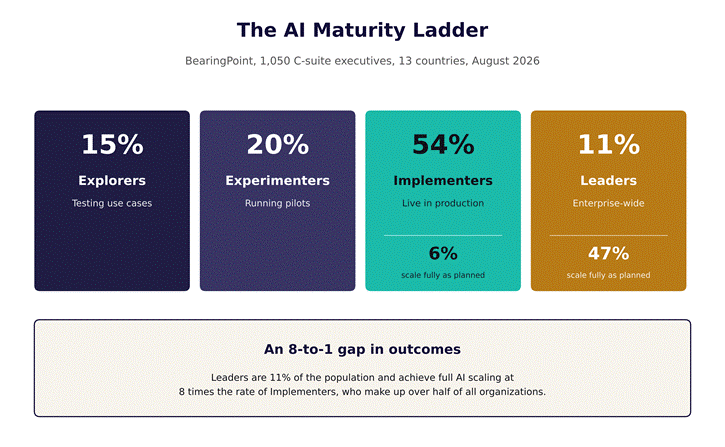
Fig. 1 — The AI maturity ladder and the scaling gap it produces. Source: BearingPoint, “AI Adoption” survey, 1,050 C-suite executives, 13 countries, August 2026.
Where the Value Actually Lands
The encouraging number in the same study is that AI is not failing to deliver value: 73% of organizations with AI already implemented report measurable top-line or bottom-line impact, and roughly 40% report both revenue growth and cost reduction at once. The discouraging number sits right next to it.
AI’s economics today are a cost story, not a growth story. 24% of organizations report cost savings of at least 10% from AI. Only 4% report revenue growth of at least 10% — a roughly 6-to-1 skew toward cutting cost over creating it. BearingPoint’s own 2030 projections (35% cost savings versus 22% revenue growth) say that skew narrows but does not flip in the next four years.
That matters for how a business case gets written today. An AI investment pitched on revenue growth is, on this data, pitching the harder and slower of the two outcomes — worth doing, but worth sequencing after the cost case, not instead of it. It also explains a pattern this site has flagged before: boards approve AI budgets readily (85% of Roland Berger’s GCC respondents expect theirs to rise further in 2026, discussed below) while finance teams remain skeptical of the revenue line in the same business case. Both reactions are consistent with the same underlying data — cost reduction is real and arriving faster than revenue growth, so a business case that leads with the harder number will keep meeting resistance it does not deserve.
What’s Actually Blocking the Climb
Asked what stands between them and full scaling, executives did not point at model capability. 40% named legal and regulatory uncertainty as the main barrier. 34% pointed to integration with existing IT systems. 54% — the single largest figure in the barriers section — flagged high-quality, trusted, connected data as the critical requirement they have not yet met.
None of the three barriers is a quick fix, and they compound. Legal and regulatory uncertainty (40%) slows down exactly the kind of cross-border data use that connected systems require. Integration debt (34%) means the AI layer sits on top of the same fragmented core systems that made the data problem (54%) exist in the first place. An organization that has not resolved its data architecture is, by definition, not ready to resolve the other two — which is a reasonable explanation for why 54% of the market sits stuck at Implementer rather than spread evenly across the ladder.
That data-and-governance bottleneck is consistent with what this site covered in its look at why agentic AI projects get quietly shelved (see “The Agentic AI Cancellation Wave”) and in the network-operations rollouts already shipping at Nokia and Google Cloud (see “Autonomous Network Agents Just Went Live in Telecom”). BearingPoint’s own framing of the fix echoes both: “Responsible AI does not mean slowing down innovation. It is about capturing value today while ensuring that AI autonomy never advances faster than governance and human oversight,” said Frédéric Gigant, the firm’s Global Leader for Customer & Growth.
Agentic AI specifically is still at the Explorer stage industry-wide: only 13% of surveyed organizations report a defined agentic strategy with active initiatives, and just 10% are scaling agents enterprise-wide — consistent with the adoption-gap pattern this site documented across four separate 2026 surveys in September (see “The AI Agent Adoption Gap”).
The Workforce Side Nobody’s Pricing In
One figure in the BearingPoint data deserves more attention than it has received: 62% of organizations already report AI-induced workforce overcapacity of at least 10% today, and 94% expect that level of overcapacity by 2030. That is not a layoff announcement — it is a staffing-plan input that most of the organizations in the Implementer stage, by their own admission, have not yet built into workforce planning the way they have built AI into IT budgets.
A scaling plan that does not include a workforce-capacity plan is not a complete scaling plan. That gap sits squarely inside the governance category BearingPoint already flags as the main thing separating Leaders from everyone else. The jump from 62% to 94% over four years is also a near-universal statement: on this data, workforce overcapacity stops being an edge case affecting a few automated functions and becomes close to a default condition of running AI at scale at all, in every organization that gets there — which makes it a planning input for every function, not a one-time headcount review.
The AI Scaling Gap in the Gulf
Two separate pieces of regional research published in 2026 show the same pattern, at a sharper angle. Roland Berger’s Middle East survey of C-suite and director-level decision makers across Saudi Arabia, the UAE, and Qatar found 80% of organizations have embedded AI into strategic plans and 85% expect AI budgets to rise further in 2026 — but only 34% have the enterprise-wide data foundation needed to scale, and fewer than one-third have the operating models and governance structures to match the ambition. Public-sector organizations are well ahead of private enterprise (90% with an AI strategy in place or in development, versus 75% in the private sector), which Roland Berger’s Nizar Hneini called “a wake-up call for the region” on execution, not intent.
A narrower but even starker version of the same gap shows up in GCC human-capital data: Korn Ferry’s Q1 2026 survey of 105 CHROs across six GCC markets, including Kuwait, found 93% of organizations exploring, piloting, or deploying AI in some HR function — and only 1% considering themselves fully ready to scale it enterprise-wide. The barriers named are familiar: 61% cite technology integration, 44% cite a shortage of AI-skilled talent, and only 3% place primary AI accountability with HR leadership at all, versus 60% defaulting it to IT. A separate Ipsos GCC pulse survey the same quarter found 73% of employees across the UAE, Saudi Arabia, Kuwait, and Qatar believe AI will strengthen their organization’s competitiveness — ambition and anxiety about execution are coexisting in the same workforce, not opposing camps.
The Gulf is not behind on AI ambition. It is behind on the unglamorous operating-model work — data, governance, accountability — that the global data says is the entire difference between the 11% and the 54%. That is the same conclusion this site reached evaluating which GCC cloud regions are actually live versus merely announced (see “GCC Cloud Providers: A Data-Backed Guide”) — the infrastructure and the intent are frequently ahead of the governance that would let either one scale.
What This Means, By Stage
| Stage | Share of enterprises | What the data says to do next |
| Explorers | 15% | Stop running isolated pilots. Pick one process with a measurable before/after and fund it like a project, not an experiment. |
| Experimenters | 20% | The data-quality barrier (54% globally) bites here first. Fix data access and ownership before adding a second use case. |
| Implementers | 54% | This is where most organizations stall — live in production, 6% scaling fully. The blockers are integration (34%) and regulatory clarity (40%), not model quality. |
| Near-Leaders | ~11% combined | Already enterprise-wide in at least one function. The gap to “Leader” is governance and financial accountability built in from the start, not a bigger model. |
What comes next
The agentic-AI governance question raised here — strategy without scale, in 13% of organizations — is the same one this site will keep tracking as Gulf operators start piloting the kind of autonomous network agents already live at Nokia and Google Cloud. The next AI and Beyond post will follow that thread forward; the next technical post returns to the 6G course with AI-Native RAN.
If 54% of organizations are stuck at “Implementer,” and the data says the fix is data, governance, and accountability rather than a better model — where is that work actually sitting on your own roadmap this quarter?