

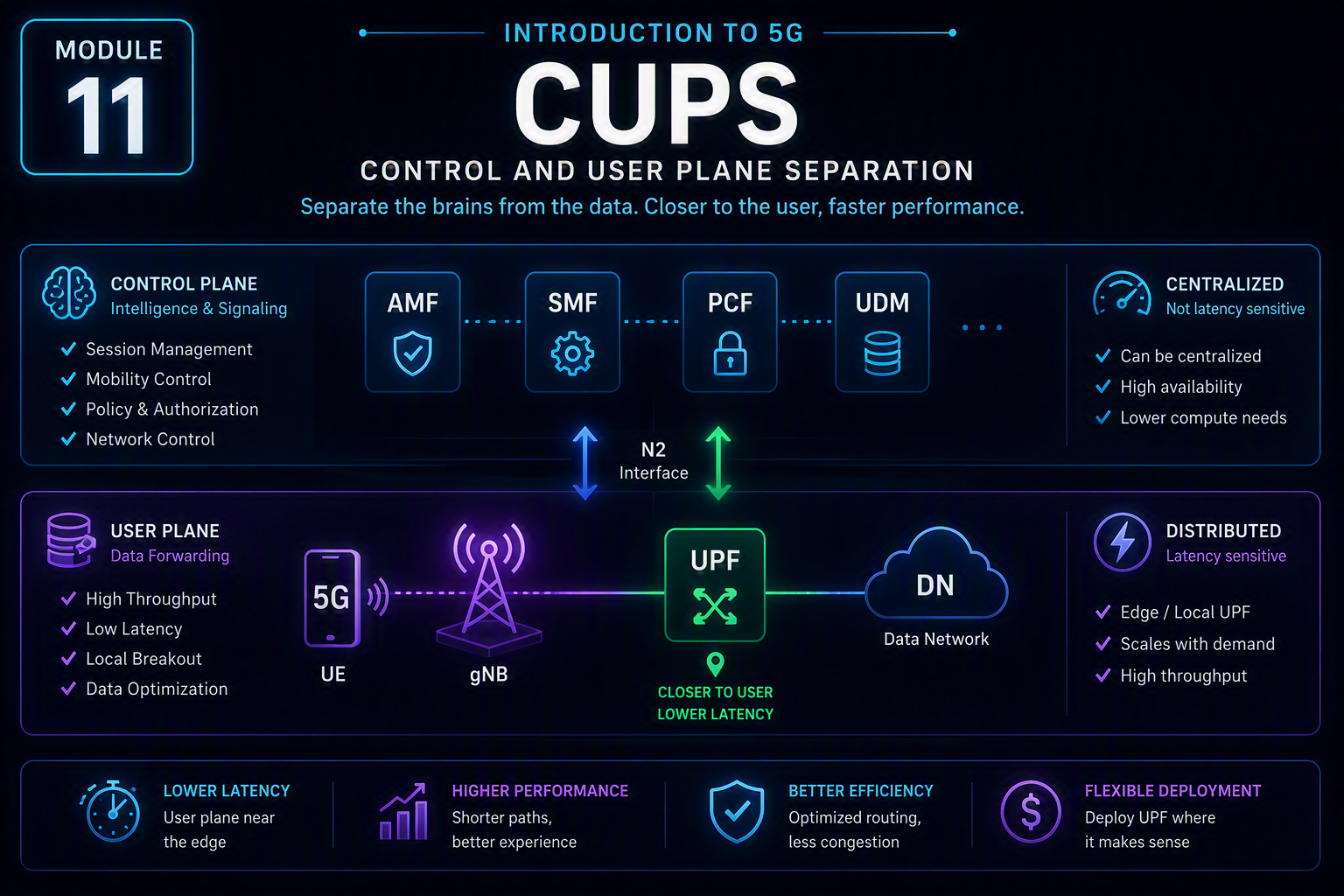
CUPS control user plane separation is a precisely defined 3GPP concept — Release 14’s TS 23.214 for its original 4G/EPC application, using the PFCP (Packet Forwarding Control Protocol, TS 29.244) — and understanding its actual origin, rather than treating it as a generic 5G buzzword, clarifies exactly what 5G Core’s AMF/SMF/UPF split (Module 10) does and doesn’t inherit from it.
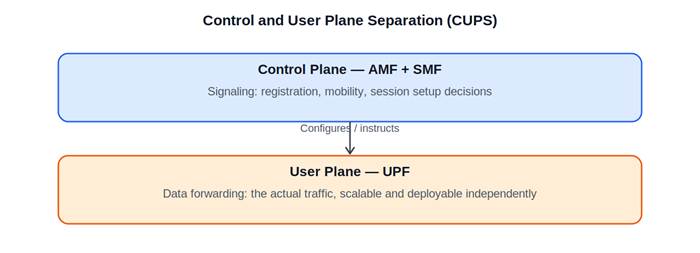
Diagram for Module 11
Diagram: CUPS control user plane separation — control-plane decisions separated from user-plane forwarding.
Defining the two planes precisely
Every mobile network handles two conceptually distinct traffic types. The control plane carries signaling — messages establishing, modifying, and tearing down sessions, managing mobility, coordinating what should happen. The user plane carries the actual data a device sends and receives — the payload representing what’s actually happening, once the control plane has set it up.
CUPS’s real origin: 3GPP Release 14, for 4G EPC
This is worth being precise about, since it’s commonly misstated: CUPS was standardized in 3GPP Release 14 (2017) specifically for 4G’s EPC, in TS 23.214, retrofitting separation into an LTE core that wasn’t originally designed with it. CUPS split the existing S-GW into SGW-C (control) and SGW-U (user), and the P-GW into PGW-C (control) and PGW-U (user), connected via the standardized Sxa (SGW-C to SGW-U), Sxb (PGW-C to PGW-U), and Sxc (TDF-C to TDF-U) interfaces — all running the PFCP protocol defined in TS 29.244. This let operators scale user-plane forwarding capacity and deploy it closer to the network edge, independent of control-plane elements, without a full EPC architectural overhaul.
How EPC was coupled before CUPS
Before Release 14, LTE’s S-GW and P-GW each handled control-plane and user-plane responsibility within the same network element. Scaling user-plane capacity for growing data volume often meant scaling functions that also carried control-plane responsibility, even when the bottleneck was purely data volume. Deploying user-plane forwarding closer to the network edge was architecturally awkward, since the same function carried control-plane logic that typically made more sense centralized.
5G Core: the same principle, applied natively rather than retrofitted
5G Core didn’t need a CUPS-style retrofit — it was designed from Release 15 onward with control-plane and user-plane responsibilities natively separated into different functions from day one: AMF and SMF (control plane) versus UPF (user plane), connected via the N4 reference point, which — notably — also uses PFCP, the same protocol CUPS introduced for 4G. This is a genuine, direct lineage: 5G Core’s N4/UPF control interface is architecturally descended from CUPS’s Sxb/PGW-U interface, reusing the same underlying protocol rather than inventing a new one.
So it’s accurate to say 5G Core’s AMF/SMF/UPF split applies and extends the principle CUPS established for 4G, and even reuses its protocol (PFCP) at the N4 interface — but it’s more precise to say 5G Core was built with this separation as a native design choice, rather than describing AMF/SMF/UPF as “implementing CUPS,” which slightly overstates a direct implementation relationship where what actually exists is native design plus protocol reuse.
Why this separation matters, concretely
- URLLC’s 1ms latency target (Module 1) depends heavily on minimizing the physical distance user-plane traffic travels. This separation makes edge deployment of user-plane forwarding practical in a way a coupled model doesn’t support cleanly.
- Independent scaling means an operator facing rapid data-volume growth doesn’t need to over-provision control-plane infrastructure just to keep pace, and vice versa.
- Network slicing (Module 12) benefits directly: different slices can share common control-plane infrastructure while using entirely different, independently deployed UPF instances tuned to each slice’s user-plane requirements.
Closing out the Core section
Modules 9 through 11 have covered 5G Core’s foundational architecture: the Service-Based Architecture governing how functions communicate (TS 23.501/23.502), the AMF/SMF/UPF split handling everyday mobility and session management (TS 23.501 §6.2), and the control/user-plane separation principle underlying that split — originally established for 4G via CUPS (TS 23.214) and natively extended into 5G Core using the same PFCP protocol at the N4 interface.
Next in this series: Module 12 — Network Slicing: One Physical Network, Many Virtual Ones.
One thought on “Introduction to 5G — Module 11: Control and User Plane Separation (CUPS) and Why It Matters for 5G”