

Originally published on 4GNation, March 2016 — republished here as part of the Telco & Beyond Engineering Archive.
Some of the earliest technical writing I did was on the fundamentals of LTE air-interface signaling — the kind of detail that rarely makes it into vendor documentation but matters enormously when you’re troubleshooting a live network. Rank Indication (RI) is one of those quiet, unglamorous parameters that decides whether a UE gets single-antenna performance or full MIMO throughput. Revisiting it a decade later, the concept hasn’t changed — LTE MIMO scheduling still rests on the same UE feedback loop, and understanding it remains a solid foundation before jumping into 5G’s more complex beamforming and layer-management schemes.
The eNodeB configures the RI reporting periodicity for every UE during the attach procedure, and the UE has to honour it. The RI reporting periodicity can overlap with CQI reporting periodicity, in which case the UE will drop CQI and report RI instead.
Now, coming to the RI itself — its contents are just a couple of bits. The exact number depends on antenna configuration. If the eNodeB is configured with 2 transmit antennas on the downlink, the RI report will be one bit; if it’s 4 antennas, RI will be 2 bits.
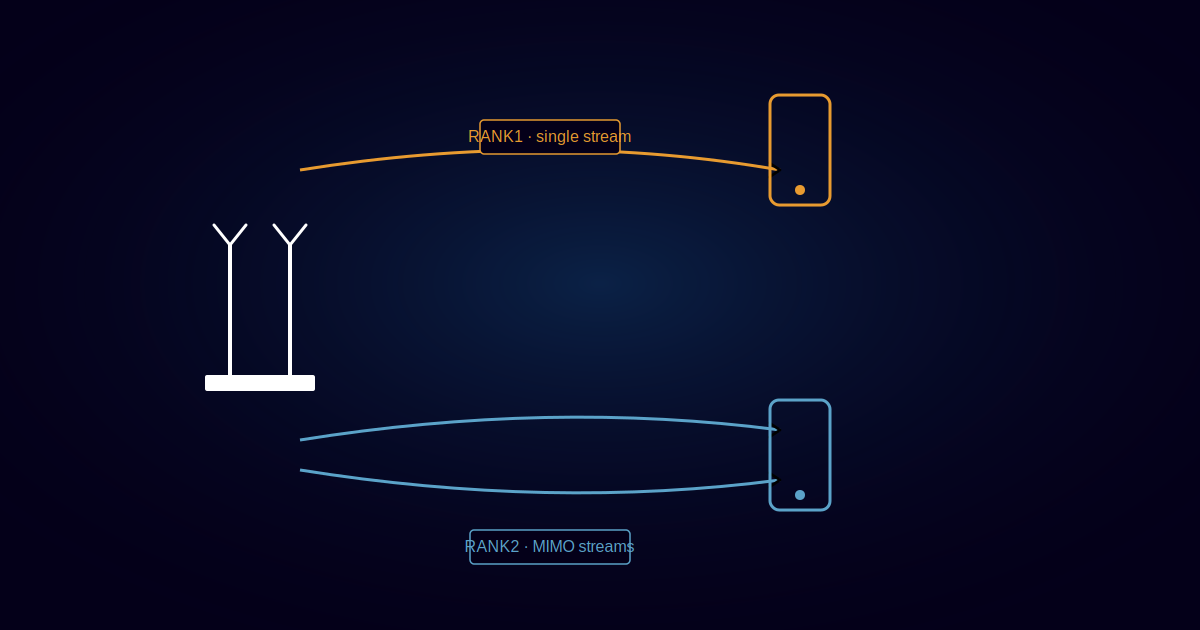
Let’s consider the two-antenna case, where RI is indicated using one bit: a bit value of 0 indicates RANK1, and a bit value of 1 indicates RANK2.
- RANK1 means the UE is seeing good SINR on only one of its receive antennas, so it’s effectively asking the eNodeB to bring transmission mode down to single-antenna or transmit diversity.
- RANK2 from the UE means good SINR on both antenna ports, and the eNodeB can go ahead and schedule MIMO.
It’s essential for the eNodeB to correctly decode a UE’s RI report in order to know the channel conditions and schedule the downlink appropriately. The LTE specifications also state that if a UE isn’t reporting any RI, the eNodeB should default to assuming RANK1.
The word “rank” isn’t arbitrary terminology — it refers to the mathematical rank of the MIMO channel matrix (H) between the eNodeB’s transmit antennas and the UE’s receive antennas. A channel with rich multipath scattering produces a channel matrix with two effectively independent, decorrelated paths — mathematically rank 2 — meaning two separate data streams can be sent and separated at the receiver without interfering. A channel dominated by a single strong line-of-sight path, or one where the transmit and receive antennas are poorly decorrelated, behaves like rank 1, no matter how many physical antennas exist. The UE isn’t guessing at a policy preference when it reports RI — it’s measuring the actual spatial richness of the current channel, typically by evaluating the eigenvalue spread of the channel matrix estimated from cell-specific reference signals (CRS).
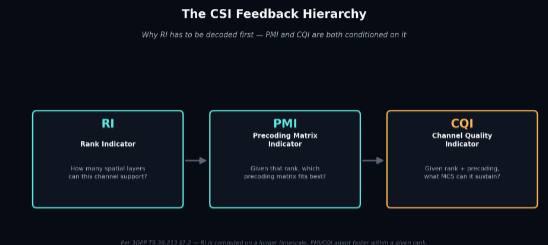
RI doesn’t get reported in isolation. It’s the first of three coupled measurements the UE sends back to the network — RI, PMI (Precoding Matrix Indicator), and CQI (Channel Quality Indicator) — and the dependency runs in one direction: PMI and CQI are both computed conditional on the reported RI, not independently of it. This matters practically because RI is deliberately reported on a longer timescale than PMI/CQI, per 3GPP TS 36.213 §7.2 — spatial rank changes relatively slowly as a UE moves through an environment, while precoding and MCS need to adapt faster to fast fading.
This is the part that makes RI genuinely useful for field troubleshooting rather than just a spec detail. A UE in a dense urban or indoor environment, surrounded by rich multipath reflection, will typically report RANK2 often — the scattering creates two genuinely separable spatial paths. The same UE on a rural macro site with a dominant line-of-sight path to the tower will often report RANK1 consistently, even with 2 or 4 transmit antennas physically available, because the channel itself doesn’t support a second independent stream regardless of hardware. Persistently low rank reports on a site expected to have rich scattering — dense urban, indoor — can be a genuine signal worth investigating, rather than something to dismiss as “just the UE being conservative.”
The engineer’s takeaway
If MIMO throughput on a site is consistently underperforming despite good RSRP and SINR, checking the RI distribution is worth doing before assuming a scheduler or hardware problem — a channel that’s structurally rank-1 will never deliver RANK2 throughput no matter how the scheduler is tuned, because the physical channel itself is the bottleneck, not the configuration.
RI is one half of the link-adaptation picture — for how the network recovers when a transmission still fails despite correct scheduling, see HARQ in LTE.
One thought on “What is the use of Rank Indication in LTE”