

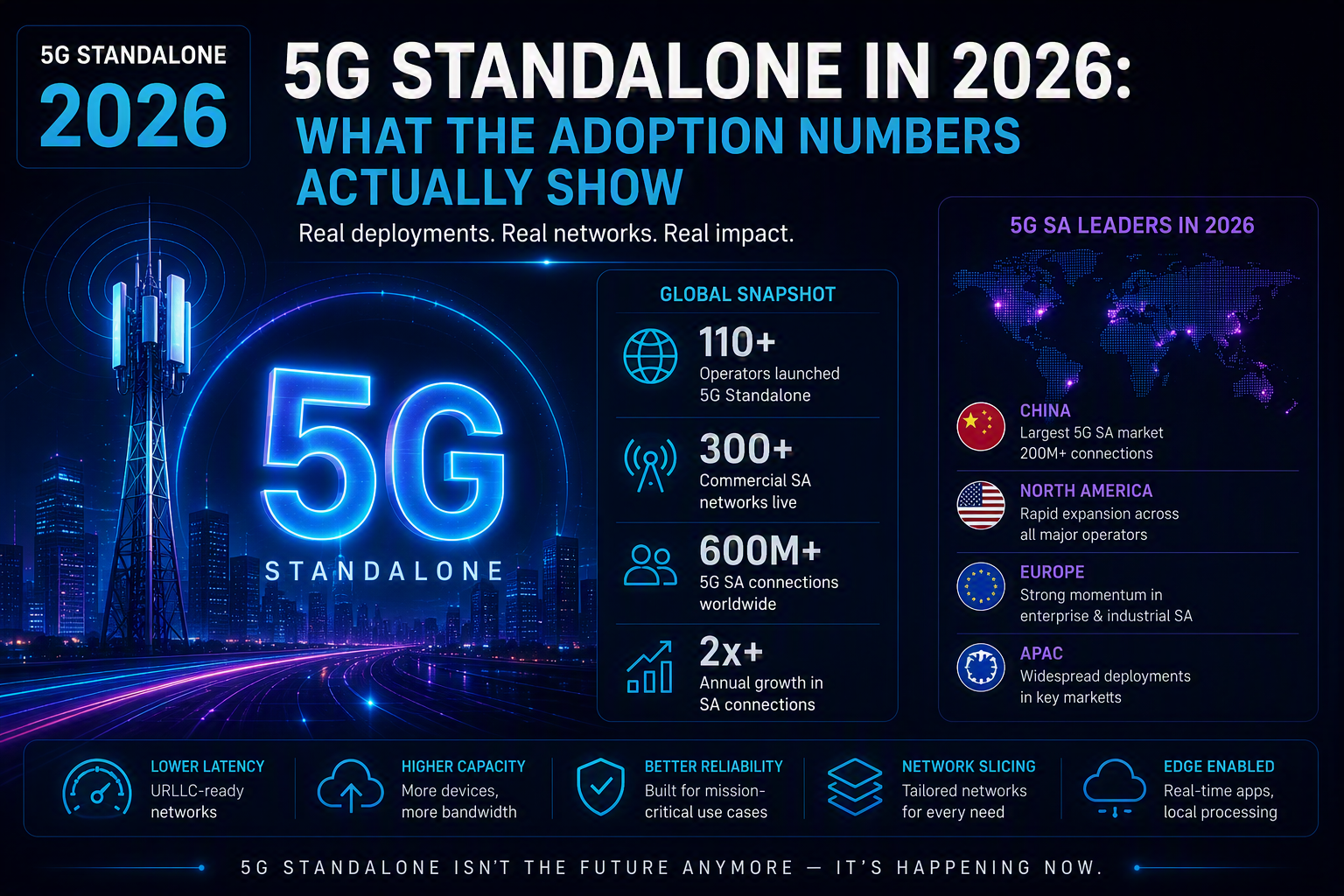
5G Standalone 2026 deployment has moved well past the “still a trial technology” phase this site’s Introduction to 5G course (Module 3) described as the historical starting point — but the latest industry data tells a more nuanced story than a simple adoption curve, and it’s worth looking at honestly rather than repeating the vendor talking points.
The scale, in real numbers
As of February 2026, GSA counted 645 operators across 192 countries investing in 5G tests, pilots, and deployments, with 383 operators in 146 countries having launched commercial 5G services. Of those, 94 operators have launched or soft-launched a 5G Standalone network specifically, and 28 operators are investing in 5G-Advanced for public networks, with seven of those already launched. That’s a meaningful jump from where the market stood even a year earlier — GSA’s April 2025 tracking showed 163 operators across 65 countries investing in public 5G SA, with 73 operators in 39 countries having actually launched.
Market share tells the adoption-curve story concretely: as of March 2025, 5G Standalone’s share of overall 5G services stood at 26%, with new operators continuing to launch through late 2025 and into 2026 — Sweden and Telia Lietuva in December 2025, followed by UCOM in Armenia, Altice/SFR in France, and YTL Communications in Malaysia, with Wind Tre in Italy adding another launch in early 2026.
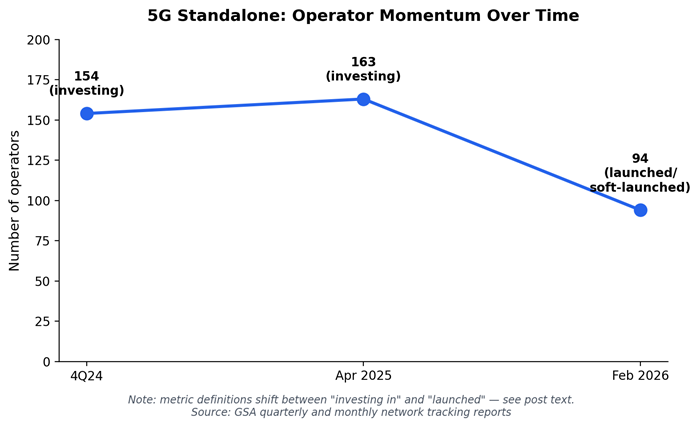
5G Standalone operator growth over time
Why this matters beyond a bigger number
GSA’s own April 2026 analysis frames this as a genuine architectural shift: while non-standalone still accounts for the majority of launched 5G services, standalone is steadily gaining share and now underpins the industry’s next wave of innovation — the foundation operators need for 5G RedCap, network slicing, and the broader move toward programmable, cloud-native networks. This directly matches what Module 3 of this site’s 5G course explained: NSA (Option 3/EN-DC) simply cannot deliver network slicing or URLLC-grade latency, because those capabilities depend on 5G Core architecture that doesn’t exist in an EPC-anchored NSA deployment. Every operator adding an SA core is, in effect, unlocking capability their NSA deployment structurally couldn’t offer.
The part most 5G marketing skips: SA doesn’t automatically mean faster
This is where the data gets genuinely interesting, and where a lot of vendor messaging oversimplifies. Opensignal’s real-world measurement data shows results vary significantly by market — SA architecture alone does not guarantee higher download speeds, and in some markets it actually shows a decline relative to NSA.
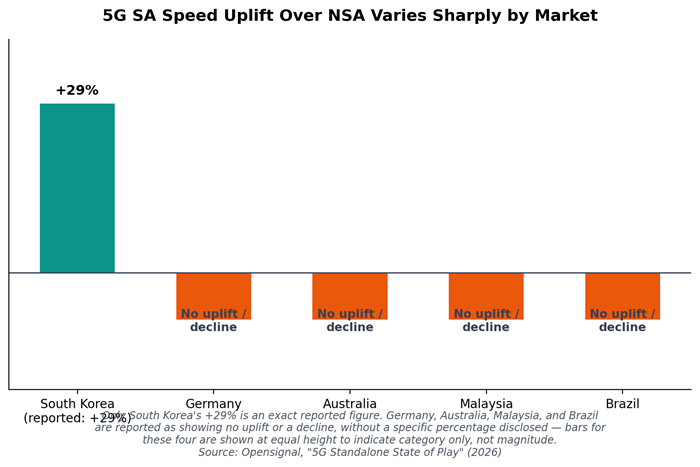
5G SA speed uplift over NSA by market
South Korea is a telling example: absolute SA download speeds exceed 600 Mbps, yet the uplift over NSA is “only” +29%, reflecting how mature and well-optimized South Korea’s existing NSA baseline already was. By contrast, markets including Malaysia, Australia, Germany, and Brazil show SA delivering no download uplift at all — in some cases a measurable decline — demonstrating that SA architecture alone doesn’t guarantee a better experience; a well-optimized NSA layer can outperform a newly launched SA network.
This is a genuinely useful corrective to how SA migration often gets pitched internally: the business case for SA isn’t really “it’s faster.” Based on the real-world measurement data, that claim doesn’t hold consistently across markets. The actual business case is architectural — SA is the prerequisite for slicing, RedCap, and URLLC use cases NSA cannot deliver regardless of how well-tuned it is, not a guaranteed speed upgrade in itself.
Regulatory pressure is starting to force the pace in some markets
South Korea’s government has taken the unusual step of directly mandating the transition: all 5G base stations must be connected to standalone core equipment by 2026, reinforced with financial incentives, explicitly aligning the country’s network evolution with its national AI and 6G ambitions. That’s a meaningfully different dynamic than the market-driven pace seen elsewhere — a reminder that in some markets, SA migration timelines are becoming policy decisions, not purely commercial ones.
What this means for network strategy conversations
If SA migration is being pitched internally purely on a speed argument, the current real-world data doesn’t consistently support it — and leading with a claim the data can contradict market-by-market is a weaker position than the architectural one. The more defensible case, and the one this site’s 5G course has built toward across fourteen modules, is capability: slicing, RedCap, URLLC, and the cloud-native core architecture that 2026 and beyond will increasingly be built around. The Opensignal data is a useful gut-check before that pitch goes into any executive deck — know which markets your own network’s SA rollout is likely to actually outperform NSA on speed, and lead with capability everywhere else.
Source data: GSA (Global mobile Suppliers Association), “State of the Market April 2026” and “Public Networks and Mobile Operators — February 2026”; Opensignal, “5G Standalone State of Play” (2026).