

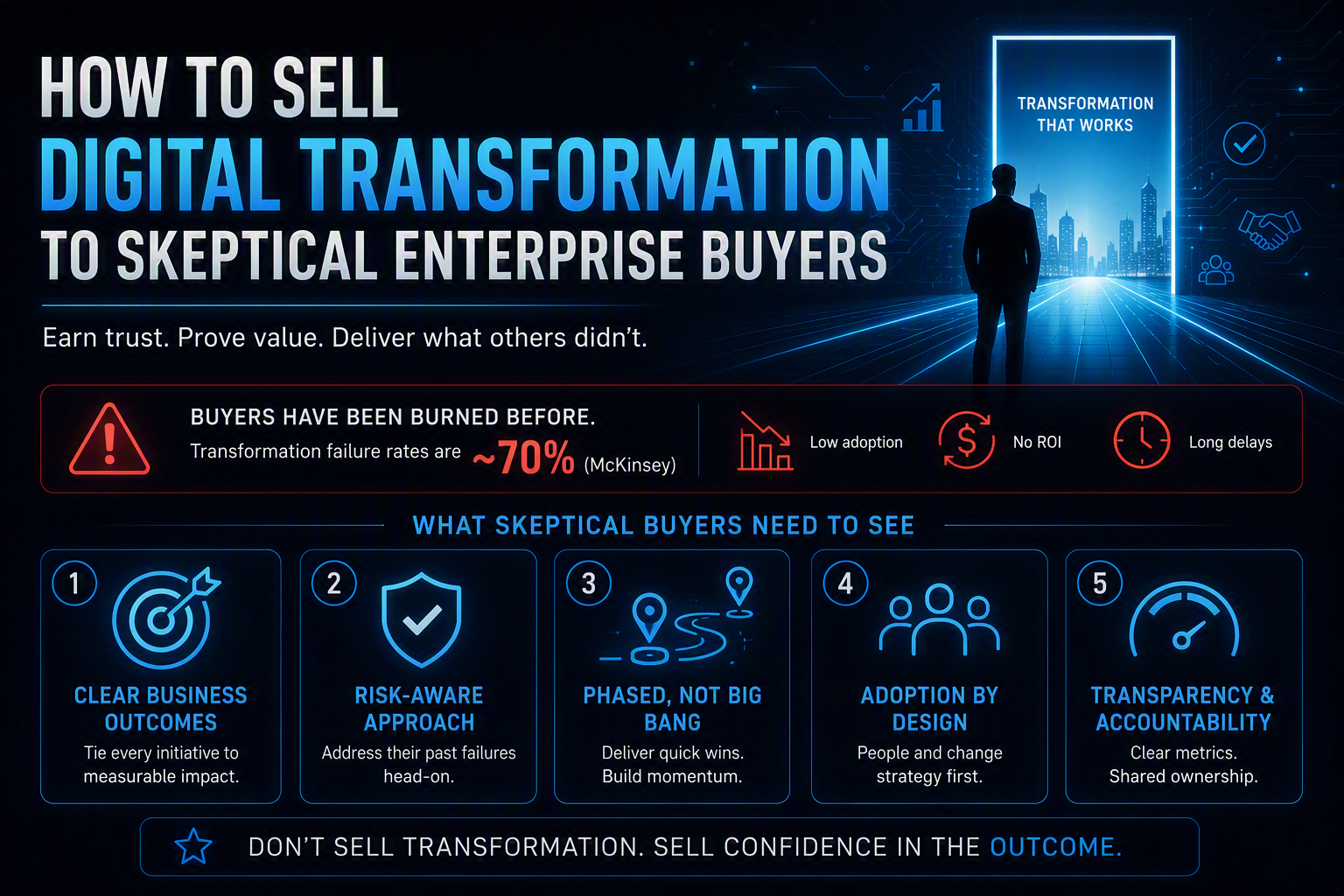
To sell digital transformation to skeptical enterprise buyers, you first have to understand that every one of them has already been through a project that didn’t work. A CRM rollout that stalled at 40% adoption. A “digital strategy” that turned out to be a rebranded IT budget increase. A vendor who promised efficiency gains and delivered eighteen months of change requests.
You are not walking into a blank room. You are walking into a room with scar tissue.
The numbers back up what that room feels like. A widely cited McKinsey figure puts digital transformation failure rates around 70% — and while researchers argue about the exact methodology behind that number, every serious study since, from BCG to Gartner to Bain, lands somewhere between 65% and 90%. Whatever the precise figure, the buyer across the table has more experience with transformation failure than transformation success.
Most sales pitches for transformation projects fail because they’re built for buyers who don’t exist — buyers who are excited, blank-slate, and ready to be convinced. The buyer actually in front of you is tired, has been burned, and is scanning your deck for the same empty promises they’ve heard three times already.
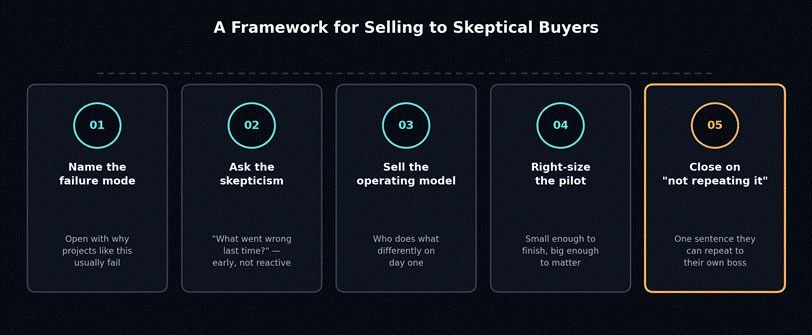
The five-step framework this post walks through.
Stop leading with vision
The instinct is to open with the future state — the dashboard, the automation, the AI-augmented workflow. That’s backwards for this buyer. Vision is what they’ve already bought once and didn’t get.
Open instead with the failure mode you’re not going to repeat. If you know the market — and if you’ve sat across from enough CIOs, procurement heads, and operations directors, you do — name the pattern plainly: transformation projects usually fail because the software gets deployed before the workflow gets redesigned, not because the software was bad.
That single sentence does more trust-building than any slide about ROI. It tells the buyer you’ve seen this movie before and you’re not selling them the sequel.
Make the skepticism the agenda, not the objection
Most sales training treats objections as something to handle once they surface. With a transformation-fatigued buyer, don’t wait. Ask the question yourself, early: “What went wrong last time you tried something like this?”
This does three things. It surfaces the real internal politics behind the last failed rollout — often more revealing than anything in their RFP. It signals you’re not afraid of the answer. And it gives you the actual objection to solve for, instead of guessing at generic ones like budget or timeline.
The buyers who’ve been burned aren’t skeptical of digital transformation. They’re skeptical of vendors who talk about transformation and mean software.
Sell the operating model, not the platform
A platform is something IT evaluates. An operating model is something the business owns. If your pitch can be fully summarized as “here’s what the tool does,” you’re selling to the wrong decision layer, and you’ll get stuck in a procurement cycle that treats you as a commodity.
Instead, walk the buyer through who does what differently on day one after go-live — which approvals disappear, which handoffs get automated, which meeting stops needing to happen. Specificity here is the entire game. Vague promises of “efficiency” and “agility” are exactly the language of the last project that disappointed them.
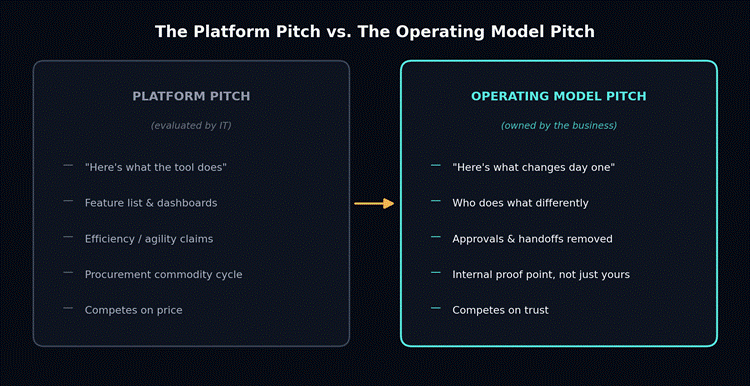
The difference between the pitch that gets commoditized and the one that gets trusted.
Know who’s actually in the room
A pitch that lands perfectly with the person you’re presenting to can still die in committee, because enterprise buying decisions are rarely made by one person. Every deal has at least four roles working against or for you, whether or not they’re all in the meeting.
The Economic Buyer controls budget and is measured on the risk this decision puts on their own numbers — they don’t care about your feature set, they care about downside. The Technical Buyer’s job is to find reasons to say no; they screen for feasibility, security, and integration risk, and a pitch with no answer for them dies quietly in a technical review you never see. The User Buyer is the one who actually lives inside whatever you build, and in a transformation-fatigued account, this is often the person most burned by the last failure — they were the ones re-trained on a system that got abandoned eight months later. And the Coach is your internal ally, the person who tells you what’s actually happening politically, which is information no amount of discovery calls will surface on their own.
Selling to only one of these roles is the single most common reason technically sound transformation deals stall. A brilliant pitch to the Economic Buyer with no Coach inside the account means you find out about the political objection after you’ve already lost.
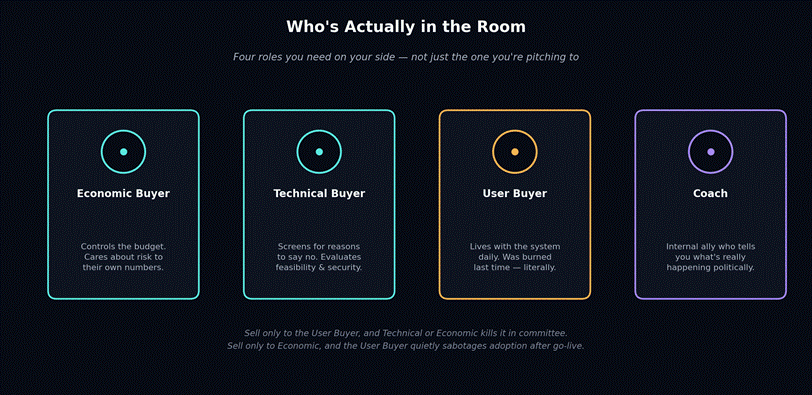
Four roles, four different objections — miss one and the deal stalls somewhere you can’t see.
Give them a smaller first win than they’re asking for
Skeptical buyers often ask for a bigger pilot than they need, because they’ve learned that small pilots get killed for lack of visible impact. Resist matching that instinct. A pilot big enough to matter but small enough to finish in one quarter builds more credibility than a six-month proof of concept that risks becoming this year’s stalled initiative.
The first deliverable should be something the buyer’s own team can point to internally as proof it’s working — not just to you. That internal proof point is what survives the next budget review, long after your deck is forgotten.
What to do when the answer is still no
Sometimes the scar tissue is too fresh, or the internal politics too damaged, and the deal doesn’t close this cycle. That doesn’t mean the account is dead — it means the timeline changed.
The mistake most sales teams make here is going quiet. Staying present without pitching is what actually rebuilds trust over the following two or three quarters. Share something genuinely useful with no ask attached — a relevant case study, an introduction to someone solving a similar problem, a point of view on a regulatory change that affects them. When the internal conditions shift and they’re ready to try again, you want to be the vendor who stayed useful, not the one who stopped calling the moment the answer was no.
The close isn’t “yes.” It’s “we won’t repeat that.”
By the time you’re asking for commitment, the actual thing you’re closing on isn’t the ROI case — it’s a specific, credible answer to “how is this different from last time.” If you can’t answer that in one sentence the buyer could repeat to their own boss, you haven’t earned the close yet.
Have you sold — or bought — a transformation project that had to overcome this kind of institutional scar tissue? What actually rebuilt the trust?