

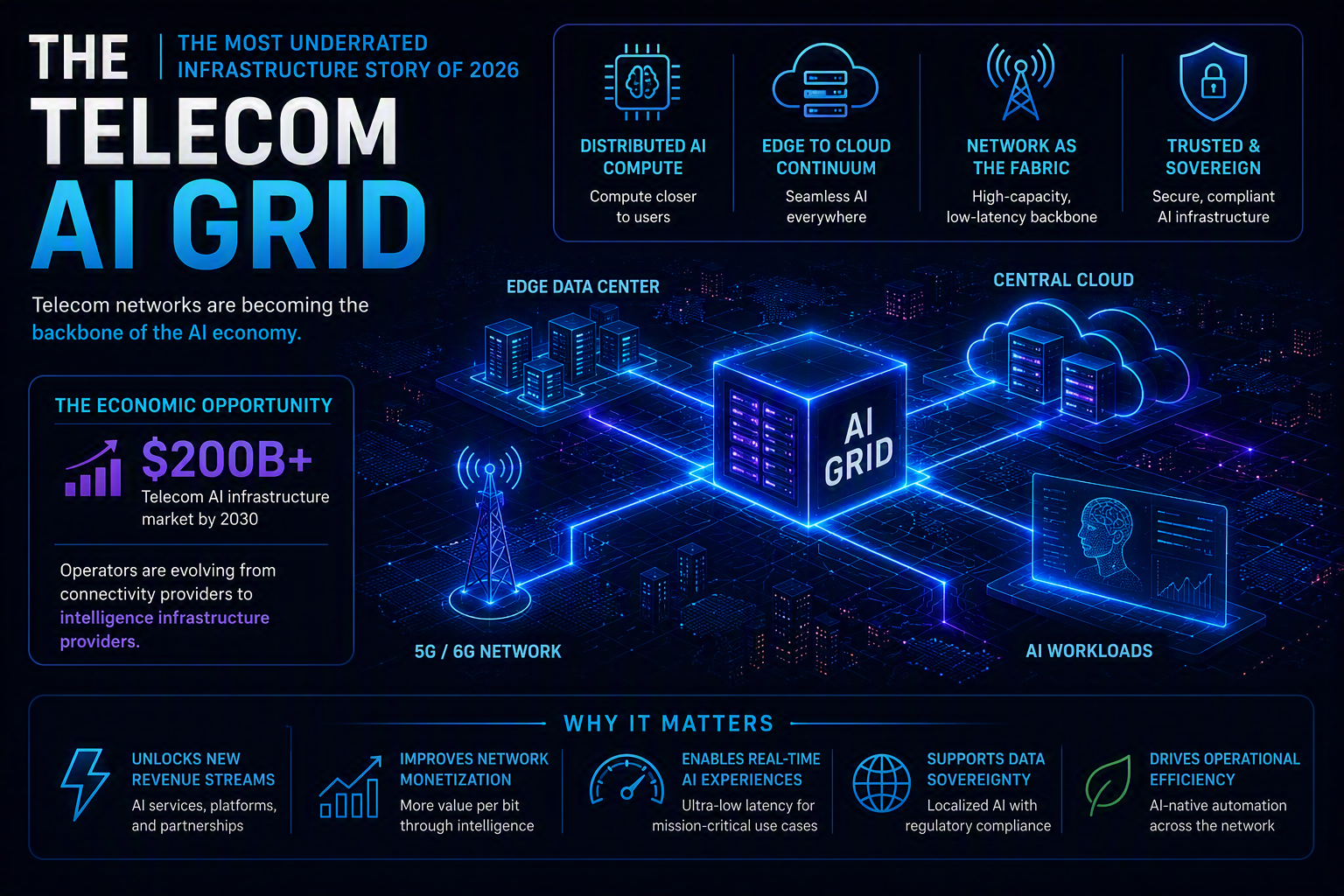
While the headlines this month are all about Starlink chasing carrier subscribers, a much bigger structural shift in telecom is happening almost entirely outside mainstream coverage: the telecom AI grid. It’s the industry’s least-covered major story of 2026, and arguably its most consequential — and unlike most infrastructure buzzwords, it comes with real deployments, real economics, and real skeptics worth taking seriously.
The premise is deceptively simple. Telecom operators already own roughly 100,000 distributed network facilities worldwide — regional hubs, mobile switching offices, central offices — sitting on more than 100 gigawatts of largely idle spare power capacity. At NVIDIA’s GTC 2026 conference in March, that idle capacity got a name and a business model: the AI grid, a geographically distributed AI inference fabric built on top of infrastructure that already exists.
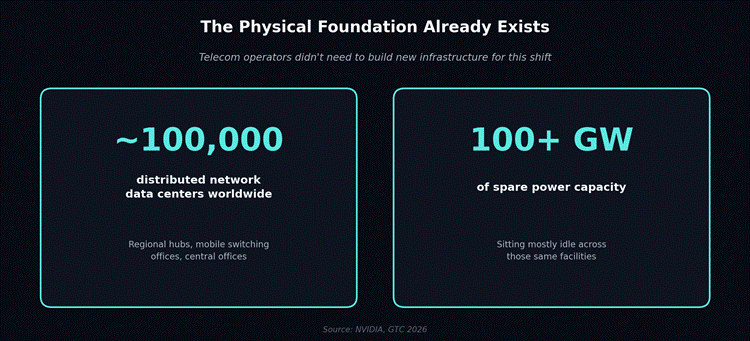
The scale of unused capacity telcos are sitting on right now.
Why this isn’t just another cloud story
For three decades, telecom’s business model was straightforward: move bits, charge for bandwidth. Centralized hyperscale cloud handled compute. The telecom AI grid breaks that division cleanly, and the reason is physics, not ambition.
Enterprise AI workloads are increasingly latency-sensitive — real-time inference for conversational agents, industrial automation, or live video analysis can’t tolerate a round trip to a hyperscaler region three states or three countries away. Telcos already own the real estate that removes that round trip entirely. Comcast’s own validation testing found edge-based inference on this kind of distributed infrastructure was both cheaper and faster than centralized deployment during burst demand conditions.
This isn’t a future plan — and the early results are real
What separates this from typical vendor-hyped infrastructure trends is that it’s not theoretical. At GTC 2026, six major operators — spanning North America and Asia — announced AI grid deployments already in motion, not roadmap slides.
Akamai has taken the pattern furthest: its Inference Cloud, by the company’s own account the first global-scale implementation of NVIDIA’s AI Grid reference design, routes workloads across more than 4,400 edge locations running thousands of GPUs. On that same infrastructure, video-generation workloads from Decart have hit single-digit-millisecond network latency, and Personal AI has reported over 50% lower cost-per-token than a centralized alternative by running smaller models closer to users — a concrete illustration of the latency argument actually paying off, not just theorizing about it.
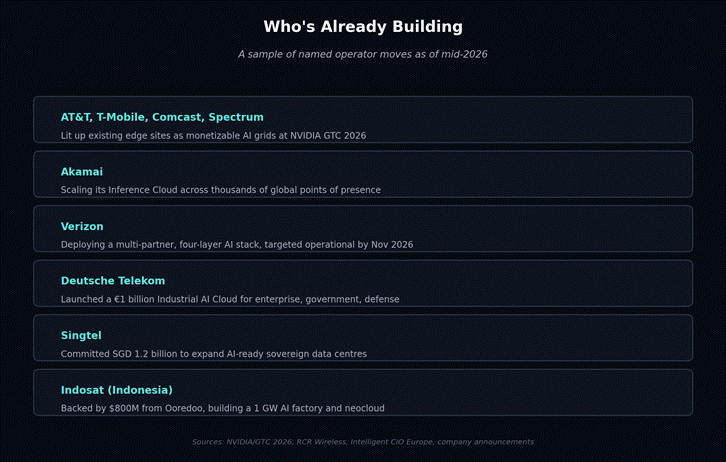
A sample of the named commitments already public as of mid-2026.
The monetization question nobody outside the industry is asking
Building the infrastructure is only half the story — how operators charge for it determines whether this becomes a real business or an expensive science project. Two models are competing for how telcos sell this capacity.
The simpler path is renting GPU-hours, billed like a cloud instance — straightforward, but revenue is capped by the hourly rate, and that rate keeps compressing as GPU supply improves. On-demand A100 hourly rates, for reference, have already been reported well under $2/hour on some platforms in 2026. The more ambitious path is selling tokens — metering AI output the way a mobile plan meters data. NVIDIA’s own analysis argues the same physical GPU can generate several times more annual revenue under a token model than a GPU-hour model, because efficiency gains from newer hardware become margin instead of forcing price cuts. Independent research backs the shift in principle: Omdia’s Telco B2B AI Monetization Index projects a 65% compound annual growth rate for telco B2B AI revenue through 2030, albeit from a small base of roughly $4 billion in 2025.
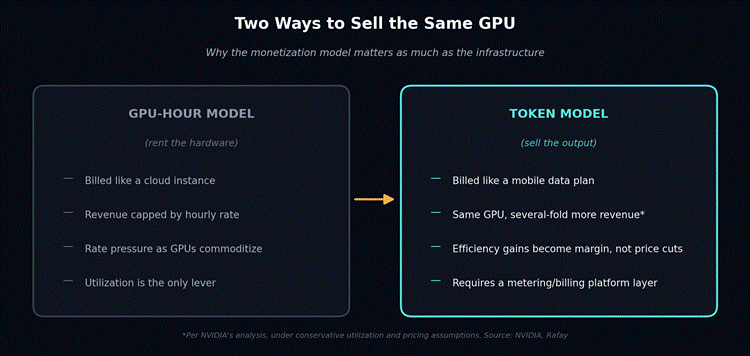
The strategic choice underneath the infrastructure headlines.
The real skepticism worth taking seriously
Comprehensive coverage of this trend means including the case against it, and there is a substantive one — not from casual doubters, but from people who’ve built RAN roadmaps professionally.
The sharpest version of this critique targets AI-RAN specifically: retrofitting radio access network hardware with GPU-class silicon. A hardened 5G baseband unit is built for 24/7 reliability on a tight power budget; a Hopper-class GPU board pulls hundreds of watts and costs multiples more. Critics with telecom engineering backgrounds argue plainly that much of the current AI-RAN push is driven more by fear of missing the AI cycle than by hardware economics that actually pencil out at the cell-site level. That’s a materially different claim than “the AI grid doesn’t work” — the criticism is specifically that bolting inference silicon onto radio hardware is the wrong layer to do it at, while edge data centers and central offices (the actual AI grid infrastructure this piece is about) remain a more defensible use case.
Analyst coverage adds a second, more business-model-shaped warning: trying to build a generic, horizontal AI cloud to compete head-on with hyperscalers is a high-cost, low-margin trap for most operators. The defensible ground, in this view, isn’t matching AWS or Azure feature-for-feature — it’s the narrower spaces hyperscalers structurally can’t serve as well: data sovereignty requirements, latency-critical edge workloads, and the trusted billing relationship telcos already have with enterprise customers.
The catch everyone glosses over: power, not compute, is the real constraint
Even setting aside the AI-RAN debate, the honest complication in the broader AI grid story is that “100+ gigawatts of spare capacity” doesn’t mean 100 gigawatts is immediately usable. Engineering leaders at Data Center World 2026 were direct about this: next-generation AI clusters need 40 to 100+ kilowatts per rack, far beyond what most legacy telecom facilities were designed to deliver, and retrofitting for the liquid cooling and power density modern AI hardware needs is neither fast nor cheap.
The operators moving fastest are the ones treating this as a power and real estate problem first, and a compute problem second. That’s a very different capital allocation conversation than the one most “telco pivots to AI” headlines suggest.
Why this matters beyond the operators building it
For enterprise buyers, the telecom AI grid quietly solves a problem that’s been showing up in survey after survey this year: DDN’s 2026 State of AI Infrastructure Report found 99% of IT and business leaders experienced inefficiencies in their AI workloads, with 65% describing their AI environments as too complex to manage. A telecom partner offering AI inference bundled with the connectivity relationship an enterprise already trusts is a materially different sales conversation than another point solution vendor — assuming the operator has picked its monetization model and its narrow defensible use case, not tried to out-hyperscale the hyperscalers.
For operators in markets where data sovereignty is a hard requirement rather than a preference — much of the GCC included — this is also the more direct path to sovereign AI offerings than partnering with a foreign hyperscaler from scratch. The infrastructure argument, the sovereignty argument, and the monetization argument all point at the same narrow, defensible answer — which is exactly the answer the AI-RAN skeptics say most operators haven’t found yet.
If you’re evaluating AI infrastructure options for your own organization, is your current or prospective connectivity provider even part of that conversation yet — or is it still framed purely as a hyperscaler decision?