

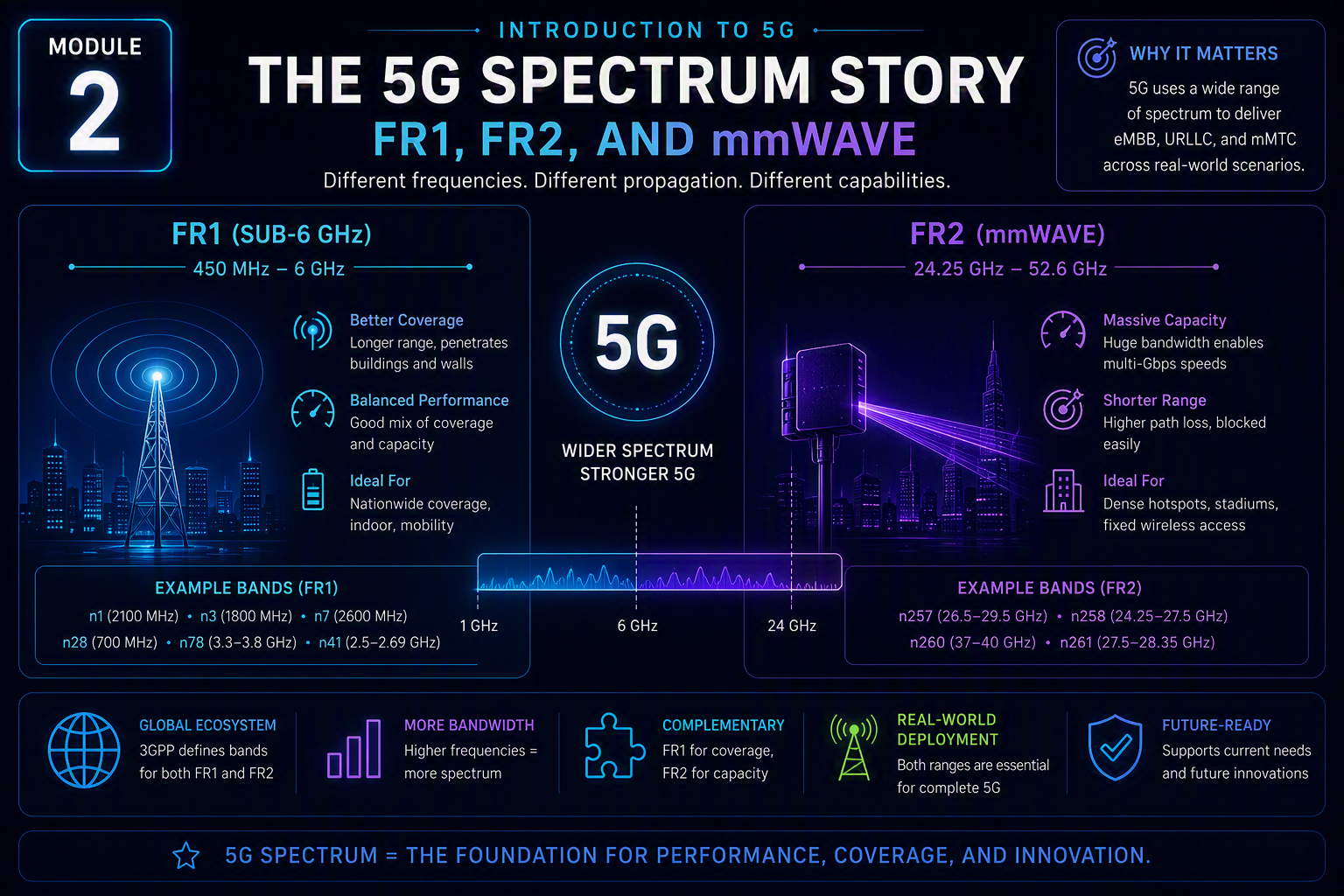
5G spectrum FR1 FR2 designations aren’t informal shorthand — they’re precise 3GPP frequency range definitions in TS 38.104, each governing a completely different set of physical propagation behavior, and each carrying its own catalog of standardized operating bands. If Module 1 explained why 5G needed new capability, this module explains where the raw bandwidth for those capabilities physically comes from.
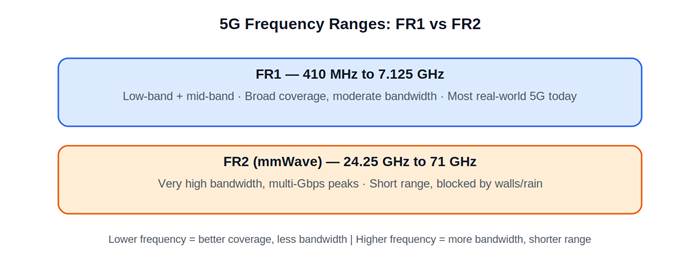
Diagram for Module 2
Diagram: 5G spectrum FR1 FR2 comparison — coverage versus bandwidth tradeoff.
The basic tradeoff: frequency, coverage, and capacity
Radio frequency planning always comes down to the same physical tradeoff. Lower frequencies travel farther and penetrate buildings and obstacles better, but they have less available contiguous bandwidth, capping how much data can move through them. Higher frequencies offer enormous amounts of available bandwidth — physically enabling much higher data rates — but they travel shorter distances and are far more easily blocked by walls, foliage, and even heavy rain.
Every generation before 5G operated almost entirely below 6 GHz. Module 1’s IMT-2020 target of 20 Gbps peak downlink simply isn’t achievable within that crowded sub-6GHz range using realistic channel bandwidths — which is precisely why 5G’s spectrum strategy needed to expand into frequency territory previous generations left largely untouched.
FR1: the familiar range, formally extended
Frequency Range 1 (FR1), per 3GPP TS 38.104, covers 410 MHz to 7,125 MHz. FR1 was originally capped at 6,000 MHz; 3GPP extended the upper limit to 7,125 MHz in Release 17 to accommodate additional mid-band spectrum coming into commercial use. FR1 splits informally into low-band and mid-band, each with real, standardized 3GPP band numbers already in commercial use:
| Band | Frequency range | Common name | Typical use |
| n71 | 617–698 MHz | 600 MHz | Low-band, wide coverage |
| n28 | 703–803 MHz | 700 MHz | Low-band, wide coverage |
| n5 / n26 | 824–894 MHz | 850/800 MHz | Low-band, refarmed from 2G/3G |
| n1 | 1920–1980 / 2110–2170 MHz | 2100 MHz (IMT core) | Mid-band, widely refarmed |
| n78 | 3300–3800 MHz | C-band / 3.5 GHz | Mid-band, primary global 5G workhorse |
| n77 | 3300–4200 MHz | C-band (extended) | Mid-band, used heavily in the US |
| n79 | 4400–5000 MHz | 4.9/4.7 GHz | Mid-band, notably used in China/Japan |
Source: 3GPP TS 38.104, Table 5.2-1 (NR operating bands).
Band n78, in the 3.3–3.8 GHz range, is where most people’s real-world 5G experience actually comes from today — it delivers a meaningful, broadly deployable capacity improvement over 4G without the severe coverage limitations higher frequencies impose, which is why operators worldwide prioritized this band early in 5G rollouts.
FR2: entering millimeter wave territory
Frequency Range 2 (FR2), per the same TS 38.104 definition, covers 24.25 GHz to 71 GHz — commonly called millimeter wave (mmWave), named for the physically small wavelength at these frequencies (a few millimeters, versus tens of centimeters at FR1 frequencies). 3GPP formally splits FR2 into two sub-ranges: FR2-1 (24.25–52.6 GHz, the original mmWave allocation from Release 15) and FR2-2 (52.6–71 GHz, added in Release 17 to support even higher bandwidth use cases). Real deployed FR2 bands include:
| Band | Frequency range | Common name |
| n257 | 26.5–29.5 GHz | 28 GHz |
| n258 | 24.25–27.5 GHz | 26 GHz |
| n260 | 37–40 GHz | 39 GHz |
| n261 | 27.5–28.35 GHz | 28 GHz (US) |
Source: 3GPP TS 38.104, Table 5.2-2 (NR operating bands in FR2).
A typical mmWave cell might cover a few hundred meters in open line-of-sight conditions, with performance degrading sharply behind walls, through foliage, or in moderately heavy rain — which is why mmWave deployments concentrate in dense, localized installations: stadiums, dense urban corridors, and specific high-traffic venues, rather than blanket area coverage.
Why 5G needed both, not just one
A network built entirely on FR1 would struggle to deliver on IMT-2020’s most ambitious eMBB peak-rate targets from Module 1 — the contiguous bandwidth simply isn’t available at those frequencies. A network built entirely on FR2 would deliver extraordinary peak speeds in tiny pockets while leaving most of a coverage area without usable signal. 5G’s spectrum strategy deliberately layers both: FR1, particularly mid-band n78/n77, carries the broad, reliable coverage layer most users experience most of the time, while FR2 supplements it in specific high-density locations where its extreme capacity is genuinely usable.
What this means practically
Understanding 5G spectrum FR1 FR2 explains a lot of real-world 5G experience that otherwise seems inconsistent: why “5G” can mean a modest, reliable speed bump on band n78 in most locations, and an extraordinary, sometimes flaky, multi-gigabit connection on band n261 in a stadium or airport. Both are legitimately 5G, operating under the same TS 38.104 specification — they’re just trading coverage against raw capacity at genuinely different points on the same physical curve.
Next in this series: Module 3 — 5G Deployment Options: NSA vs. SA, covering how operators actually roll 5G out on top of, or independent from, existing 4G infrastructure.
One thought on “Introduction to 5G — Module 2: The 5G Spectrum Story — FR1, FR2, and mmWave”