

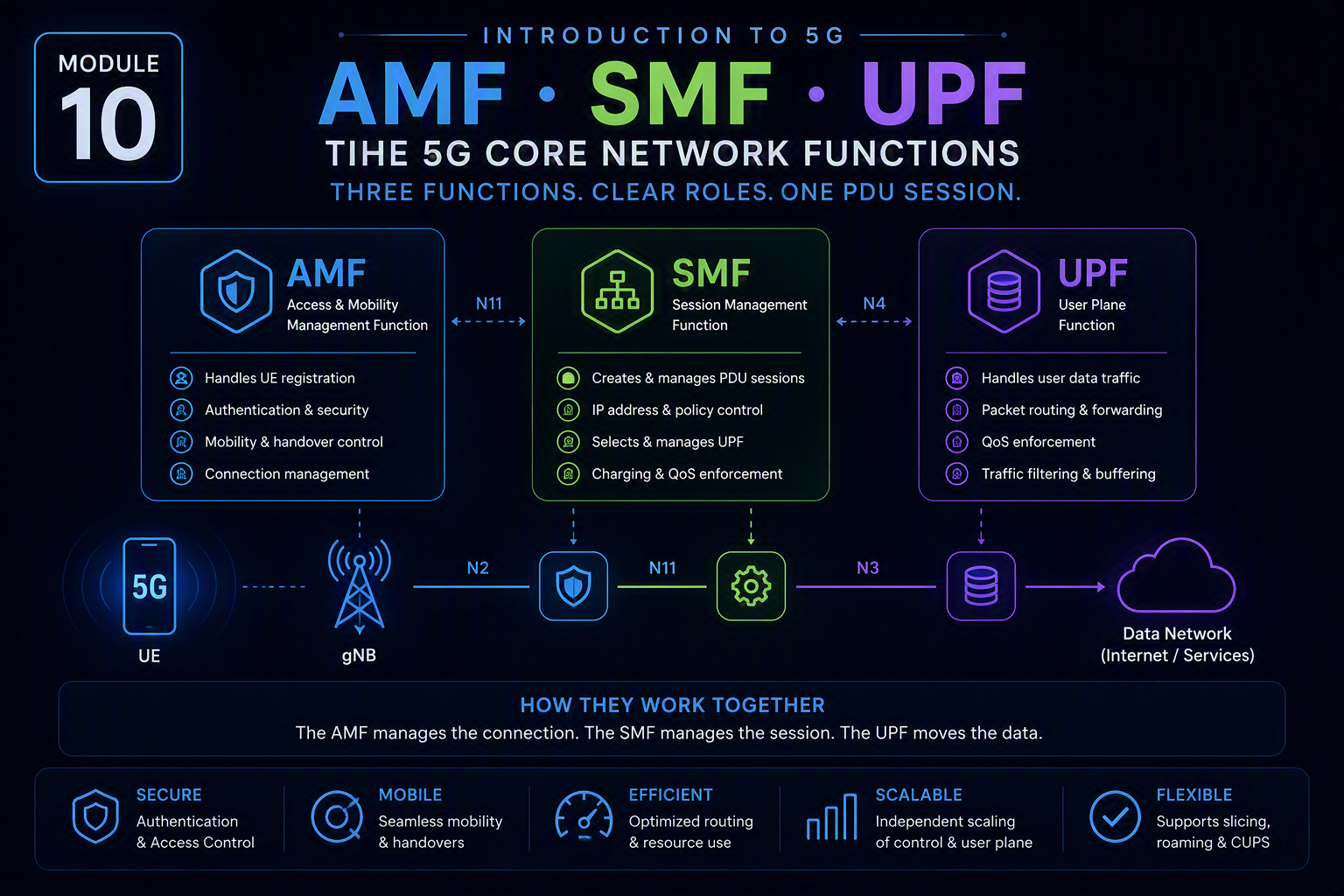
AMF SMF UPF 5G Core functions are formally defined in 3GPP TS 23.501, Section 6.2, with precise responsibility boundaries — and understanding exactly where LTE’s EPC functions were split apart to create them explains most of the architectural reasoning behind 5G Core’s overall design.
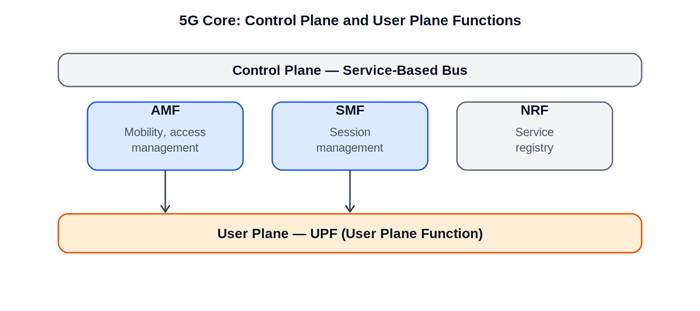
Diagram for Module 10
Diagram: AMF SMF UPF 5G Core — control-plane and user-plane function split.
Mapping backward from EPC
LTE’s EPC concentrated responsibility into fewer functions: the MME handled mobility management and much session-control signaling; the S-GW handled intra-network user-plane routing and mobility anchoring; the P-GW handled external network connectivity and IP address allocation. 5G Core splits these responsibilities further, into more numerous, more specialized functions.
AMF: Access and Mobility Management Function (TS 23.501 §6.2.1)
The AMF is the closest direct MME equivalent, though narrower by design. Per TS 23.501, its responsibilities explicitly include: registration management, connection management, reachability management, mobility management, and termination of NAS signaling (N1) and RRC-related signaling coordination with RAN (N2). What the AMF explicitly does not handle — a deliberate split from MME’s broader scope — is session management, carved out entirely into the SMF.
SMF: Session Management Function (TS 23.501 §6.2.2)
The SMF owns PDU session establishment, modification, and release; IP address allocation and management for the UE; selection and control of the appropriate UPF; and configuration of traffic steering at the UPF to route traffic to the correct destination. This is a direct carve-out of session management responsibility the MME handled as part of its broader EPC-era remit.
UPF: User Plane Function (TS 23.501 §6.2.3)
The UPF is where user data actually flows — combining responsibilities LTE split across the S-GW and P-GW. Per TS 23.501, UPF responsibilities explicitly include: packet routing and forwarding, packet inspection, QoS handling per Module 13’s 5QI framework, acting as the external PDU session point of interconnect (equivalent to P-GW’s external-facing role), and — critically — supporting deployment flexibility including edge deployment, directly relevant to URLLC latency from Module 1.
Why splitting AMF and SMF apart actually matters
Separating mobility management (AMF) from session management (SMF) — responsibilities EPC’s MME handled together — directly supports network slicing (Module 12): different slices can use different SMF instances configured differently per use case, while sharing common AMF-level mobility infrastructure where that makes sense. EPC’s more consolidated MME design didn’t offer this kind of selective flexibility.
The N1/N2/N3/N4 reference points that connect them
These functions don’t just communicate over SBI (Module 9) — several critical interactions use dedicated reference points defined in TS 23.501 Figure 4.2.3-1: N1 carries NAS signaling between UE and AMF; N2 carries signaling between (R)AN and AMF; N3 carries user-plane traffic between (R)AN and UPF; N4 carries control signaling (using the PFCP protocol) between SMF and UPF, letting the SMF configure exactly how the UPF should handle a given session’s traffic.
A practical example, tying it together
A device establishing a new session: the AMF handles initial registration (N1/N2) and coordinates with the SMF to establish the PDU session. The SMF selects an appropriate UPF instance — potentially edge-deployed for a URLLC session — and configures it via N4/PFCP. From that point, data flows directly through the UPF via N3, without round-tripping through AMF or SMF for every packet — those remain involved only for control-plane events like mobility updates, not the ongoing data flow itself.
What comes next
This AMF/SMF/UPF split, and the N1–N4 reference points connecting them, is a direct, concrete implementation of a broader principle worth its own dedicated treatment: separating control-plane decision-making from user-plane data forwarding.
Looking forward to your feedback below.
Next in this series: Module 11 — Control and User Plane Separation (CUPS) and Why It Matters for 5G.
2 thoughts on “Introduction to 5G — Module 10: The Key 5G Core Network Functions — AMF, SMF, and UPF, and How They Divide Labor”