

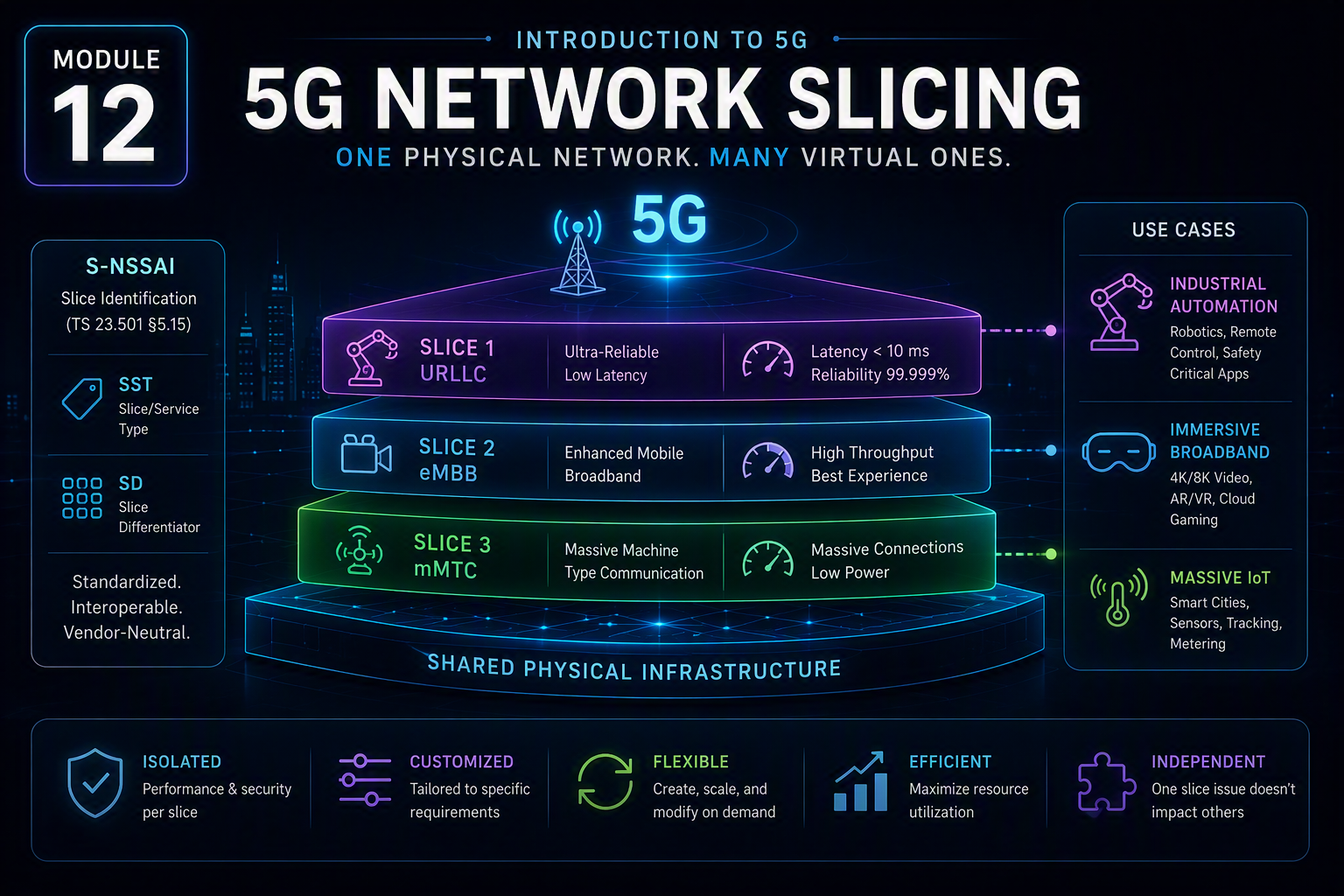
5G network slicing is identified and selected through a precisely defined 3GPP data structure — S-NSSAI (Single Network Slice Selection Assistance Information), per TS 23.501 Section 5.15 — with standardized slice type values that make cross-operator and cross-vendor slicing interoperable rather than an ad-hoc per-operator convention.
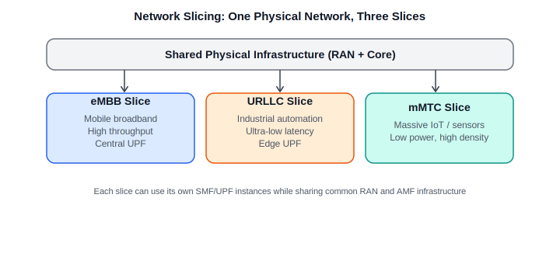
Diagram for Module 12
Diagram: 5G network slicing — one physical network divided into independently configured slices.
The problem slicing solves
Module 1’s three-pillar tension is unresolved by RAN and Core architecture alone: eMBB, URLLC, and mMTC traffic have genuinely conflicting requirements, and building three entirely separate physical networks would solve the conflict at prohibitive cost. Network slicing is 5G’s formal answer: logically isolated, independently configured virtual networks running on shared physical infrastructure.
S-NSSAI: the structure that identifies a slice
Per TS 23.501, an S-NSSAI consists of two parts: a mandatory SST (Slice/Service Type), an 8-bit value identifying the expected slice behavior, and an optional SD (Slice Differentiator), a 24-bit value distinguishing multiple slices of the same SST for the same operator. 3GPP standardizes four SST values explicitly, leaving the rest operator-defined:
| SST value | Standardized name | Characteristics |
| 1 | eMBB | High data rate, per Module 1’s eMBB targets |
| 2 | URLLC | Low latency, high reliability, per Module 1’s URLLC targets |
| 3 | MIoT (Massive IoT) | High device density, corresponds to mMTC |
| 4 | V2X | Vehicle-to-everything, latency and reliability critical |
| 128–255 | Operator-specific | Reserved for individual operator use |
Source: 3GPP TS 23.501, Table 5.15.2.2-1 (Standardized SST values).
What actually makes a slice a slice
A genuine slice isn’t simply a QoS profile or VLAN-style separation — it can have dedicated (or shared) instances of specific network functions, potentially its own SMF and UPF (Module 10), configured with slice-specific parameters, while sharing common infrastructure like RAN and AMF-level mobility management (Module 11) where sharing doesn’t compromise the slice’s requirements. This is precisely why Service-Based Architecture’s modularity (Module 9) and CUPS’s control/user-plane separation (Module 11) matter so much: SBA makes it practical to instantiate different function combinations per slice, and CUPS makes it practical for different slices to use entirely different UPF deployments — edge-deployed for a URLLC slice, centralized for an eMBB slice — while sharing common control-plane infrastructure.
Network Slice Selection: NSSF and the selection procedure
Devices are directed to the appropriate slice through a procedure defined in TS 23.501 Section 5.15.5, involving the NSSF (Network Slice Selection Function). A device provides its Requested NSSAI (a set of S-NSSAI values) during registration; the AMF, if not already slice-aware for that device, consults the NSSF, which returns the Allowed NSSAI — the slices the device is actually authorized to use — along with AMF selection guidance if a different, slice-appropriate AMF instance is needed. The AMF then routes session establishment toward the appropriate slice-specific SMF and, ultimately, UPF.
A concrete example, tying it together
An operator serving three customers on one physical network: an eMBB slice (SST=1) for consumer mobile broadband, using a centrally deployed UPF optimized for aggregate throughput; a URLLC slice (SST=2) for industrial automation, using an edge-deployed UPF close to the factory floor with dedicated radio resources; and an MIoT slice (SST=3) for a utility’s smart-meter deployment, tuned for infrequent small transmissions and power efficiency. All three run on shared RAN and, to varying degrees, shared core infrastructure — but each behaves, from its own traffic’s perspective, like a network purpose-built for its requirements.
The honest caveat
Full, dynamic, end-to-end slicing — with real-time slice creation and independent guarantees enforced across RAN and Core together — remains more mature in core-network implementations than in comprehensive, dynamic RAN-inclusive deployments industry-wide. S-NSSAI-based slice selection and core-level slicing are standardized and commercially deployed today, particularly in enterprise and private network contexts; the more ambitious, fully dynamic end-to-end vision remains an area of ongoing industry maturity.
Next in this series: Module 13 — Quality of Service in 5G: 5QI and How the Network Prioritizes Traffic.
One thought on “Introduction to 5G — Module 12: Network Slicing — One Physical Network, Many Virtual Ones”