

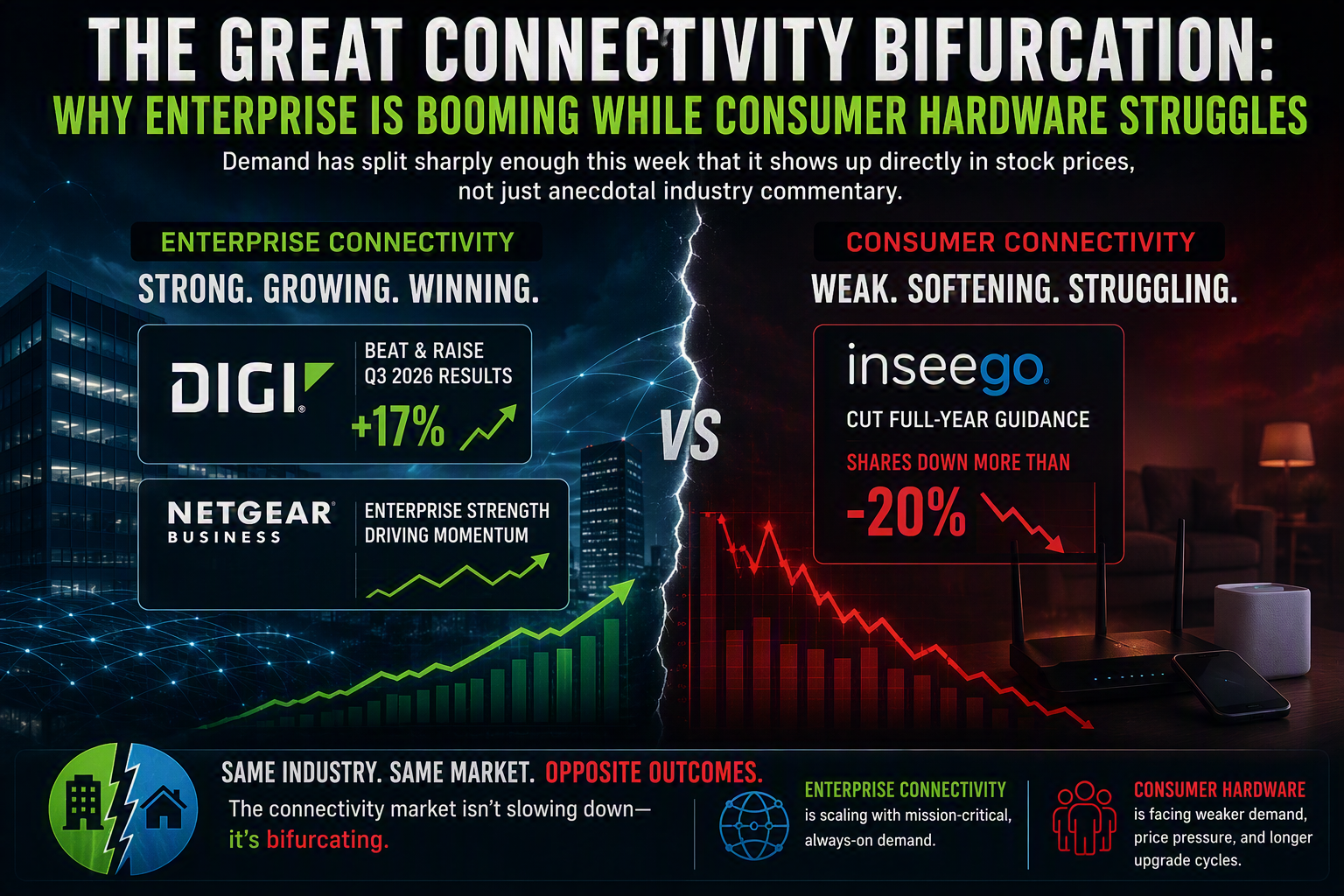
Enterprise vs consumer connectivity demand has split sharply enough this week that it shows up directly in stock prices, not just anecdotal industry commentary. Digi International posted a beat-and-raise quarter that sent its shares up 17 percent. Netgear posted enterprise strength of its own. Inseego, by contrast, cut full-year guidance and lost more than a fifth of its value in a single week. Same broad connectivity hardware sector, same general market conditions — genuinely opposite outcomes.
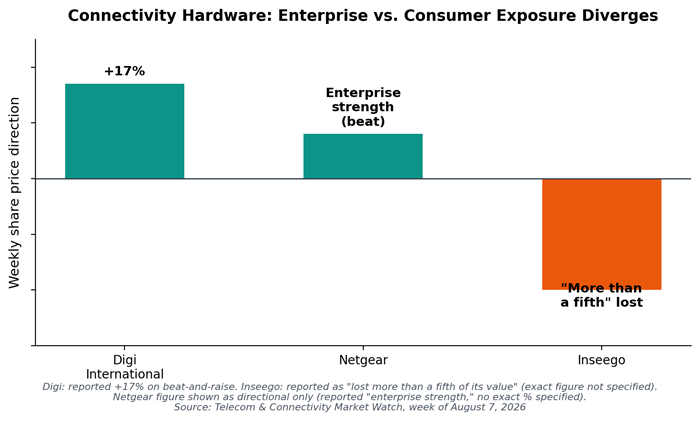
Connectivity hardware earnings divergence chart
What’s actually driving the split
The distinction isn’t “good company versus bad company” — it’s exposure to enterprise and industrial demand versus exposure to consumer and single-purpose hardware. Digi and Netgear both pointed to the same underlying dynamic in their earnings commentary: enterprise and industrial connectivity — SD-WAN-managed routers, remote asset monitoring, industrial IoT gateways — is where real demand is concentrating right now, while consumer-grade and single-purpose connectivity hardware is under sustained pricing and demand pressure.
Why this matters beyond one earnings cycle
This is a genuine structural signal worth taking seriously, not just quarterly noise. Enterprises are consolidating onto fewer, better-managed devices with real SD-WAN capability and centralized remote management behind them — a pattern consistent with the broader enterprise IT trend toward fewer vendors, deeper integration, and less tolerance for point solutions that don’t fit into a managed fleet. A single-purpose consumer router or a basic cellular gateway doesn’t fit that model; a managed, remotely monitorable enterprise-grade device does.
The balance-sheet lesson hiding inside this story
Inseego’s guidance cut and Hughes’s Chapter 11 filing the same week are both reminders of something easy to overlook when evaluating connectivity hardware purely on a spec sheet: multi-year deployments outlive product cycles, and they very much outlive a struggling vendor’s balance sheet. An enterprise IoT deployment — say, a five-year fleet of remote monitoring gateways across dozens of sites — depends on the vendor still existing, still shipping firmware updates, and still honoring support contracts three and four years into the deployment. A vendor’s financial health is a genuine technical risk factor for a multi-year connectivity deployment, not just an investor concern.
What this means for procurement decisions right now
If you’re evaluating connectivity hardware for an enterprise or industrial deployment, the practical takeaway from this week’s numbers is straightforward: the vendor’s balance sheet now matters as much as the datasheet. A device with slightly weaker specs from a financially healthy vendor with strong enterprise traction is very often the safer multi-year bet over a marginally more capable device from a vendor showing the kind of guidance cuts and value erosion Inseego posted this week. This isn’t a call to avoid any specific vendor — it’s a reminder that connectivity hardware procurement for anything running longer than a single budget cycle needs to weight vendor stability as a real selection criterion, not an afterthought after the technical shortlist is already set.
Source: Telecom & Connectivity Market Watch, week of August 7, 2026 — earnings commentary from Digi International, Netgear, and Inseego.