

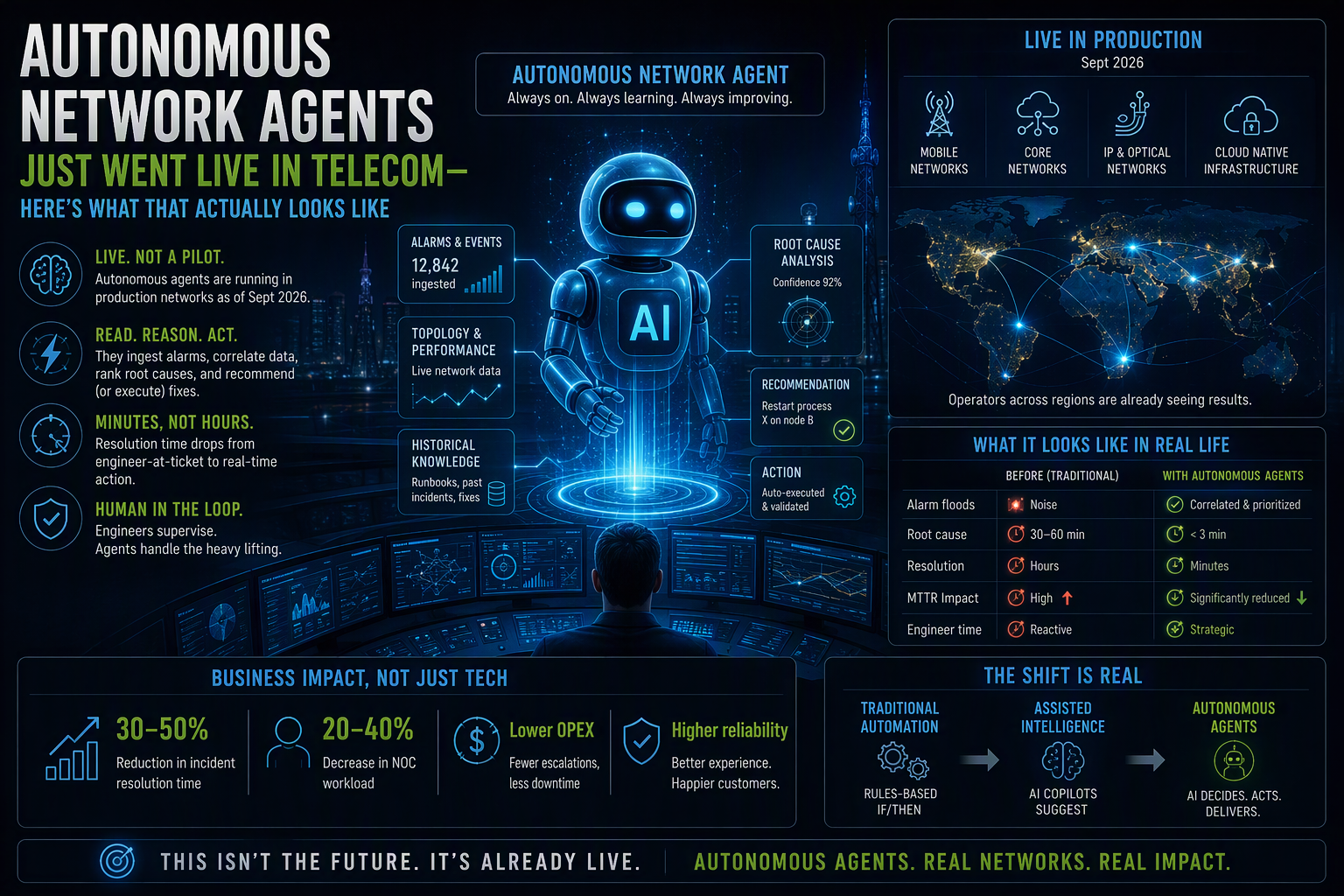
Autonomous network agents are no longer a slide in a vendor roadmap deck. As of September 2026, they are running inside live telecom networks, reading alarms, ranking root causes, and recommending fixes in the time it used to take an engineer to open a ticket. That is a genuinely different claim from most of what passes for “agentic AI news” this year, which has mostly been enterprise chatbots, coding assistants, and pilots that quietly get shelved before anyone measures the return.
Two announcements from Google Cloud, one with Nokia and one with a smaller data-integration partner called Future Connections, show what “live” actually means in this specific corner of the industry right now: which functions have moved from human hands to agent recommendation, which are still advisory only, and why the operating model behind them is worth more attention than the AI itself.
The interesting story isn’t that AI reached the network. It’s that the network is the one place agentic AI seems to be surviving contact with production.
In This Post
- The $2.7 trillion number everyone is quoting, and why it says less than it sounds like
- Where autonomous network agents are already live — Nokia’s Assurance Center, six named agents
- The second deployment: Google Cloud’s own agent framework, and who is actually running it
- Why this corner of agentic AI might actually work when so much else hasn’t
- Where autonomous network agents stand, domain by domain: live, piloting, or still manual
- What telecom and GCC operators should watch next, not just believe
The Number Everyone Is Quoting
Gartner raised its 2026 global AI spending forecast on September 16 to $2.7 trillion, up 49.5% year over year, with AI infrastructure alone accounting for roughly $1.48 trillion of that total — more than half. Gartner projects the market to keep compounding to $3.6 trillion in 2027. Distinguished VP analyst John-David Lovelock has described the current AI data-center buildout as one of the largest infrastructure undertakings in modern history, and the spending breakdown backs that framing: infrastructure and services dwarf every application-layer category, including the AI agents and assistants segment, which Gartner sizes at a comparatively modest $29 billion.
That gap between infrastructure spend and application-layer spend is the same gap this site has covered before in the enterprise adoption funnel and the agentic AI governance research covered further down — money is flowing to compute and platforms far faster than it is flowing to agents that actually change how work gets done. Telecom’s network-operations agents are one of the few places that pattern is starting to break, which is exactly why they are worth a closer look.
Where Autonomous Network Agents Are Already Live
Nokia and Google Cloud expanded their partnership this year to embed Gemini-powered agents directly into Nokia’s Assurance Center, the network operations platform used by mobile operators to monitor and manage live networks. The integration ships with six specialized agents: a router agent that interprets operator intent and coordinates the others; an event triage agent that matches alarms against historical patterns to isolate root cause; a KPI selector agent that interprets network performance counters; an anomaly reasoner that separates genuine faults from false alarms; an action reasoner that matches live events against an automation catalog to recommend remediation; and a dashboard agent that builds visual reporting from a natural-language request.
Two of the six — the router and event triage agents — were already functional when the partnership was demonstrated live at DTW Ignite in Copenhagen in June 2026. The full suite became available as a SaaS offering on the Google Cloud Marketplace in September 2026, with the remaining agents rolling out through 2027.
“The AI era demands a new kind of network — one that is programmable, AI-native, and able to operate at machine speed,” said Vivek Jaiswal, Nokia’s senior vice president for autonomous networks, in the companies’ joint announcement. Google Cloud’s global telco market lead, Sridhar Gollapudi, framed it more bluntly: “Agentic AI marks a fundamental shift in how telecommunications networks are managed.”
The vendors’ own figures claim a 50% to 80% reduction in the time it takes to identify and remediate a network problem. Industry analyst Tom Hollingsworth, reviewing the launch for Futurum Group, flagged the obvious next question: those numbers come from demonstrations and early deployments, not from operators running the system at scale in production for a full reporting cycle. Whether the improvement holds up outside a controlled setting, and whether operators settle for advisory recommendations or push toward closed-loop automation once they trust the system, are both still open.
The Second Deployment: Google Cloud’s Own Framework
Nokia’s Assurance Center runs on top of a broader Google Cloud initiative called Autonomous Network Operations, first introduced in 2025 with a RAN performance agent. This September, Google Cloud extended that framework with two more agents built alongside a data-integration partner, Future Connections, and put into production by a named operator.
Autonomous Data Steward acts as an intelligent data layer over the fragmented data sets that make network analytics hard — RAN performance, core session failures, and probe data living in separate systems that rarely get queried together. Built on Gemini with a zero-copy architecture over Google’s Dataplex Universal Catalog, it can interpret a plain-language request, map it to the right telecom counters, and generate the ETL workflow itself, with Google Cloud citing storage cost reductions of up to 70% from avoiding duplicate data copies.
Core Network VoLTE Agent monitors voice-over-LTE service health specifically — call setup success rate, Mean Opinion Score, and CSCF signaling performance — and correlates that against broader network signaling data to catch degradation before customers report it. One NZ, New Zealand’s largest mobile operator, has deployed it in production as part of its own autonomous-network program: a rare case of a named, on-record operator running a network AI agent live rather than piloting one behind closed doors.
Google Cloud says the methodologies behind both new agents are being open-sourced, so operators who don’t want a packaged Nokia-style product can build customized agentic workflows on the same underlying framework.
Why This Corner of Agentic AI Might Actually Work
This matters because it cuts against the pattern this site has already documented twice this quarter. The agentic AI governance research covered here in September found that Gartner expects most enterprise agentic AI pilots to be scaled back or scrapped by the end of 2027, largely because organizations skip the governance work — clear ownership, audit trails, and defined escalation paths — needed to trust an agent with a real decision. The survey-reconciliation piece on agent adoption found the same gap from a different angle: named governance processes correlate with roughly 12 times more agents reaching production.
The network-operations agents described above are built around exactly that missing governance structure, which Nokia and Google Cloud call glass box autonomy: every agent recommendation carries a confidence score, low-risk actions can be pre-approved for automatic execution, and anything above that threshold stops for a human engineer’s sign-off before it touches a live network. It is a narrower, more supervised version of autonomy than the phrase “agentic AI” usually implies — and that narrowness looks like the reason it is shipping while broader enterprise agent programs stall.
Glass box autonomy isn’t a compromise on the way to full automation. For a network carrying live voice and data traffic, it may be the only version of autonomy operators can actually adopt.
Where Autonomous Network Agents Stand, Domain by Domain
The distinction that matters for anyone evaluating this space is the same one this site applies to cloud infrastructure and every other GCC technology claim: live versus announced. Here is where things actually stand.
| Network domain | Status, September 2026 | Live example |
| Assurance / OSS (alarms, event triage, remediation) | Live, advisory | Nokia Assurance Center — 6 Gemini agents (router, event triage, KPI selector, anomaly reasoner, action reasoner, dashboard); full suite on Google Cloud Marketplace, September 2026 |
| Voice core / VoLTE quality management | Live, single operator | Google Cloud Core Network VoLTE Agent, deployed by One NZ for call setup success rate, MOS, and CSCF monitoring |
| Data layer (fragmented telecom data, cross-domain queries) | Live, single deployment | Google Cloud Autonomous Data Steward with Future Connections — zero-copy architecture on Dataplex, up to 70% storage cost reduction claimed |
| RAN performance and optimization | Piloting | Google Cloud’s original RAN AI agent, introduced 2025 as the first piece of the Autonomous Network Operations framework |
| Closed-loop, no-human-in-the-loop remediation | Not yet live at scale | “Glass box autonomy” keeps a human in the loop for anything above low-risk; no vendor has published a production closed-loop case study |
(Sources: Nokia and Google Cloud joint newsroom announcement; Google Cloud press materials on the Autonomous Network Operations framework expansion; Futurum Group analysis of the Nokia Assurance Center launch.)
What Telecom and GCC Operators Should Watch Next
None of the operators named publicly so far — One NZ, and the unnamed operators in Nokia’s demonstrations — are based in the Gulf. That is worth noting rather than glossing over: the data-backed guide to GCC cloud infrastructure published on this site already shows Google Cloud running live regions in Saudi Arabia, Qatar, and the UAE, so the infrastructure needed to run this framework regionally already exists. What doesn’t yet exist, publicly, is a GCC operator on record running it. That gap is either an opportunity for whichever regional operator moves first, or a sign that data-residency and regulatory review inside GCC telecom carriers move on a slower clock than the vendor roadmap.
Three things are worth tracking over the next two quarters rather than taking at face value: whether the vendors’ 50–80% remediation-time claim survives a full reporting period in production, not just a demo; whether operators expand from advisory recommendations into policy-approved closed-loop automation, or stay conservative; and whether any GCC-based operator becomes the first in the region to put a network AI agent into production rather than a pilot.
What Comes Next
The AI spending headline will keep growing every quarter — Gartner already has 2027 penciled in at $3.6 trillion. The more useful question, for anyone running or selling into a telecom network, is which slice of that spending is producing agents that engineers actually trust with a live decision. Right now, the answer is a short list: assurance and event triage, one voice-quality use case, and one data-integration layer. Everything else is still either a pilot or a slide.
Where does the first GCC operator to put a network AI agent into production come from, and what would it take to get there first?
If new posts like this one are useful, sign up below for updates — no spam, just telecom and enterprise-AI analysis as it happens.