


How to read an enterprise account like an engineer? Most account reviews run on a commercial checklist: contract value, renewal date, support tickets, satisfaction score. None of that tells you whether an account is about to need more capacity, is carrying risk it hasn’t flagged, or has quietly outgrown what it originally bought. That information exists — it’s sitting in the account’s own usage and traffic data — but it’s rarely read as a sales signal, because reading it takes technical fluency most commercial account plans don’t ask for.
Module 1‘s self-assessment table asked whether your sales motion opens conversations with capacity and price, or with the customer’s business outcome. This module is the mechanism that makes the second option possible: a systematic way of reading an account’s technical signals before the meeting, not during it.
A commercial account review asks whether the customer is happy. A technical one asks whether the customer’s own infrastructure is quietly asking for something they haven’t requested yet.
Four enterprise account technical signals worth tracking
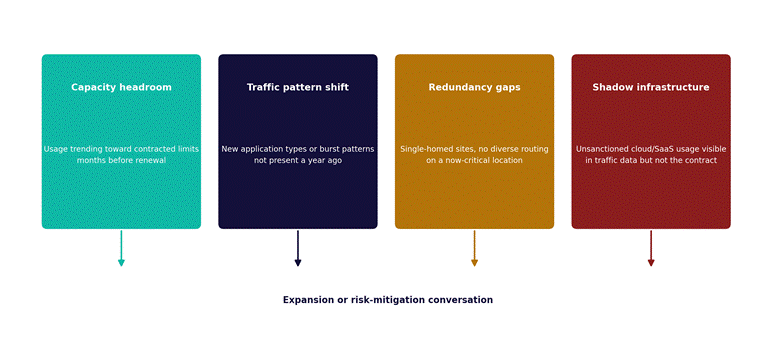
Figure 1. Four categories of enterprise account technical signals, and where each one leads the conversation.
| Signal | What it looks like in the data | What it actually means |
| Capacity headroom | Utilization trending toward a contracted ceiling well ahead of renewal | Growing faster than the current commitment — expansion, not a renewal-time surprise |
| Traffic pattern shift | New application types or burst patterns not present a year earlier | The business has changed — a new system, location, or workload, often before the account team hears about it |
| Redundancy gaps | A now-critical site still single-homed, no diverse routing or backup path | Risk the customer may not have reassessed since the site’s role changed |
| Shadow infrastructure | Traffic consistent with cloud/SaaS usage absent from the contracted services | Infrastructure spend happening outside the relationship — the clearest sign you’re seen as a connectivity vendor, not a partner |
Scored account-reading checklist
Use this before any renewal or QBR meeting — score each signal 0 (no data/not checked), 1 (checked, no concern), or 2 (checked, flag for the conversation).
| Signal | Where to check it | Score (0/1/2) |
| Capacity headroom | Utilization/capacity reports, trended over the last 2 quarters | |
| Traffic pattern shift | Flow analysis (NetFlow/sFlow or platform-native equivalent) | |
| Redundancy gaps | Topology and redundancy records for business-critical sites | |
| Shadow infrastructure | Traffic patterns suggesting unsanctioned cloud/SaaS spend |
A total score of 4 or higher (across any combination of signals) is the practical threshold for raising a dedicated technical conversation with the account rather than folding it into a routine check-in.
Worked example
A QBR is scheduled for a logistics customer with no flagged issues in the CRM. Running the checklist beforehand: capacity headroom scores 2 (utilization at the primary site has grown 38% in two quarters, nearing the contracted ceiling); shadow infrastructure scores 2 (traffic patterns show consistent connections to a major cloud provider’s region, absent from the account’s contracted services).
- Total score: 4. Above threshold — this QBR needs a technical-opportunity agenda item, not just a satisfaction check-in.
- Reframe the opening question. Instead of “how are things going,” the account team opens with: “We noticed utilization at your primary site has grown significantly — is that tied to the new regional expansion we’ve heard about?”
- Result. The customer confirms a new fulfillment center going live next quarter, currently planned to connect through the cloud provider directly — exactly the shadow-infrastructure signal already flagged. The conversation becomes a proposal to bring that connectivity in-scope rather than losing it by default.
What comes next
Module 4 covers the competitive reset this kind of account intelligence operates inside — why the real competition for this budget is increasingly the hyperscaler or SI the shadow-infrastructure signal just revealed, not another telecom operator.
Run the checklist against one account on your own book this week — what’s the total score, and does it change what you’d lead the next conversation with?