

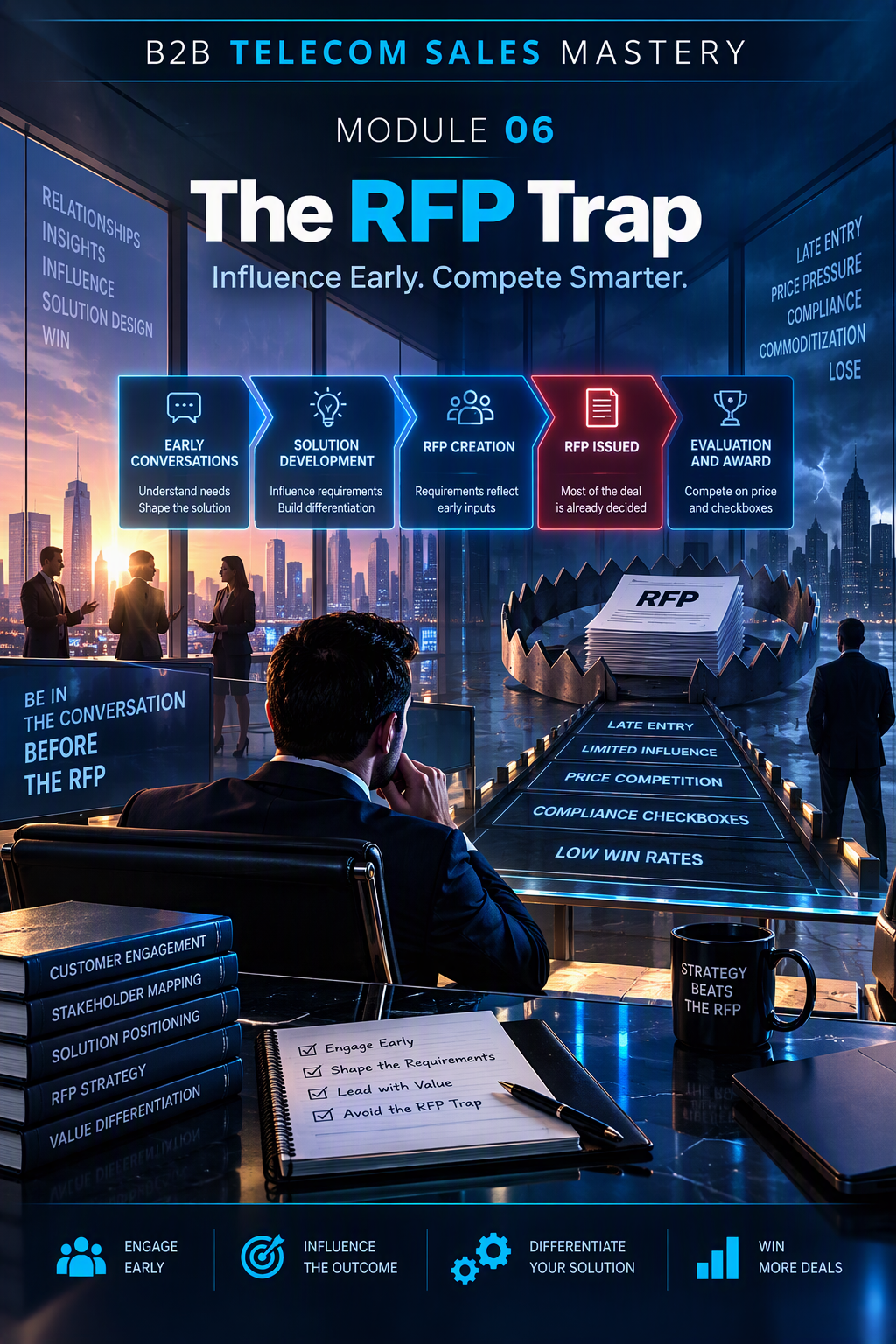
Telecom RFP Strategy, by the time a formal RFP document exists, most of the deal is already decided. That’s the trap: sales teams treat RFP response as the competition, when the real competition happened earlier, in whichever vendor conversations shaped what the requirements document actually asks for. A vendor entering only once the RFP is issued is competing on price and compliance checkboxes — the exact terms the earliest-engaged vendor wrote.
Winning an RFP you didn’t help write is possible. Winning one you helped write is just confirmation.
Where influence is actually won or lost
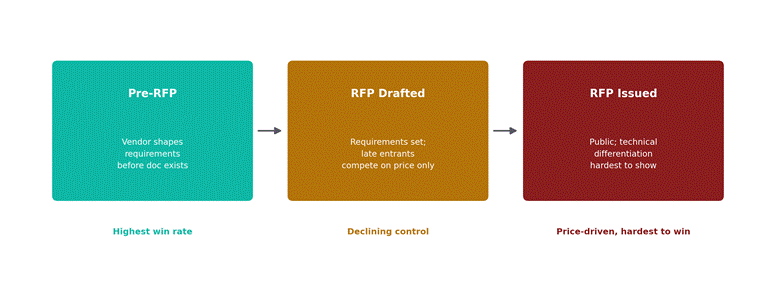
Figure 1. Influence and win probability both decline sharply once the RFP is formally issued.
| Stage | What’s happening | What a telco seller should be doing |
| Pre-RFP | The customer is exploring the problem, often informally, sometimes without knowing they’ll issue an RFP yet | Using Module 3’s account-reading signals to surface the need before it’s formalized, and shaping the technical conversation early |
| RFP drafted | Requirements are being finalized, usually with input from whichever vendor was already in the room | Too late to shape scope broadly, but still possible to clarify a specific technical requirement if a direct relationship exists |
| RFP issued | The document is public; every vendor responds against the same fixed requirements | Compete on documented technical credibility and proof, since requirement-shaping is no longer available |
Why technical credibility matters more once you’re responding, not shaping
If you’ve arrived at RFP stage rather than before it, price and basic compliance still won’t be what separates you from the hyperscaler or SI competitors covered in Module 4 — it will be demonstrated technical specificity. A generic response restates the RFP’s own requirements back at the customer. A credible one answers with the kind of detail only someone who actually understands the account’s real environment would know — which is exactly what Module 3’s and Module 5’s account intelligence exists to produce ahead of time.
A pre-RFP engagement checklist
- Is this account’s whitespace already mapped (Module 5)? If a “Whitespace & Hot” category exists here, the opportunity should already be identified before any RFP conversation starts.
- Has a technical signal (Module 3) already surfaced that maps to what this RFP is likely to ask for? If so, that’s the opening for a pre-RFP technical conversation, not a cold response.
- Who else is already talking to this account informally? If a hyperscaler or SI is already shaping requirements (Module 4), the realistic goal shifts from “win the RFP” to “influence the requirements enough to stay competitive.”
- Is there a standing relationship with someone on the technical side of the account who can clarify a requirement before it’s locked? A single clarifying conversation pre-RFP is often worth more than the entire written response.
Worked example
An RFP lands for a connectivity and edge-compute package at an account with no prior recent engagement. The account team’s first instinct is to start drafting the response immediately.
- Check the account plan first (Module 5). This account was never mapped — a gap the team now has to work around rather than from.
- Read the RFP’s requirements for shaping fingerprints. Several technical specifications are unusually precise in a way that suggests a specific vendor’s architecture — a signal another vendor likely shaped this document already.
- Recalibrate the goal. Rather than assuming a fair, open competition, the realistic goal becomes: identify where the written requirements still leave room for genuine technical differentiation, and concentrate the response there rather than spreading effort evenly across every section.
- Result. The response wins on one specific technical section where real account-specific detail was possible, rather than losing uniformly across a RFP shaped by a competitor who engaged earlier.
What comes next
Module 7 covers qualification — a BANT-style framework adapted specifically for platform deals, so pre-RFP effort gets spent on opportunities actually worth shaping early.
Of your current open opportunities, how many are you engaging with before the RFP exists, versus responding to one already written by someone else?