


Coaching telecom KAMs through the move from connectivity to platform selling is the part of this transition that no structure, pricing model or forecast can replace. Every framework in this course depends on account managers who can read technical signals, open conversations on business outcomes, and hold their ground with a technical buyer. Most KAMs were hired and rewarded for something else: managing relationships and renewals well.
This module gives sales leaders a way to place each KAM on a capability ladder, diagnose what is holding them at their current stage, and run a focused 90-day plan to move them up one step. It draws directly on the tools from earlier modules, because those tools are what the coaching should be built around.
You cannot coach someone into a technical consultant by telling them to be more consultative. You coach the specific behaviors, one at a time.
The capability ladder for coaching telecom KAMs
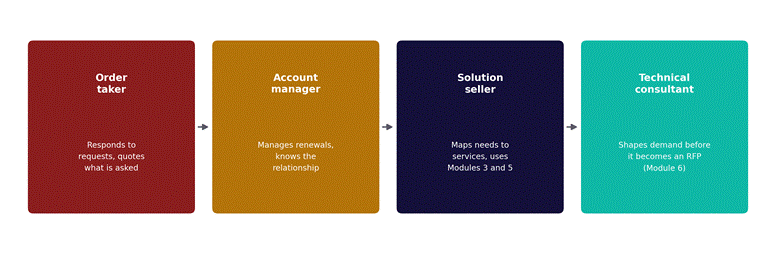
Figure 1. Four stages. Most KAMs move one stage at a time; skipping a stage rarely holds under pressure.
| Stage | Observable behavior | Typical gap holding them here |
| Order taker | Quotes what the customer asks for; meetings are reactive | Has no account plan and no view of whitespace (Module 5) |
| Account manager | Strong relationships, reliable renewals, little new category revenue | Opens conversations on price and renewal, not outcomes (Module 1 self-assessment) |
| Solution seller | Maps customer needs to services and builds proposals across categories | Reads signals only after the customer raises a need (Module 3) |
| Technical consultant | Shapes requirements before an RFP exists and is trusted by technical buyers | Usually none; the goal is to keep and spread this behavior |
Diagnosing where a KAM really is
Self-assessment tends to overstate stage. These questions, asked about a specific account rather than in general, give a more reliable reading:
- “Walk me through the whitespace map for this account.” A KAM without one is at stage 1 or 2, regardless of how strong the relationship is.
- “What did the last QBR open with?” If the answer is the renewal or the price, the KAM is at stage 2.
- “Which technical signal on this account would you raise before the customer does?” A specific answer, tied to usage or traffic data, indicates stage 3 or higher.
- “Which deal in your pipeline did you help shape before it became an RFP?” A concrete example is the clearest evidence of stage 4.
A 90-day coaching plan
Coach one transition at a time, anchored to one account, with a visible output at the end of each month.
| Month | Focus | Output |
| 1 | Build the account plan for one priority account using the Module 5 whitespace framework | A completed whitespace worksheet, reviewed with the leader |
| 2 | Run the Module 3 checklist before the next customer meeting and reframe the opening around one signal | A meeting brief and a short debrief on how the customer responded |
| 3 | Qualify one new opportunity found in months 1 and 2 using Module 7, and map its stakeholders (Module 8) | A scored, mapped opportunity in the pipeline |
Joint customer calls matter more than classroom sessions. The leader attending one meeting per month, then debriefing on what the KAM said and what they could have said, is the single most effective coaching activity in this plan.
Worked example
A KAM with excellent customer relationships and strong renewal numbers has generated almost no platform pipeline in a year. The leader’s initial read is that the KAM lacks technical knowledge.
- Diagnose with the questions above. The KAM has no whitespace map, and the last three QBRs opened with renewal terms. That places the KAM at stage 2. The gap is not product knowledge; it is that conversations never start anywhere that would surface a platform need.
- Pick one account. The leader chooses a logistics customer with a strong relationship and a known expansion plan.
- Month 1 output. The whitespace map shows cloud access to new sites as Whitespace and Hot.
- Month 2 output. The KAM opens the next meeting with a usage question tied to the new sites, with the leader present. The customer confirms the plan and asks for options.
- Result. By day 90 the KAM has one qualified platform opportunity, built with the KAM’s own account knowledge. The same approach is then repeated on a second account, with the leader stepping back.
What comes next
Module 16 closes Part 4 with territory and quota design for a mixed connectivity and platform book, so that compensation rewards the behaviors this coaching plan is trying to build.
Place each member of your team on the four-stage ladder: how many are at stage 2, and which one account would you use to start moving each of them up?