

This 5G troubleshooting guide collects all 14 modules of the course on one page, in the order they are meant to be read, with a symptom index for engineers who arrive with a live fault rather than time to study. Every module works from public 3GPP specifications, not vendor documentation, so the methods apply whichever equipment sits in your network.
The course starts where most real investigations should: with a method. Module 1 covers reading signaling flows, interpreting cause codes and eliminating layers in order, and every later module applies that same approach to one class of fault.
Most 5G faults are found faster by ruling layers out in order than by guessing which one is broken.
How to use this 5G troubleshooting guide
There are two ways in. If you are building the skill, read the modules in sequence: each one assumes the method from Module 1 and several build on earlier fault types. If you are chasing a specific problem, start from the symptom index below, go to the module it points to, and use the second column if the first module rules your suspicion out.
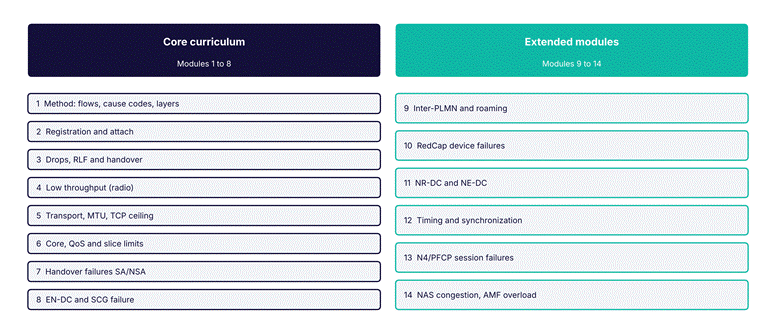
Figure 1. The course in two parts: the core curriculum covers the faults every 5G network sees; the extended modules cover dual connectivity, device classes, timing and the core network.
Start from the symptom
| What you are seeing | Start with | Then check |
| Devices fail to register or attach | Module 2 | Module 14 if rejections cluster at busy hours |
| Calls or data sessions drop | Module 3 | Module 7 if drops follow mobility |
| Low throughput despite good signal | Module 4 | Module 5 for transport limits |
| Speed plateaus at the same value regardless of radio conditions | Module 5 | Module 6 for QoS or slice limits |
| A slice or QoS class underperforms while others are fine | Module 6 | Module 13 for the user plane session |
| Handover failures or ping-pong between cells | Module 7 | Module 3 for radio link failure |
| NSA devices fall back to LTE only | Module 8 | Module 11 for other dual connectivity modes |
| Roaming subscribers fail while home users work | Module 9 | Module 2 for registration detail |
| IoT or RedCap devices fail where phones succeed | Module 10 | Module 2 for registration detail |
| NR-DC or NE-DC sessions fail to add the secondary node | Module 11 | Module 8 for SCG failure patterns |
| Degradation across many TDD sites at once | Module 12 | Module 4 to confirm the radio impact |
| Sessions set up but no user traffic flows | Module 13 | Module 6 for QoS enforcement |
| Mass registration rejections at peak load | Module 14 | Module 2 for individual cause codes |
Core curriculum: Modules 1 to 8
- Module 1: Signaling Flows, Cause Codes and Layer Elimination. The method the whole course is built on.
- Module 2: Registration and Attach Failures in SA and NSA. Why devices cannot get onto the network.
- Module 3: Session Drops, Radio Link Failure and Handover. What breaks established connections.
- Module 4: Low Throughput on the Radio Side. When the link is up but slow.
- Module 5: Transport, MTU and the TCP Ceiling. Limits that sit outside the radio entirely.
- Module 6: Core, QoS and Slice Limits. When the network is applying the wrong treatment.
- Module 7: Handover Failures in SA and NSA. Mobility faults between cells and technologies.
- Module 8: EN-DC and SCG Failure. The non-standalone dual connectivity faults most networks still carry.
Extended modules: Modules 9 to 14
- Module 9: Inter-PLMN and Roaming Failures. Faults that only appear across operator boundaries.
- Module 10: RedCap Device Failures. The reduced-capability device class and its specific failure modes.
- Module 11: NR-DC and NE-DC Dual Connectivity. Dual connectivity beyond EN-DC.
- Module 12: Timing and Synchronization Faults. Why timing problems show up as radio problems.
- Module 13: N4/PFCP Session Failures. The link between the session manager and the user plane.
- Module 14: NAS Congestion Control and AMF Overload. When rejections are the network protecting itself.
Before you start
The course assumes working knowledge of the 5G system architecture. If terms such as AMF, SMF, UPF, CU/DU split or 5QI are unfamiliar, the free Introduction to 5G course covers them in 14 shorter modules and is the better place to begin. Engineers coming from LTE will also find the background in How the UE Goes Out of Sync in LTE useful before Module 3, and Conditional Handover in 5G NR is a natural companion to Module 7.
Frequently asked questions
Do I need to read the modules in order?
Not when you are working a live fault: the symptom index above takes you straight to the right module. For learning, reading in order works best, because every module applies the method from Module 1.
Is this course specific to one vendor?
No. It is written from public 3GPP specifications, so parameter names and procedures follow the standards rather than any vendor’s documentation. Vendor tools present the same information under their own names.
Does it cover both SA and NSA networks?
Yes. Several modules treat standalone and non-standalone separately, and Modules 8 and 11 focus on dual connectivity, which is where many live networks still see their most persistent faults.
Which symptom on the list above costs your network the most time today, and does your team have a documented first check for it?