

This introduction to 5G course takes you from why 5G exists to how a 5G network moves a session between cells, in 14 modules that each fit in a single sitting. It is written from public 3GPP specifications, aimed at engineers who are new to 5G and at the commercial and management roles who need to understand the network underneath their decisions.
The modules build in a deliberate order: the radio foundations first, then the radio access network, then the core, and finally the services that run across all of it. Each one links back to the concepts it relies on, so you can also enter at any point and fill gaps as you go.
5G is easiest to understand as four layers stacked on each other: spectrum, radio, core, and the services built on top.
How the introduction to 5G course is organized
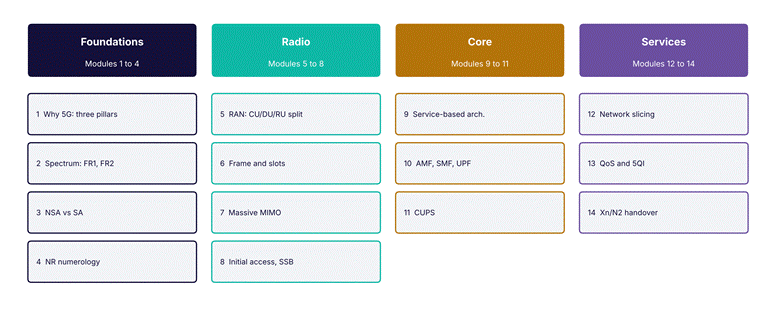
Figure 1. The course in four parts, from radio foundations through to the services that run across the network.
Part 1: Foundations
- Module 1: Why 5G? From 4G’s Limits to 5G’s Three Design Pillars. The problems 5G was designed to solve.
- Module 2: The 5G Spectrum Story: FR1, FR2 and mmWave. Where 5G operates and why frequency shapes everything else.
- Module 3: 5G Deployment Options: NSA vs. SA. The two ways operators build 5G networks.
- Module 4: New Radio Numerology. Flexible subcarrier spacing and why LTE’s fixed 15 kHz had to go.
Part 2: The radio access network
- Module 5: 5G RAN Architecture: gNB and the CU/DU/RU Split. How the base station is divided and why.
- Module 6: 5G NR Frame Structure and Slot-Based Scheduling. How time is organized on the air interface.
- Module 7: Massive MIMO and Beamforming. How 5G gets more capacity from the same spectrum.
- Module 8: 5G NR Initial Access: Cell Search, SSB and Random Access. How a device finds and joins a cell.
Part 3: The 5G core
- Module 9: 5G Core Architecture: Service-Based Architecture Explained. The design principle behind the core network.
- Module 10: The Key Core Functions: AMF, SMF and UPF. How the core divides its labor.
- Module 11: Control and User Plane Separation (CUPS). Why separating signaling from traffic matters.
Part 4: Services across the network
- Module 12: Network Slicing: One Physical Network, Many Virtual Ones. How one network serves very different needs.
- Module 13: Quality of Service in 5G: 5QI and Traffic Prioritization. How the network decides what goes first.
- Module 14: Mobility and Handover in 5G: Xn and N2 Handovers. How sessions survive as devices move.
Suggested paths by role
| If you are | Focus on | Why |
| A radio or RAN engineer | Modules 2, 4, 5, 6, 7 and 8 | The air interface and RAN architecture you will configure and optimize |
| A core or IP engineer | Modules 3, 9, 10, 11 and 13 | The core functions, the NSA and SA choice, and how traffic is treated |
| In enterprise sales or solutions | Modules 1, 3, 7, 12 and 13 | What 5G can promise a customer: slicing, QoS and capacity, explained without vendor terms |
| A manager or strategist | Modules 1, 2, 3 and 12 | Why 5G exists, the spectrum and deployment choices behind it, and how it becomes a sellable product |
Where to go after this course
Once the architecture is familiar, the 5G Troubleshooting Guide applies it to real faults across 14 further modules, starting from signaling flows and cause codes. For the commercial side, 5G Standalone in 2026: What the Adoption Numbers Actually Show puts the NSA and SA choice from Module 3 in market context, and Network APIs for AI Agents shows one way operators are turning network capabilities into products.
Frequently asked questions
Do I need an engineering background?
No. The modules explain terms as they introduce them, and the role paths above show which modules matter most if your work is commercial rather than technical. An engineering background helps with Modules 4, 6 and 8, which go furthest into the radio detail.
Is the course free?
Yes. All 14 modules are free to read, with no sign-up required.
Is it based on the standards or on one vendor?
It is written from public 3GPP specifications, so it describes how 5G works in any network rather than on any one vendor’s equipment.
Which part of the 5G stack do you find hardest to explain to colleagues outside your own specialty: the radio, the core, or the services on top?